
Decentralized finance (DeFi) continues to evolve as one of the most important segments of the cryptocurrency industry, offering users multiple ways to generate passive income without relying on traditional financial intermediaries. Through smart contracts, digital asset holders can earn rewards by lending, staking, providing liquidity, and participating in various decentralized financial mechanisms. As the number of DeFi protocols grows, so does the range of investment strategies, each with its own balance of risk, potential returns, and technical complexity. For this reason, selecting a DeFi project requires evaluating not only its expected profitability but also the protocol's reliability, smart contract security, and the sustainability of its economic model.
Contents
- What Are DeFi Projects for Passive Income?
- Main Ways to Earn Passive Income in DeFi
- Best DeFi Projects for Passive Income
- Comparison of Popular DeFi Protocols
- How to Choose a DeFi Project and Reduce Investment Risks

1. What Are DeFi Projects for Passive Income?
DeFi (Decentralized Finance) is an ecosystem of financial services built on blockchain networks and powered by smart contracts. Unlike traditional banking products, users maintain full control over their assets through cryptocurrency wallets, while transactions are executed automatically without centralized intermediaries.
Passive income in DeFi is generated by putting digital assets to work through various financial mechanisms. Users can supply liquidity, deposit assets into lending protocols, participate in staking, or adopt more advanced yield-generation strategies in exchange for a share of transaction fees or network rewards. The level of returns depends on market demand for liquidity, user activity, and overall market conditions.
Today, the largest DeFi protocols manage billions of dollars in total value locked (TVL). Most leading platforms also undergo regular smart contract audits, publish open-source code, and implement decentralized governance mechanisms, making them significantly more transparent than many early blockchain projects.
2. Main Ways to Earn Passive Income in DeFi
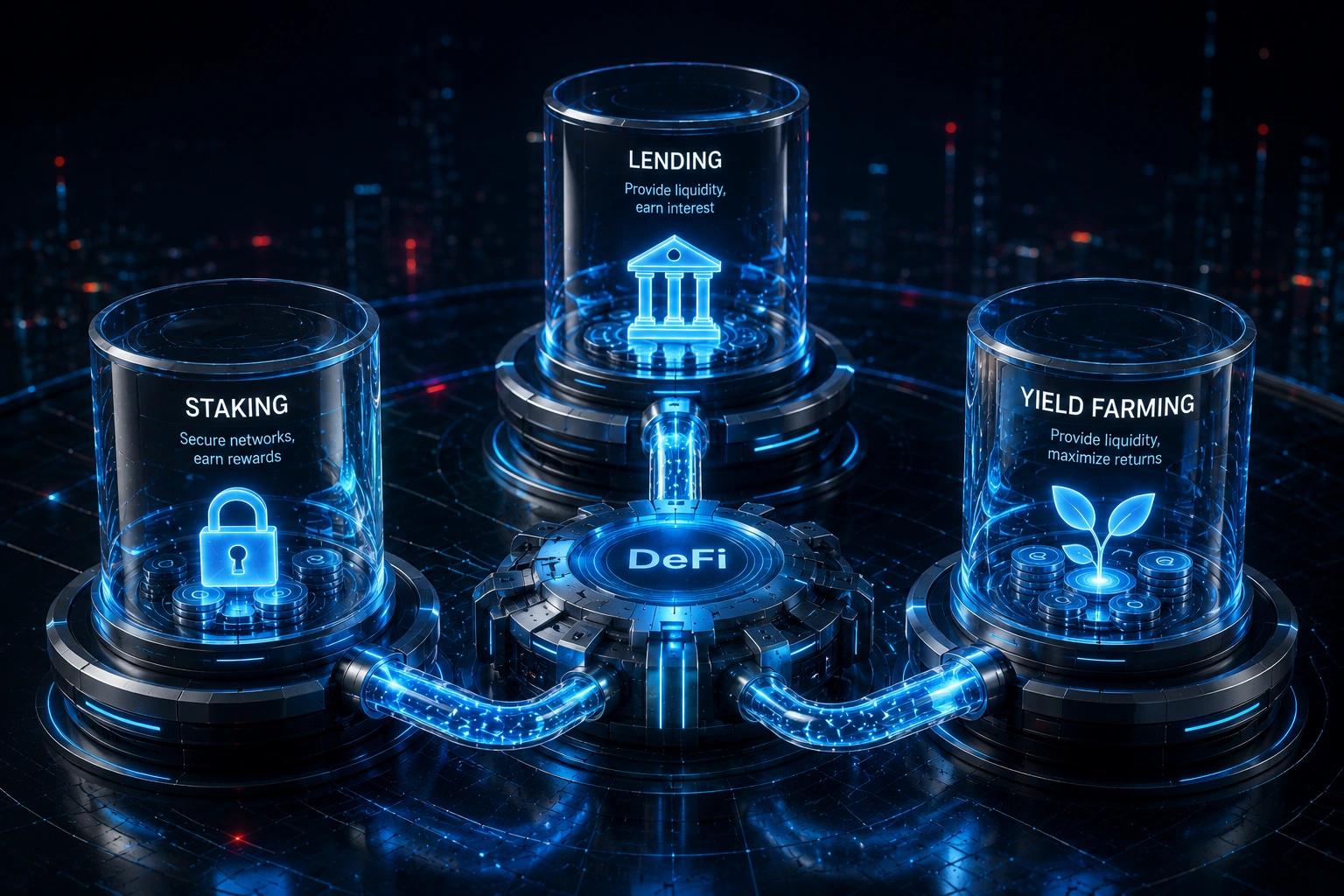
The modern DeFi ecosystem offers several approaches to generating passive income. Each strategy targets different types of investors and varies in complexity, potential returns, and associated risks.
Before allocating capital, it is important to understand how each strategy works and evaluate not only potential profits but also the possibility of losses caused by market volatility, smart contract vulnerabilities, or changing market conditions. Different passive income methods also require varying levels of user involvement: some are almost fully automated, while others demand continuous portfolio monitoring and active management. Selecting the right strategy depends on investment objectives, individual risk tolerance, and experience with decentralized financial applications.
- Lending. Users deposit cryptocurrency into lending pools, where borrowers pay interest for accessing liquidity.
- Liquid Staking. Locked assets continue earning staking rewards while derivative tokens remain available for use across other DeFi applications.
- Restaking. Already staked assets are reused to secure additional protocols, allowing users to earn supplementary rewards.
- Yield Farming. Income is generated through decentralized exchange trading fees and incentive rewards distributed to liquidity providers.
- Yield Aggregators. Automated algorithms continuously allocate capital across multiple strategies to maximize capital efficiency and optimize returns.
Each of these approaches offers its own advantages and limitations, meaning there is no universal solution suitable for every investor. In practice, the effectiveness of any strategy depends on market conditions, the reliability of the selected protocol, and sound risk management.
For this reason, investors should understand how every DeFi mechanism operates, evaluate a project's reputation, and monitor changes in market conditions before committing funds. Many experienced participants diversify their capital across multiple protocols and blockchain networks, reducing dependence on a single source of yield and improving overall portfolio resilience.
3. Best DeFi Projects for Passive Income
Aave remains one of the most recognized decentralized lending protocols, supporting dozens of cryptocurrencies across multiple blockchain networks. Users earn interest by supplying liquidity, while borrowing rates are determined by market demand. The protocol has also expanded its ecosystem through the introduction of the decentralized stablecoin GHO.
Lido continues to dominate the liquid staking sector on Ethereum. After staking ETH, users receive stETH tokens, which can be deployed throughout the DeFi ecosystem without sacrificing underlying staking rewards. This significantly improves capital efficiency while maintaining exposure to staking income.
EigenLayer represents one of the fastest-growing areas of decentralized finance through its restaking model. The protocol enables previously staked Ethereum assets to secure additional services and generate extra rewards. However, this approach introduces more complex technical and economic risks compared to traditional staking.
Yearn Finance automates yield optimization by allocating capital among multiple DeFi protocols through its Vault strategies. Meanwhile, Pendle Finance specializes in tokenizing future yield, allowing users to trade future income separately from the underlying asset. These platforms are primarily designed for investors seeking more advanced financial strategies within the DeFi ecosystem.
4. Comparison of Popular DeFi Projects for Passive Income
Each protocol follows a different yield-generation model, making the choice of platform highly dependent on investment goals, preferred risk levels, and familiarity with decentralized finance. Some projects focus on relatively stable interest income, while others provide more sophisticated strategies with potentially higher returns but increased risk exposure. Comparing the leading protocols helps investors better understand their strengths and select the most suitable solution for their portfolio.
| Project | Category | Source of Income | Key Features |
|---|---|---|---|
| Aave | Lending | Borrowing interest | High liquidity and multi-chain support |
| Lido | Liquid Staking | Staking rewards | Receives the liquid staking token stETH |
| EigenLayer | Restaking | Additional rewards | Reuse of previously staked assets |
| Yearn Finance | Yield Aggregator | Automated yield strategies | Optimized capital allocation |
| Pendle Finance | Yield Tokenization | Yield generation and trading future returns | Separates the underlying asset from future yield |
These projects demonstrate different approaches to capital utilization and yield generation across the DeFi ecosystem. Some prioritize simplicity and stability, while others introduce innovative financial mechanisms that appeal to more experienced users. Despite their differences, each protocol plays an important role in expanding the opportunities available for decentralized passive income generation.
When comparing platforms, investors should consider not only potential returns but also liquidity, protocol transparency, smart contract security, and the project's long-term track record.
5. How to Choose a DeFi Project and Reduce Investment Risks
Before investing, it is advisable to evaluate a protocol's development history, total value locked (TVL), independent smart contract audits, developer activity, and governance model. These indicators provide valuable insights into the maturity of the project and the likelihood of technical or economic issues. Investors should also assess the team's reputation, the frequency of protocol updates, and community engagement, as these factors often reflect the project's long-term sustainability. The greater the transparency of a platform, the easier it becomes to evaluate potential risks and make informed investment decisions.
Other important considerations include supported blockchain networks, transaction fees, asset liquidity, and the ability to withdraw funds quickly. High yields alone should never be viewed as evidence of reliability, as exceptional returns are frequently accompanied by elevated risks related to market volatility, tokenomics, or smart contract design. Investors should also monitor protocol upgrades and changes in market conditions, as both can significantly influence long-term profitability.
Many long-term investors reduce risk through diversification by allocating capital across multiple established DeFi protocols that employ different yield-generation models. Additional protection can be achieved by storing significant holdings in hardware wallets and regularly monitoring developments within selected protocols. A comprehensive approach to risk management makes participation in DeFi more sustainable while allowing investors to combine multiple passive income strategies within a single portfolio.











