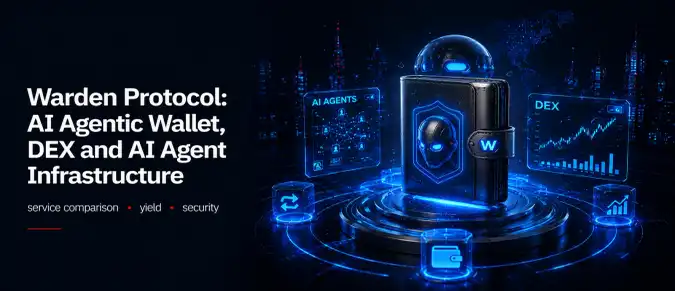

Warden Protocol is developing infrastructure for the AI agent economy by combining blockchain technology, agent identity, verifiable computation, and mechanisms for interacting with Web3. One of the ecosystem's first user-facing products was Warden App, an agentic wallet where cryptocurrency operations can be initiated through natural language and specialized AI agents. Its trading features rely on integrations with external DeFi infrastructure, including Uniswap and Jupiter, so Warden is more accurately viewed not as a standalone DEX with its own primary liquidity, but as an AI interface for accessing decentralized trading. In 2026, the project's structure changed: Warden Protocol and the WARD token continued development under a dedicated Warden Foundation, while Warden App transitioned to a new team.
Contents:
- What Is Warden Protocol and an Agentic Wallet
- AI Agents, Warden Chain, and Protocol Infrastructure
- DEX Features, Swaps, and Trading Through Warden
- How Warden Differs from a Traditional Crypto Wallet and DEX
- WARD Token, Ecosystem Development, and Key Risks
1. What Is Warden Protocol and an Agentic Wallet
Warden Protocol is positioned as full-stack infrastructure for the AI agent economy. The protocol's purpose extends beyond cryptocurrency wallet management: it creates an environment where software agents can establish identities, interact with each other, perform tasks, and execute transactions. The user-facing layer of this model was initially represented by Warden App.
Warden App was developed as an agentic wallet — a cryptocurrency wallet with an AI-powered interface. Instead of manually switching between networks, DEXs, bridges, and analytics services, users can describe an action in natural language. For example, a request may involve checking a portfolio, transferring tokens, swapping assets, or analyzing a crypto project, after which the relevant agent prepares the required operation.
According to the user documentation, the application supports Warden, Ethereum, Solana, Base, BNB Smart Chain, and Arbitrum. This multichain model is important for an agentic wallet: users interact through a single interface, while execution can take place across different networks and external protocols.
However, Warden Protocol and Warden App should be distinguished from each other. In May 2026, the team announced that the protocol and WARD would move under the management of a dedicated Warden Foundation, while Warden App would continue operating under a new team. Therefore, wallet and trading interface features should not automatically be considered functions of the blockchain protocol itself.
2. AI Agents, Warden Chain, and Protocol Infrastructure
The Global Agent Network formed the foundation of Warden's original architecture. It was designed as infrastructure for interaction between autonomous AI agents. The concept assumes that an agent should have a verifiable identity, the ability to discover other services, perform tasks, and make payments without requiring a separate closed system for every application.
Warden Chain serves as the blockchain layer of the ecosystem. Within the project's architecture, blockchain technology is used for identity, reputation, payments, and verifiable agent actions. One of its mechanisms is Proof of Prompt, a record that connects an AI agent's actions with verifiable data. The project is also developing SPEx, or Statistical Proof of Execution, as a technology for verifying the results of AI computations.
- Agent Identity — an on-chain identity system that enables AI agents to be identified and discovered.
- Agent Hub — a directory of specialized agents for trading, analytics, DeFi, and other tasks.
- Warden Chain — the protocol's blockchain infrastructure and the native network for WARD.
- Proof of Prompt — a mechanism for recording actions and prompts to improve the verifiability of agent activity.
- Warden Studio and Warden Code — tools designed for creating, configuring, and publishing custom AI agents.
Developers can use Warden Code, a CLI tool for building agents with support for A2A and LangGraph. Its functionality includes registering agents through the ERC-8004 Identity Registry, configuring skills and payments, and launching custom interaction interfaces. This demonstrates that the project targets not only wallet users but also developers building agentic applications.
In 2026, the infrastructure direction expanded with Halo, a permissionless P2P network for AI inference on Base. Under this model, users and autonomous agents can purchase access to AI models, while operators can provide computing resources. Halo became a separate direction within Warden Foundation and strengthened the protocol's focus on AI infrastructure rather than solely on a cryptocurrency interface.
3. DEX Features, Swaps, and Trading Through Warden
The term "Warden DEX" requires clarification. The core Warden Protocol is not a traditional AMM with its own liquidity pools similar to Uniswap or PancakeSwap. Warden App's trading capabilities were primarily designed as an intelligent layer on top of external DeFi protocols: an AI agent receives a user's request and accesses integrated infrastructure to identify and execute the required operation.
In July 2025, the Uniswap Trading API Agent was integrated into Agent Hub. It provided access to EVM asset swaps through natural language. Instead of manually selecting a trading route and configuring transaction parameters, users could specify which tokens they wanted to exchange, while the agent used Uniswap infrastructure to prepare the transaction.
On Solana, a similar function is provided by Jupiter Agent. It uses Jupiter, a liquidity aggregator within the Solana ecosystem, for swaps and routing. The agent also supports balance checks, SPL token transfers, and transaction status tracking. On Arbitrum, Warden integrated trading functionality through Uniswap and cross-chain operations through deBridge.
Warden's DEX functionality therefore represents an orchestration layer built on existing DeFi liquidity. This is an important distinction from the separate WardenSwap project, which operates under a different domain and has its own history as a DEX aggregator. WardenSwap should not automatically be associated with the modern Warden Protocol simply because of the similarity in their names.
4. How Warden Differs from a Traditional Crypto Wallet and DEX
A traditional self-custody wallet provides an interface for storing keys, signing transactions, and connecting to dApps. A DEX handles asset swaps using its own or aggregated liquidity. An agentic wallet combines these layers with AI: the user describes the desired outcome, while software agents determine which actions and services are required.
| Parameter | Warden / Agentic Wallet | Traditional Web3 Wallet | Traditional DEX |
|---|---|---|---|
| Primary Function | AI-powered management of Web3 actions | Asset storage and management | Token swaps |
| Interface | Chat and AI agents | Menus and dApp connections | Trading interface |
| Swaps | Through integrated DeFi services | Built-in aggregator or external dApp | Native or aggregated liquidity |
| AI | Core orchestration layer | Usually an additional feature | Usually not required |
| Multichain | Multiple supported networks | Depends on the wallet | Depends on the protocol |
| Additional Features | Research, agents, automation, trading | Staking, dApps, transfers | Swaps, liquidity, farming |
The main advantage of this approach is the abstraction of technical details. Users do not necessarily need to manually find the appropriate protocol for each operation. For example, a swap request on Solana can be routed to Jupiter Agent, while an EVM swap can be handled by an agent working with Uniswap. In a broader multi-agent orchestration model, more complex tasks can be distributed among several specialized services.
However, an AI interface does not eliminate the need to verify transactions. Misinterpretation of a request, selection of the wrong asset, or unexpected routing can have financial consequences. An agentic wallet therefore changes how transactions are prepared, but it does not remove the risks of self-custody or the need to review transaction parameters before confirmation.
5. WARD Token, Ecosystem Development, and Key Risks
WARD is the native token of Warden Chain and is used as a gas asset, while also being connected to staking and the protocol's broader economy. The token entered the market on February 4, 2026. In addition to Warden Chain, WARD is available on BNB Chain and Base; the official bridge between Warden Chain and Base operates using Hyperlane infrastructure.
In January 2026, Warden announced a strategic funding round at a fully diluted valuation of $200 million. Participants and partners mentioned by the project in connection with the round included 0G, Messari, and Venice.AI. The team also stated that prior development had largely been funded by the founders, who had invested more than $6.5 million of their own capital.
Following organizational changes in May 2026, Warden Foundation focused on Warden Protocol, WARD, and Halo. In June, Halo launched in public alpha on Base as a P2P marketplace for AI inference, where payments between consumers and operators are made in stablecoins. In July, the team also announced Warden 2.0, focusing on identity, reputation, guardrails, and verification for agent infrastructure.
Warden's risks are distributed across several layers. At the wallet level, they include private key security, incorrect transactions, and interactions with smart contracts. The AI layer introduces the possibility of misinterpreted commands and inaccurate model outputs. DeFi operations depend on external DEXs, bridges, and available liquidity, while WARD is exposed to market volatility and other risks typical of crypto assets.
Another important factor is the restructuring of the ecosystem in 2026. Warden Protocol, Halo, and WARD should now be analyzed separately from the user-facing Warden App. Overall, the project has evolved from an AI crypto wallet and Agent Hub toward broader infrastructure for autonomous agents and decentralized AI. The description "AI agentic wallet + DEX" therefore captures an important part of Warden's history and user experience, but it does not fully represent the project's current architecture.











