
Start with what the reader must find
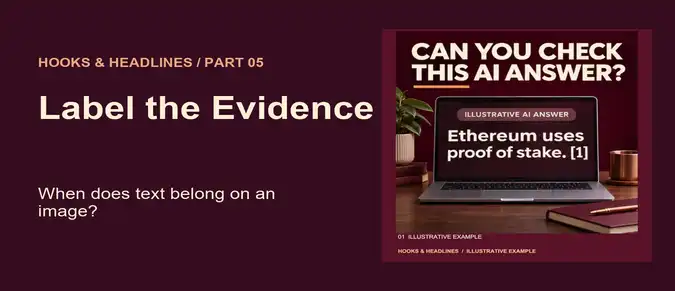
Suppose an AI answer says Ethereum uses proof of stake and attaches a citation. A screenshot captures the claim and the reference. It does not show what the reference supports. If you want readers to compare the claim with the study, place a short label next to each: AI claim and Source evidence.

Put labels where they do work
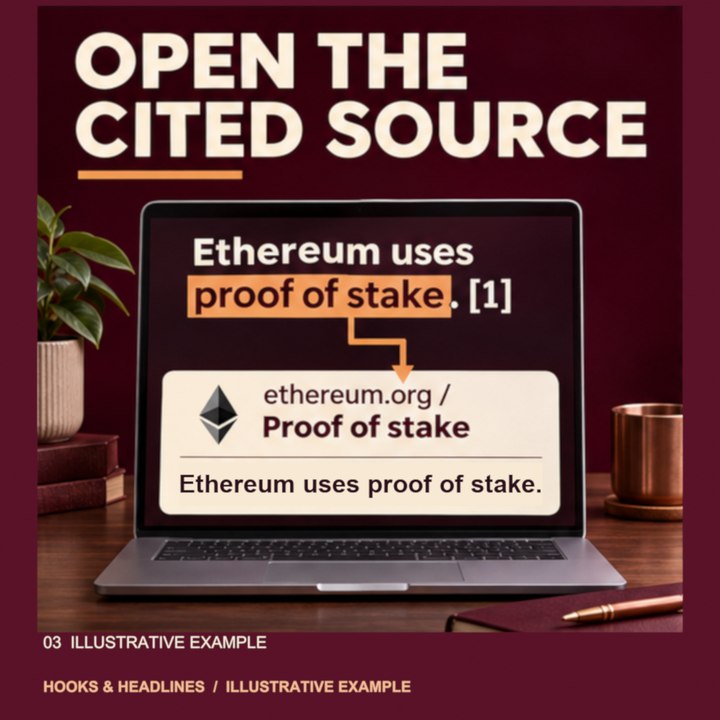
Open the Ethereum proof-of-stake documentation. It says Ethereum uses proof of stake and describes validators staking ETH. Show the explicit statement about the consensus mechanism alongside the AI answer. The staking detail helps explain how it works; on its own it is less direct evidence for the claim. A line pointing to the original passage can do more than another sentence of decorative copy.
Keep the reasoning available as text
The W3C guidance on images of text favors real text when the presentation permits it. Social cards sometimes need embedded labels; repeat the conclusion in the post and supply useful alternative text. Keep citations and caveats in a form readers can copy, search and open.
Test whether the label earns its space
Show the card at feed size. Can a reader point to the claim, the evidence and the difference between them? Remove labels that only restate the caption. If the explanation cannot survive at that size, use the image as a guide and put the full comparison in the article.











