

In the era of rapid Web3 development, the need for a reliable, high-performance, and independent infrastructure has become critical. Traditional cloud services, being centralized, often contradict the principles of decentralization and resilience.
The 4EVERLAND platform offers a comprehensive solution by creating a global network of distributed computing resources. This project combines advanced technologies such as IPFS, Arweave, and Ethereum to provide developers with a toolkit for deploying and scaling decentralized applications. The initiative's goal is to become a fundamental component in the architecture of the new internet, ensuring security, censorship resistance, and high availability of data and services.
Contents:
- The Essence and Architecture of 4EVERLAND
- Key Platform Products and Services
- The Tech Stack and Integrations of 4EVERLAND
- Economic Model and the 4EVER Token
- Advantages and Development Prospects of the Project
- Conclusion
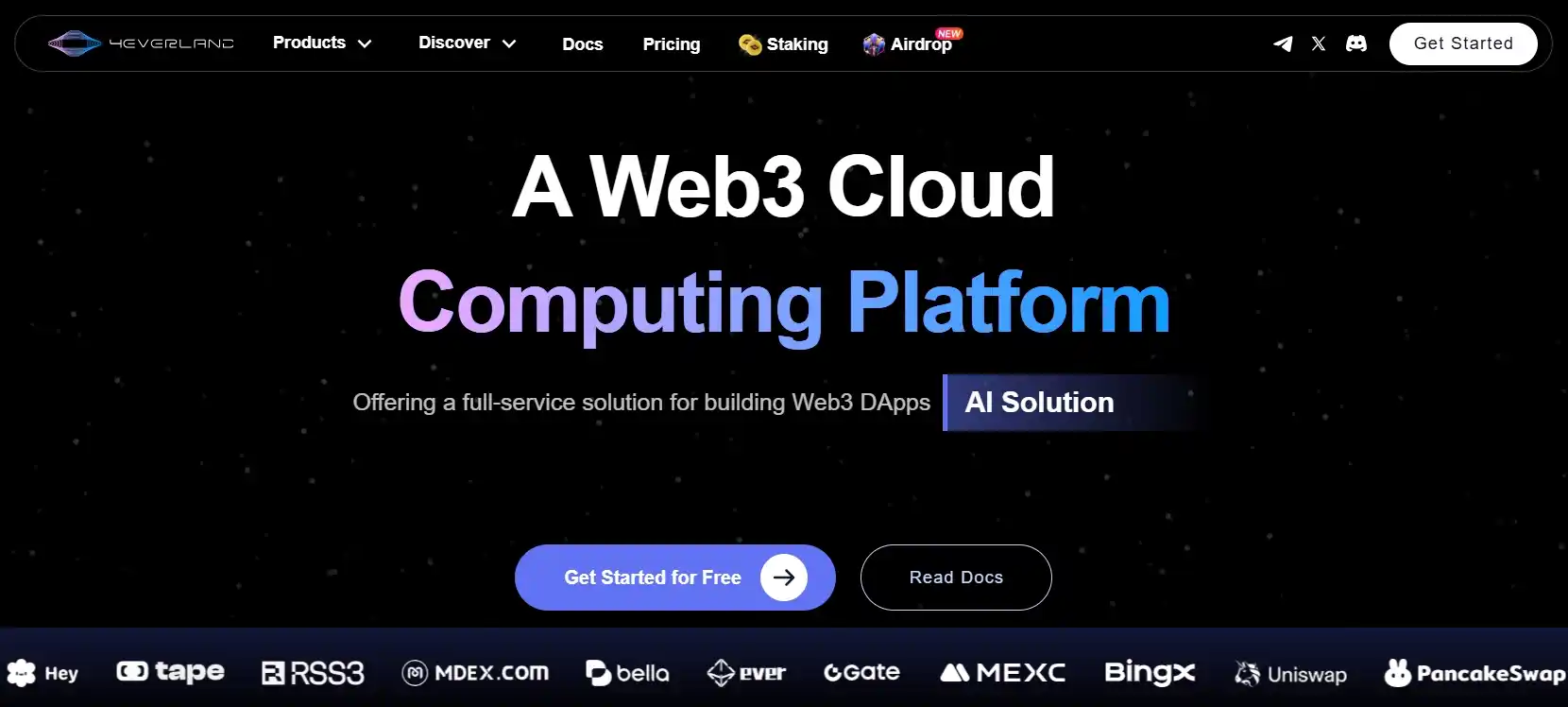
The Essence and Architecture of 4EVERLAND
4EVERLAND is a large-scale decentralized cloud ecosystem aimed at overcoming the limitations of traditional providers. Its architecture is based on the idea of combining computing power, network resources, and storage space provided by participants worldwide. This network operates without a single governing center, which increases fault tolerance and minimizes downtime risks.
The platform acts as a bridge between established internet standards and the emerging Web3 space. It abstracts the complexity of working with distributed protocols, offering developers a familiar and convenient interface for interaction. Thus, 4EVERLAND does not just offer a set of tools but creates a holistic environment for building and supporting decentralized projects.
Key Platform Products and Services
The 4EVERLAND ecosystem provides developers with a comprehensive set of tools, united into three main services. These products cover the full cycle of creating and supporting decentralized applications, from content publishing to executing complex tasks. The infrastructure allows for process automation and abstracts away the technical complexities of distributed networks.
The platform's core offerings include:
- Decentralized Hosting: Automatic deployment of websites and dApps with subsequent publication to the IPFS network, ensuring global accessibility and resistance to blocking.
- Distributed Data Storage: Secure preservation of information in decentralized networks (IPFS, Arweave) with a guarantee of long-term integrity and immutability of files.
- Decentralized Computing (DeComp): Access to the network's distributed computational resources for executing various tasks in isolated and secure environments.
In addition, the platform offers a number of auxiliary tools, such as high-speed IPFS gateways, services for working with decentralized domains (DNS, ENS), as well as monitoring and analytics systems. This entire set of products forms a complete development environment, allowing focus on application logic rather than building the underlying infrastructure.
The Tech Stack and Integrations of 4EVERLAND
The platform's power is ensured by the skillful combination of several advanced decentralized technologies. IPFS (InterPlanetary File System) serves as the foundation for hosting and storage, providing distributed content delivery via a peer-to-peer network. For long-term and immutable storage of critical data, support for Arweave is integrated. Smart contracts on the Ethereum blockchain govern network interaction processes, including settlements with participants and staking.
Particular attention is paid to compatibility and user convenience. 4EVERLAND provides seamless integration with popular development tools like GitHub, enabling automatic deployment configuration. The platform also offers its own RPC gateway for interacting with various blockchain networks, simplifying data access for dApps.
Economic Model and the 4EVER Token
The stable operation of the platform's decentralized infrastructure is supported by its own cryptocurrency—the 4EVER token. It serves as a universal tool for all internal economic processes, tying together the interests of users, resource providers, and developers. The coin is used not only for payments but also for ensuring the security and quality of the network.
The key functions of the token within the ecosystem are presented in the table:
| Function | Purpose and Description |
|---|---|
| Payment Medium | The primary currency for payments related to the use of the platform's hosting, distributed storage, and computational power. |
| Node Staking | A necessary collateral for node operators, guaranteeing their honest participation in providing network resources. |
| Developer Staking | A mechanism allowing project creators to guarantee high availability and reliability of their deployed applications. |
| Governance (DAO) | Granting voting rights to token holders for making decisions regarding the future development and improvement of the ecosystem. |
This multi-layered model creates a balanced economy where participants who make a real contribution to the network's operation are rewarded. Implementing staking from both sides—resource providers and their consumers—forms a system of mutual guarantees, directly enhancing the overall reliability and fault tolerance of the entire 4EVERLAND platform.
Advantages and Development Prospects of the Project
The main advantage of 4EVERLAND is its comprehensive approach, freeing developers from the need to independently integrate disparate decentralized technologies. The platform offers unprecedented censorship resistance and reliability due to its distributed architecture, as well as significant cost savings compared to traditional cloud giants. High performance is ensured by a global network of gateways and optimized data transfer.
The project's development prospects are associated with further ecosystem expansion. The team is actively working on supporting new blockchains, which will expand the audience and opportunities for developers. Deepening integrations with Web3 tools and advancing decentralized computing (DeComp) functions will allow the platform to become a full-fledged alternative to traditional cloud stacks for the broadest range of tasks in the new internet paradigm.
Conclusion
4EVERLAND represents a holistic and promising infrastructure designed for the needs of the decentralized network. The project successfully solves key Web3 problems by offering developers a convenient, economical, and censorship-resistant technology stack. By combining hosting, storage, and computing into a single ecosystem, the platform significantly speeds up and simplifies the creation of dApps.
Thanks to its well-thought-out architecture and balanced economic model, the initiative has every chance of becoming one of the standards in the field of distributed cloud services. Further development in supporting new blockchains and expanding computational capabilities will contribute to the mass transition to a more open, secure, and independent internet.











