
Hardware wallets remain one of the most reliable ways to store cryptocurrencies because private keys are isolated from devices with constant internet access. This approach significantly reduces the risk of digital asset theft caused by malware, phishing attacks, and other common cybersecurity threats. In recent years, the hardware wallet market has expanded considerably, with manufacturers offering devices featuring different security architectures, support for thousands of cryptocurrencies, and integration with DeFi, NFT, and Web3 ecosystems. When choosing the right device, it is important to consider not only the price but also its security design, functionality, and compatibility with the blockchains you intend to use.
Contents
- What Is a Cryptocurrency Hardware Wallet?
- How to Choose a Hardware Wallet for Cryptocurrency Storage
- Top Hardware Wallets for Cryptocurrencies
- Comparison of the Best Hardware Wallets
- How to Use a Hardware Wallet Securely
1. What Is a Cryptocurrency Hardware Wallet?
A hardware wallet is a dedicated electronic device designed to store private keys in an isolated environment. Unlike software wallets or exchange accounts, private keys never leave the device's secure memory, meaning they are never transmitted to a computer, smartphone, or remote server when signing transactions.
When a cryptocurrency transaction is created, it is generated within wallet software and then sent to the hardware wallet for signing. The user confirms the transaction directly on the device, where the digital signature is generated inside a secure chip. The signed transaction is then returned to the application and broadcast to the blockchain network. This process significantly reduces the risk of private key compromise, even if the connected computer is infected with malware.
Modern hardware wallets support not only Bitcoin and Ethereum but also many leading blockchain networks, including Solana, BNB Chain, Polygon, Avalanche, Cosmos, Tron, XRP Ledger, and numerous other ecosystems. Many devices also allow users to interact with DeFi protocols, NFT marketplaces, and Web3 applications through proprietary software or compatible third-party wallets.
Manufacturers employ different security approaches. Some rely on certified Secure Element chips, others focus on fully open-source architectures, while certain devices implement Air-Gap technology, allowing transactions to be signed using QR codes without ever connecting directly to a computer.
2. How to Choose a Hardware Wallet for Cryptocurrency Storage
Before purchasing a hardware wallet, it is important to determine how it will be used. Some users simply need secure long-term Bitcoin storage, while others require support for multiple blockchain networks, staking, NFTs, and decentralized applications. As a result, there is no universal solution suitable for every use case.
In addition to technical specifications, it is worth considering the overall user experience. Some hardware wallets are designed primarily for long-term cold storage, while others offer advanced features for interacting with Web3 applications, staking services, and decentralized finance platforms. It is also advisable to verify compatibility with your preferred operating systems and wallet software before making a purchase.
When choosing a hardware wallet, consider the following factors:
- support for the required blockchains and cryptocurrencies;
- private key protection and the presence of a Secure Element chip;
- connection options (USB, Bluetooth, NFC, or QR codes);
- compatibility with desktop and mobile devices;
- support for Web3, DeFi, NFTs, and staking;
- frequency of firmware updates;
- open-source software and transparency of the security architecture;
- backup and recovery options, including traditional seed phrases or alternative recovery methods.
It is equally important to evaluate the manufacturer's reputation and long-term software support. Reliable vendors regularly release security updates, add support for new blockchain networks, and address discovered vulnerabilities, making ongoing product support a critical factor for long-term cryptocurrency storage.
If you plan to store significant digital assets, experts also recommend considering support for multisignature wallets, fully offline operation, and compatibility with widely used software wallets.
3. Top Hardware Wallets for Cryptocurrencies
Several manufacturers currently dominate the hardware wallet market thanks to their combination of strong security, broad cryptocurrency support, and continuous software development.
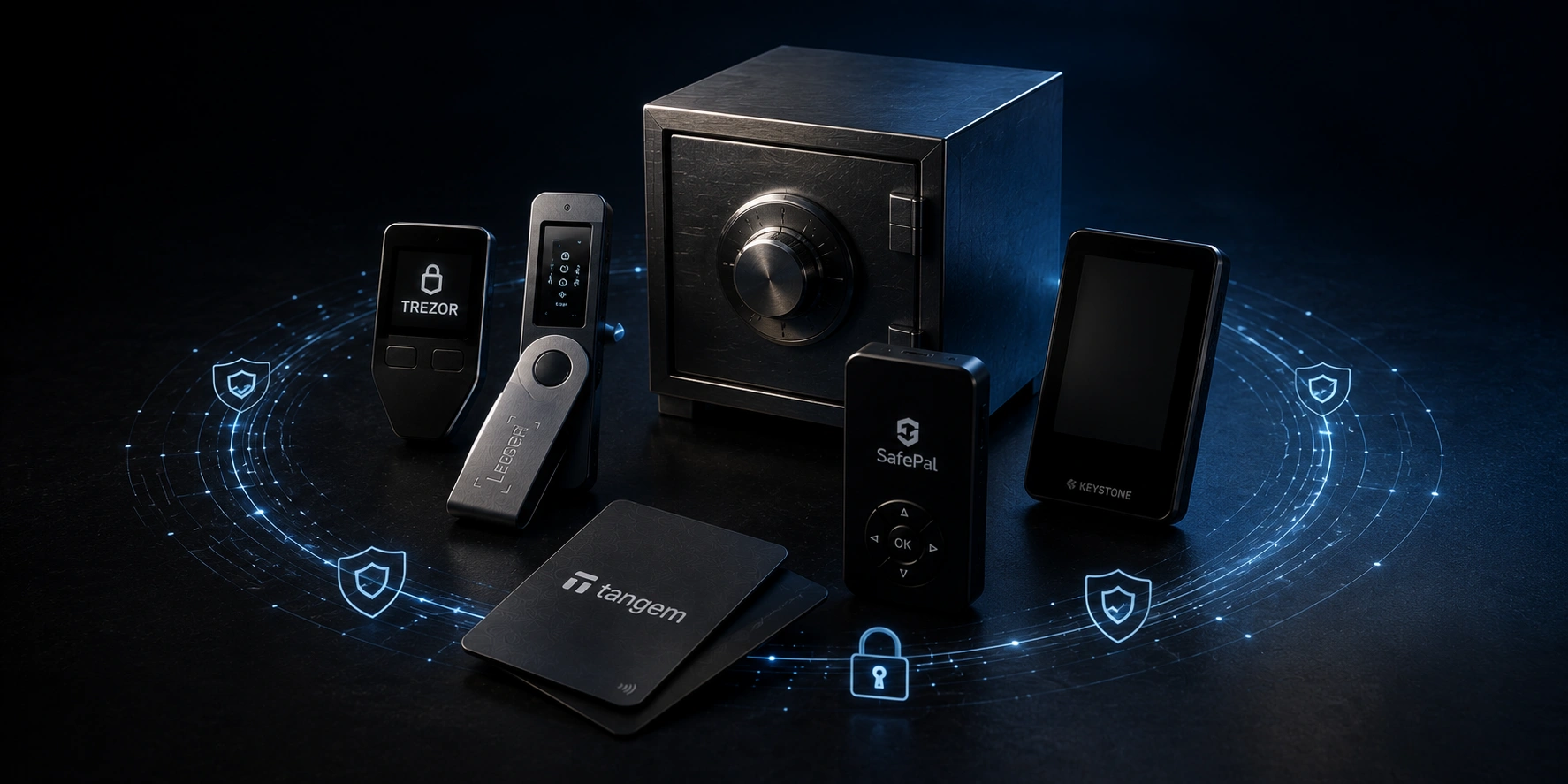
Ledger remains one of the most recognized hardware wallet brands. Devices such as the Nano series and Ledger Flex support thousands of cryptocurrencies and tokens, integrate with Ledger Live, provide NFT management capabilities, support staking for selected assets, and allow interaction with Web3 applications.
Trezor is known for its open-source firmware and transparent security model. Its latest devices support a wide range of cryptocurrencies, integrate with third-party wallets, and include Shamir Backup technology, allowing recovery data to be divided into multiple independent shares.
Tangem offers a different approach by using NFC-enabled smart cards instead of traditional USB hardware wallets. This compact design allows users to manage digital assets conveniently through a smartphone without cables.
SafePal focuses on completely offline transaction signing through QR codes. Since the device does not require a continuous USB or Bluetooth connection, it minimizes potential attack vectors while maintaining ease of use.
Keystone also adopts an Air-Gap architecture, features a large touchscreen, and supports integration with numerous third-party wallets. Its design appeals to users seeking maximum isolation and enhanced security for long-term asset storage.
For Bitcoin-only users, specialized devices such as Coldcard, BitBox02 Bitcoin-only Edition, and Blockstream Jade are also popular choices, offering advanced Bitcoin security features and multisignature support.
4. Comparison of the Best Hardware Wallets
Although all hardware wallets serve the same primary purpose, they differ in security architecture, connectivity options, supported ecosystems, and additional functionality.
When comparing hardware wallets, it is important to evaluate more than just the number of supported cryptocurrencies. Security design, connectivity, software compatibility, dedicated applications, and Web3 capabilities all play an important role in determining which device best fits a particular use case.
| Wallet | Connection | Key Features | Web3 Support | Best For |
|---|---|---|---|---|
| Ledger | USB, Bluetooth (selected models) | Secure Element, Ledger Live, broad asset support | Yes | General-purpose storage |
| Trezor | USB | Open-source firmware, Shamir Backup | Yes | Users preferring open-source security |
| Tangem | NFC | Smart card format, mobile-first experience | Yes | Everyday mobile use |
| SafePal | QR Codes | Air-Gap architecture, offline signing | Yes | Enhanced security |
| Keystone | QR Codes | Air-Gap, touchscreen, multisignature support | Yes | Long-term storage of larger holdings |
Each of these wallets is designed for different user scenarios. Some prioritize convenience and ecosystem integration, while others focus on maximum isolation and advanced security mechanisms.
Although these are among the best-known hardware wallets available today, their features may vary depending on the specific model and firmware version. Before purchasing, users should review the latest supported blockchain networks and available functionality, as manufacturers regularly introduce updates. The ideal hardware wallet ultimately depends on whether the priority is long-term cold storage, active participation in DeFi, or everyday cryptocurrency management.
5. How to Use a Hardware Wallet Securely
Even the most secure hardware wallet requires users to follow basic cybersecurity practices. After the initial setup, the recovery seed phrase or any alternative backup method provided by the manufacturer should be stored safely. Backup information should always be kept separately from the device and never stored digitally to minimize the risk of unauthorized access.
Hardware wallets should only be purchased directly from official manufacturers or authorized distributors. Before first use, users should verify that the packaging has not been tampered with, install the latest firmware, and ensure the device generates a new recovery phrase during setup rather than containing a preconfigured one.
The best hardware wallet depends on individual needs. Users actively working with multiple blockchain networks and Web3 applications may prefer versatile solutions such as Ledger or Trezor. Those prioritizing fully offline operation may find SafePal or Keystone more suitable, while Tangem provides a convenient option for mobile-first users thanks to its NFC card format.
Hardware wallets remain one of the most effective tools for self-custody of digital assets. When configured correctly, regularly updated, and combined with proper backup practices, they significantly reduce the risk of cryptocurrency loss while giving users full control over their assets across multiple blockchain ecosystems.











