

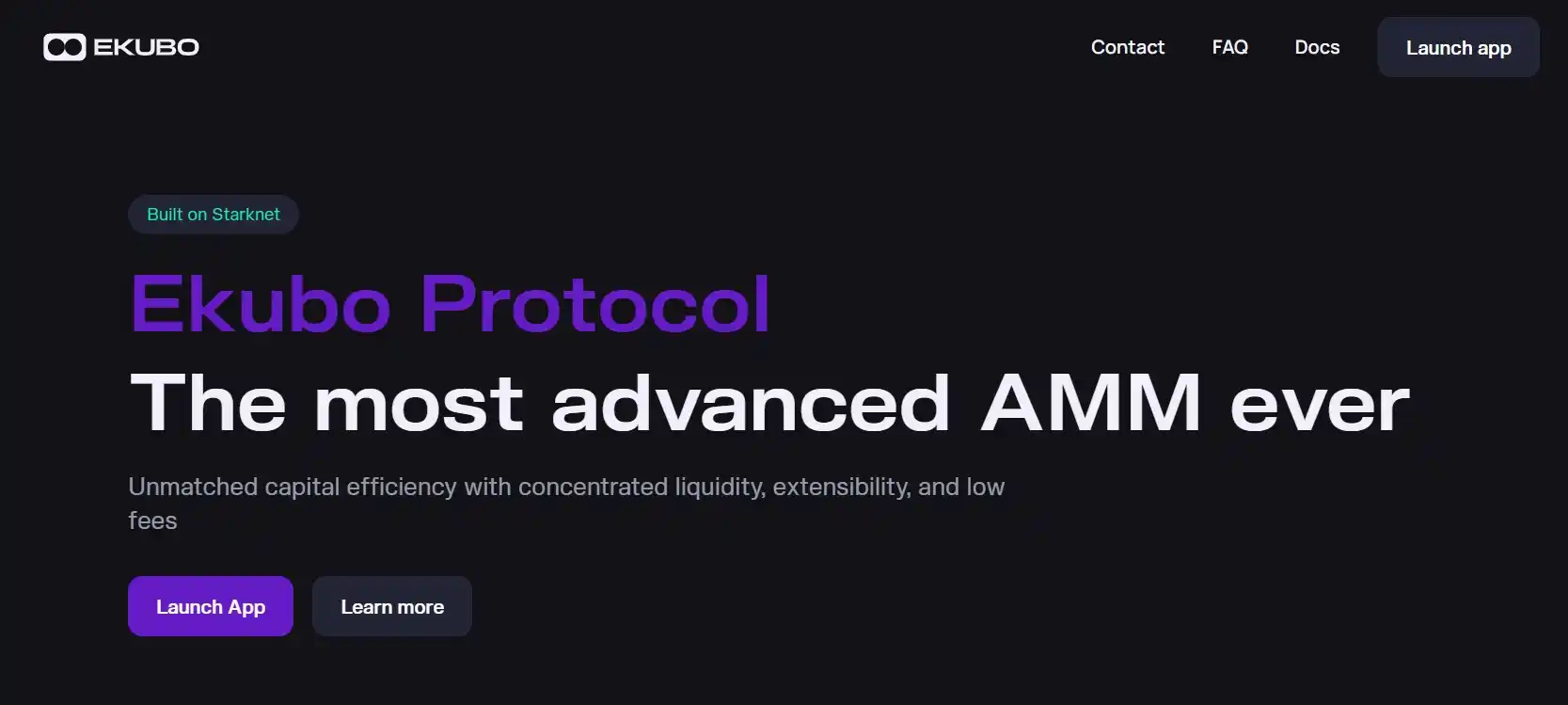
In the rapidly evolving universe of Decentralized Finance (DeFi), liquidity management efficiency remains a key challenge. The Ekubo Protocol presents a bold response to this challenge, positioning itself as one of the most technologically advanced Automated Market Makers (AMM). Built on the Starknet blockchain and utilizing the revolutionary concept of super-concentrated liquidity, Ekubo aims to fundamentally change the standards for decentralized exchanges, offering unprecedented order execution precision and returns for liquidity providers.
Contents:
- Architectural Innovation of the Protocol
- The Essence of Ekubo's Efficiency
- Ecosystem of Possibilities
- Technical Excellence and Project Partnerships
- The Future of AMM: Ekubo's Role in DeFi
- Conclusion
Architectural Innovation of the Protocol
The Ekubo Protocol utilizes an advanced single-contract (singleton) architectural model, which is fundamentally different from traditional DeFi solutions. Instead of managing numerous independent smart contracts for each pool, all functionality is concentrated in one integrated module. This specialized development for the Starknet network minimizes operational complexity and computational resource consumption.
The key outcome of this technical optimization is a significant reduction in transaction costs. Lowering overhead directly increases the net profit for all participants—from liquidity providers to traders. Thus, the chosen architecture lays the foundation for the protocol's economic efficiency, making it more attractive in the competitive decentralized finance environment.
The Essence of Ekubo's Efficiency
Ekubo's key technological advantage lies in the use of a super-concentrated liquidity mechanism. This innovation allows focusing providers' capital within an extremely narrow price range, unlike classical AMMs where funds are distributed widely and inefficiently. This approach solves two main tasks: it ensures the highest capital density in the pool and dramatically improves trading conditions.
The implementation of this concept provides the protocol with the following competitive advantages:
- Maximum Capital Efficiency: Liquidity is utilized almost 100%, significantly increasing providers' potential returns from fees.
- Minimal Slippage: Traders get the best order execution even for large deals due to high capital concentration.
- Unprecedented Precision: Liquidity can be placed with a step of 0.0001% (one hundredth of a basis point), which provides 4 million times greater precision than a standard order book.
Super-concentrated liquidity serves as the foundation for achieving Ekubo's main goal—creating a balance between the optimal exchange price for users and maximum profit for those who provide their assets. This mechanism forms a new paradigm in the operation of decentralized exchanges, where every unit of capital works with maximum output.
Ecosystem of Possibilities
The Ekubo Protocol offers a modular and extensible system of extensions, which elevates AMM functionality to a new level. Unlike static solutions, this architecture allows the creation of custom logical add-ons directly on top of the protocol's core. This approach ensures unparalleled flexibility and platform adaptability.
Thanks to the extension system, developers can implement complex financial mechanisms: limit and stop orders, automated liquidity management strategies, or customized logic using oracles. This transforms Ekubo from a standard exchange mechanism into a dynamic innovation platform where the community itself defines and creates future tools for decentralized finance.
Technical Excellence and Project Partnerships
The adoption and recognition of the Ekubo Protocol within the Starknet ecosystem is confirmed by the support of leading industry experts. Founders of key projects, such as Uri Kolodny (Co-founder and CEO of StarkWare) and Mentor Reka (Co-founder and CEO of AVNU), have publicly noted its potential, emphasizing the technological significance of the development.
Partnerships with teams like Argent (wallet) and Briq (NFT platform) demonstrate Ekubo's deep integration into the DeFi infrastructure. This backing from recognized leaders serves as proof that the protocol's optimized architecture and mechanisms represent a real technological advantage, not just a marketing ploy, strengthening community trust.
The Future of AMM: Ekubo's Role in DeFi
The role of the Ekubo project is to form a new standard for the next generation of decentralized exchanges. Its technical model demonstrates an evolutionary leap in key parameters compared to traditional AMMs, as clearly shown in the comparison table.
| Criterion | Traditional AMM (Uniswap V2) | Ekubo Protocol |
|---|---|---|
| Architecture | Multiple contracts for each pool | Single singleton contract |
| Liquidity | Distributed across a wide range | Super-concentrated |
| Capital Efficiency | Relatively low | Extremely high (leverage up to 15.7x) |
| Flexibility & Programmability | Limited, fixed functions | High, due to modular extensions |
| Operational Cost (Gas) | Higher due to architectural complexity | Lower thanks to optimization for Starknet |
As evident from the comparison, Ekubo does not merely improve individual metrics but rethinks the very architecture of AMM. Its integration with the Starknet blockchain provides advantages critical for the mass adoption of DeFi: scalability, low transaction costs, and security based on ZK technologies. This allows the protocol to become a fundamental element of an efficient and accessible decentralized financial infrastructure.
Conclusion
The Ekubo Protocol represents a significant evolutionary step in the development of automated market makers. By combining an advanced singleton architecture, a super-concentrated liquidity mechanism, and an open system of extensions, it creates a solution that redefines the standards of capital efficiency and functional flexibility in DeFi.
With the support of leading projects in the Starknet ecosystem, Ekubo has the potential to become one of the basic elements of a new financial infrastructure. Its model offers a sustainable and profitable economy for liquidity providers while providing traders and developers with a powerful toolkit for creating innovative financial products.











