
AI tools helped gather research and write the first draft of this article. I edited it; the figures were compared with the research notes, and the key sources were opened and checked. Details at the end.
A note that says "this article was created with the help of AI" is honest, but it answers almost nothing a reader wants to know. Did the tool write the conclusions or fix the commas? Did anyone check the numbers? Who answers for a mistake?
In my view, a useful disclosure answers four questions: what the AI did, what a person did, what was checked and how, and who is responsible for the article. I recommend placing it where readers will see it, not in the footer, and keeping a real person in the byline. And it travels with the sources, because readers judge a disclosure partly by whether they can verify the work behind it.
In the previous part of this series I wrote about making reasoning inspectable: putting the evidence, the method and the limits next to the claim. This part applies the same idea to one specific piece of the method, the role of AI tools. Below is what the evidence says, what Google and EU law ask for, a worked example, a template, and the most common mistakes.
What readers actually think
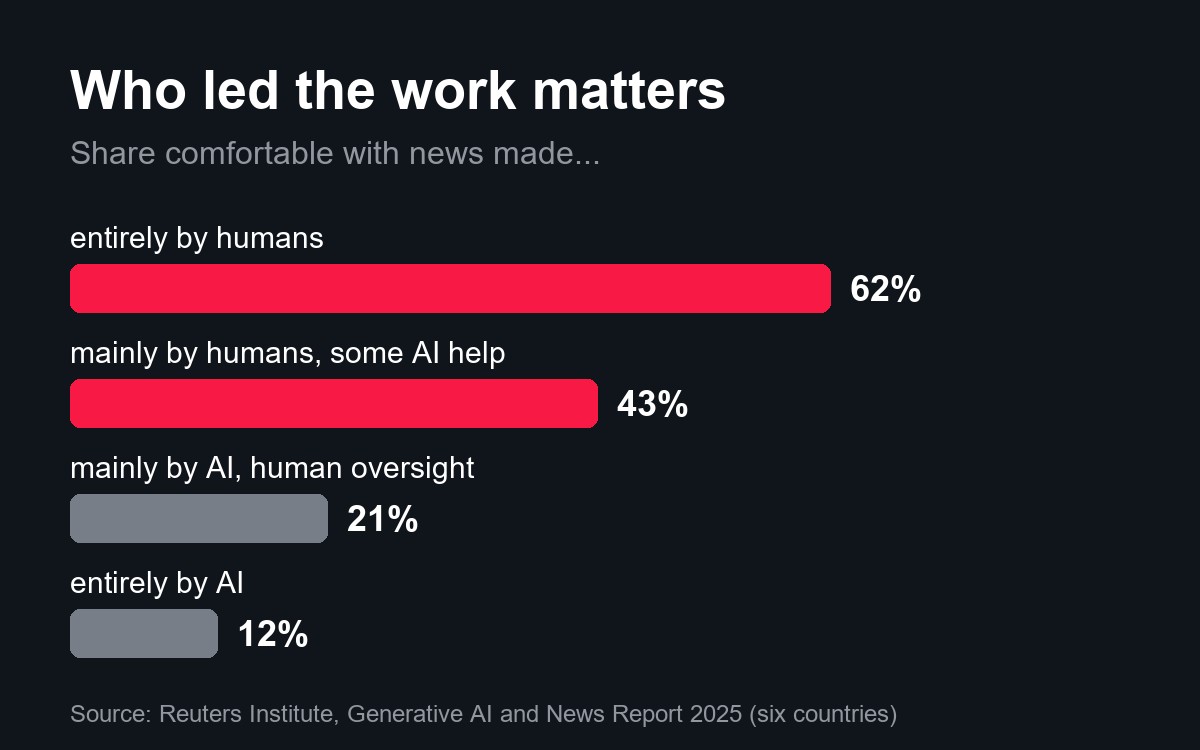
Start with the baseline. In the Reuters Institute's Generative AI and News Report 2025, covering six countries, 62% of respondents said they were comfortable with news made entirely by humans. That fell to 43% for news made mainly by humans with some help from AI, 21% for news made mainly by AI with human oversight, and 12% for news made entirely by AI [1]. (Survey of online news users in six countries.)
The sharp drop between 43% and 21% is worth noticing. This suggests readers react not only to whether AI was involved but to who led the work. A disclosure that leaves this question open may lead readers to assume the less comfortable answer; no study I cite tests this.
The same report found that only 19% of people said they see AI labels on news every day [1]. This suggests that many readers have no settled expectation of what a disclosure looks like, so the format a publisher chooses does a lot of the explaining.
What the research says about disclosure
The evidence is real but thin. Most effects are small, few studies have been replicated, and none compares different wordings on full-length news articles. Each finding below carries a label showing how much weight it can bear.
A bare label costs a little; an explained label may cost nothing. Sacha Altay and Fabrizio Gilardi ran two preregistered experiments with 4,976 participants in the United States and the United Kingdom [2]. Labelling an item "AI-generated" lowered how accurate people judged it to be, whether or not the item was true. The effect was small, about a third of the effect of a "false" label. In the second experiment, they tested explanations. When the label said the AI had only improved the style or written a first draft, the penalty disappeared. It remained when there was no explanation, or when the AI had chosen the topic and written everything. (Peer-reviewed experiment, PNAS Nexus; one study, materials were not full articles.)
This is the most direct evidence I found that specifics can beat a generic label, though it comes from one study.
In one experiment, sources largely offset the penalty. Benjamin Toff and Felix Simon found that an AI label reduced trust in a news item, but that adding a list of sources largely offset the drop [3]. The penalty was larger among people who trusted news more and knew more about journalism. (Peer-reviewed experiment, International Journal of Press/Politics, 2025.)
Surveyed readers say they want disclosure. In a 2024 Trusting News survey of partner newsrooms' audiences 94% said they wanted publishers to disclose AI use [4]. (Survey; not representative.) Those readers want to be told, even though telling them costs a little trust. The rest of this article is about reducing that cost.
In real newsrooms, the fact of AI use matters more than the reassuring wording. Trusting News and Toff worked with ten newsrooms in 2025 [4]. In a survey of their audiences, 42% said a disclosure made them less likely to trust the story, and 30% said more likely. In A/B tests, disclosures about AI used for transcription and document analysis produced a small but significant drop in trust. Disclosures about drafting and summarizing produced no significant change, and translation made almost no difference. (Survey and field test; partner audiences, not a representative sample.)
In experiments on people at work, being found out cost more than telling. Oliver Schilke and Martin Reimann ran 13 experiments with, according to their university, more than 5,000 participants [5]. People who disclosed their own AI use were trusted less than those who said nothing. But when someone else exposed the AI use, the loss of trust was larger. (Peer-reviewed experiments, OBHDP, 2025; participants judged people at work, not publications, so the transfer to readers is limited.)
Explaining the process can help trust overall. In 2019 the Center for Media Engagement tested a box explaining why and how a story was reported [6]. On real USA Today and Tennessean articles (n = 559), it improved 11 of 12 trust measures, according to the report. On a mock news site (n = 753), it improved only one. (Research centre report, not peer-reviewed; no replication.)
Put together, these findings point one way. Hiding AI use looks like the riskiest option: in one set of experiments, being exposed cost more trust than disclosing (shown for people at work, not tested for publications) [5], and most surveyed readers say they want disclosure [4]. Studies differ on how much the wording helps: sources offset the penalty in one experiment [3], while field tests found that the fact of AI use mattered more than the phrasing [4]. A bare label is a small cost. A specific explanation, paired with sources, appears to reduce or remove that cost. None of this proves that any particular wording will work for your readers. It is the best current reading of a small body of evidence.
What Google and EU law ask for
Google. Google's guidance on helpful content asks that readers can tell who created a piece of content, with bylines leading to information about the author. Where readers would reasonably expect to know that automation or AI was involved, Google suggests disclosing it and explaining how and why it was used [7]. (Official guideline.)
In early October 2026, Google added to the same page that fabricating creator profiles, such as using AI-generated headshots, made-up names or false credentials to make content appear written by human experts, is a form of deception and a sign of a low-quality page (page last updated 5 October 2026) [7][8]. (Official guideline; Google has not described how it detects this or what follows.)
Google's search quality rater guidelines add that using generative AI does not by itself determine the quality of a page; what matters is effort, originality and value to the reader [9]. And in a 2023 FAQ, Google said that crediting AI as the byline is "probably not the best way" to show AI involvement [10]. That is not a ban, but it points to a separate disclosure rather than an AI byline. (Official guidance.)
EU AI Act. Article 50(4), applicable from 2 August 2026 under the Act's original schedule, requires disclosure when AI-generated text is published to inform the public on matters of public interest. It makes an exception when the text has gone through human review or editorial control and a natural or legal person holds editorial responsibility for it [11]. (Law; this is a summary based on the published article text and law-firm commentary, not legal advice. Whether it applies to a given publisher depends on its audience and situation.) In practice, a publisher with real human review and a responsible editor may fall under this exception. The disclosure described in this article is good practice, not a statement about legal duty.
Both point to the same practical structure: a named, responsible person, a human review step that actually happens, and a disclosure that describes it.
A worked example
The article in this example is fictional.
Imagine an article comparing three ways to back up a crypto wallet's recovery phrase: paper, a steel plate, and a split backup. The author interviewed a wallet developer by video, read the recovery documentation of three wallets, and tested recovery on test wallets. AI tools were used along the way.
Version A, the common one. At the bottom of the page, in small type: "This article was created with the help of AI."
This is honest and nearly useless. It does not say whether AI tested the wallets or wrote the conclusions. According to Altay and Gilardi, an unexplained label is exactly the form that carries a penalty [2]. Placed in the footer, it also risks being "discovered" by readers rather than shown to them.
Version B, a useful one. One line under the headline:
AI tools helped transcribe the interview, summarize wallet documentation and draft one section. I tested every recovery method myself and checked each quote and figure. Details at the end.
At the end, a box:
| Task | What the AI did | What a person did | How it was checked |
|---|---|---|---|
| Interview | Transcribed a 40-minute video call | Listened again to every quoted passage | Each quote compared with the recording |
| Documentation | Summarized the recovery sections of three wallets | Read those sections in full | Every row of the comparison table links to the documentation page |
| Draft | Wrote a first draft of the "Steel plates" section | Rewrote it; removed two claims with no source | Remaining claims checked against linked sources |
| Cover image | Generated the illustration | Chose it | Labelled as an AI-generated image |
| Not done by AI | — | Recovery tests on test wallets, the comparison and the conclusions | Test steps listed in the method section |
Responsible for this article: [author name], editor. Corrections: [contact]. Last reviewed: [date].
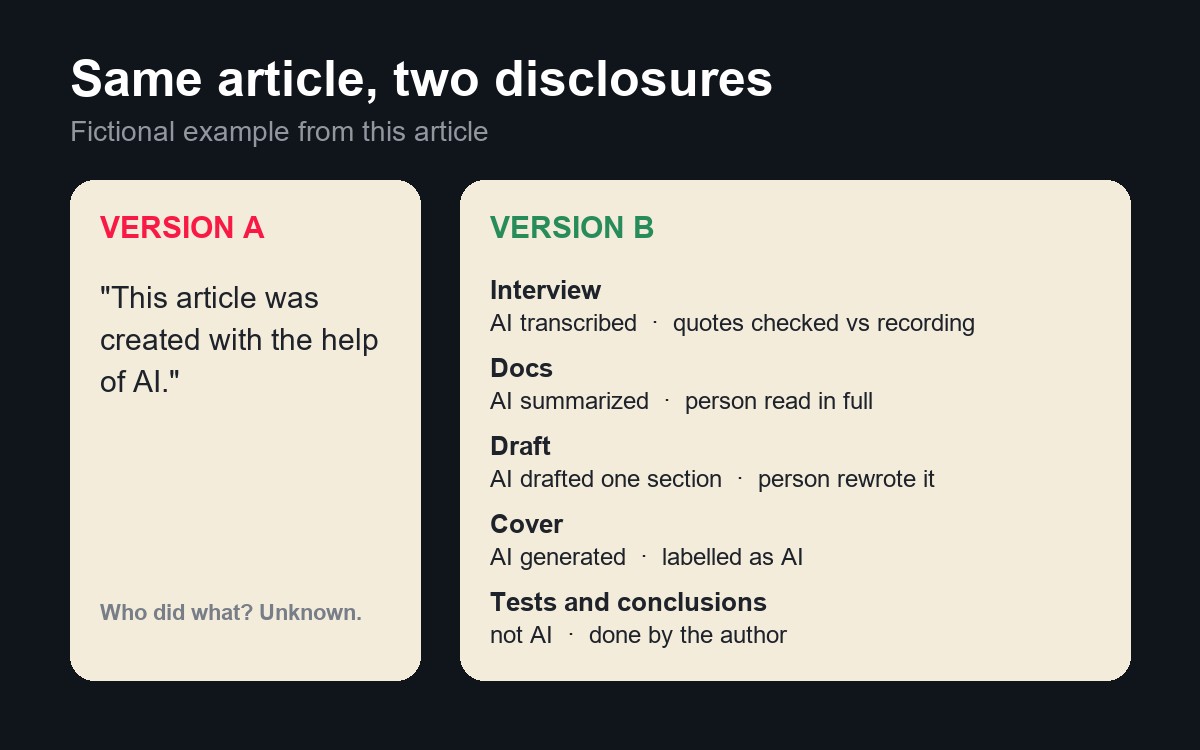
Each part does a specific job:
- The top line makes the disclosure visible before the reader starts, so nothing is left to be discovered later.
- The task column separates very different uses. Fixing grammar and drafting a section are not the same thing, and readers treat them differently [2][4].
- The check column matters most where readers are most sensitive. Trusting News saw a small drop in trust for AI transcription and document analysis [4]. No study shows that describing the check removes that drop, but these are the rows where a reader most needs to know that a person verified the output.
- The "Not done by AI" row answers the question I expect readers care about most: who formed the conclusions.
- The named person gives readers someone to hold responsible and matches the role that Google's guidance and the EU text give to a responsible person [7][11].
- The links in the table connect the disclosure to the sources. In Toff and Simon's study, adding a list of sources largely offset the penalty [3].
The box is short. Most of the work is in the verbs: transcribed, summarized, drafted, generated, rewrote, compared, tested. Each names a different operation. "AI-assisted" names none of them.
A template you can copy
HOW AI WAS USED IN THIS ARTICLE
Short version (place under the headline):
AI tools helped [tasks]. I [what you did yourself] and checked [what]. Details at the end.
| Task | What the AI did | What a person did | How it was checked |
|---|---|---|---|
Not done by AI: [conclusions, testing, interviews, final edit ...]
Tools: [tool names, if useful to readers]
Sources: linked beside each claim / listed below
Responsible for this article: [name, role]
Corrections: [contact]
Last reviewed: [date]
Checklist before publishing:
- Every task where AI produced text, data or images has its own row.
- Each row says what a person did and how it was checked, using a concrete verb.
- There is a "Not done by AI" line, and it is true.
- The short version appears near the top, not only in the footer.
- The byline is a real, named person who answers for the article.
- AI-generated images are labelled as such.
- The key claims link to their sources.
- If you could not check something, the box says so.
Common mistakes and how to fix them
1. A label with no explanation. "Made with AI" leaves readers to guess the worst. Fix: name each task, and the human check that followed it.
2. Hiding the disclosure. CNET published AI-written articles in 2022 and 2023 with the explanation tucked away. After Futurism reported on the practice, CNET's editor-in-chief announced an audit of the stories; according to Futurism, it found a small number that needed substantial correction and several with minor issues [12]. The lesson matches Schilke and Reimann's finding: AI use that others uncover costs more than AI use you show [5]. Fix: put a short line under the headline and the full box at the end.
3. Inventing an author. In November 2023, Futurism reported that Sports Illustrated had published product reviews under names such as "Drew Ortiz", with portraits taken from a marketplace of AI-generated faces. The publisher said the reviews came from a third-party contractor [13]. Gannett's Reviewed faced similar accusations the same year, which Gannett disputed [14]. Google's guidance now describes fabricated creator profiles as deception [7]. Fix: keep a real person in the byline. If you run an openly AI author persona, make its AI nature obvious everywhere the name appears, and name the human editor behind it.
4. One vague phrase covering very different uses. "AI-assisted" can mean a spell-checker or a fully generated draft. Readers react to these differently [2][4]. Fix: one row per task, plus the "Not done by AI" line.
5. Disclosure without sources. A disclosure asks the reader to trust your checks. Sources let them confirm those checks. In Toff and Simon's experiment, a list of sources largely offset the penalty for an AI label [3]. Fix: put links next to the claims they support, as described in the previous part of this series.
What disclosure does not solve
A good disclosure describes the process accurately. It does not make an inaccurate article correct, and it will not win over every reader. In the Trusting News survey, a sizeable share of readers trusted a story less after any disclosure [4]. The aim is not to make AI use look harmless. The aim is to give readers a true account of who did what, so they can decide how much weight to give the result.
How this article was made
| Task | What the AI did | What a person did | How it was checked |
|---|---|---|---|
| Research | Searched for studies and guidance; summarized them in notes | Chose the questions and the sources to rely on | Key sources [1][4][7][9][10] opened and compared with the original pages; [2][3][5][6] checked against abstracts, summaries or press releases; press cases [12]–[14] from secondary reports |
| Draft | Wrote the first draft from the notes | Edited the text and the structure | A separate fact-check compared every figure with the notes |
| Review | An AI reviewer flagged overstated claims | Decided which changes to make | — |
| Images and video | Generated the cover illustration; produced the narration voice of the companion video | Chose the illustration; designed the explanatory diagrams; wrote the narration script | Labelled as AI-generated in captions and alt text |
| Not done by AI | — | The decision to publish and responsibility for the text | — |
Conflicts of interest: none. The author holds no assets connected to the tools and companies mentioned and has no relationship with them; the wallet example is fictional.
Responsible for this article: Dmitriy Lastovka, author. Corrections: contact form.
Sources
Labels: survey, research (peer-reviewed unless noted), report, guideline, law, press.
- Reuters Institute, Generative AI and News Report 2025, 7 October 2025. Survey. https://reutersinstitute.politics.ox.ac.uk/generative-ai-and-news-report-2025-how-people-think-about-ais-role-journalism-and-society
- Altay, S., & Gilardi, F. (2024). PNAS Nexus, 3(10), pgae403. Research. https://pmc.ncbi.nlm.nih.gov/articles/PMC11443540
- Toff, B., & Simon, F. M. (2025). International Journal of Press/Politics, 30(4). Research. https://journals.sagepub.com/doi/abs/10.1177/19401612241308697
- Trusting News, Walsh & Toff, research on AI disclosures in news, 30 July 2025. Survey and field test, not representative. https://trustingnews.org/new-research-how-ai-disclosures-in-news-help-and-also-hurt-trust-with-audiences/
- Schilke, O., & Reimann, M. (2025). Organizational Behavior and Human Decision Processes, 188. Research. https://www.sciencedirect.com/science/article/pii/S0749597825000172
- Center for Media Engagement, Building Trust: What Works for News Organizations, 2019. Report, not peer-reviewed. http://mediaengagement.org/wp-content/uploads/2019/02/CME-Report-Building-Trust.pdf
- Google Search Central, "Creating helpful, reliable, people-first content" (last updated 5 October 2026). Guideline. https://developers.google.com/search/docs/fundamentals/creating-helpful-content
- Search Engine Journal, "Google adds fake author warning to helpful content guidance", 2 October 2026. Press. https://www.searchenginejournal.com/google-adds-fake-author-warning-to-helpful-content-guidance/591806/
- Google, Search Quality Rater Guidelines, 11 September 2025, section 4.6.6. Guideline. https://static.googleusercontent.com/media/guidelines.raterhub.com/en//searchqualityevaluatorguidelines.pdf
- Google Search Central Blog, "Google Search's guidance about AI-generated content", 8 February 2023. Guideline. https://developers.google.com/search/blog/2023/02/google-search-and-ai-content
- EU Artificial Intelligence Act, Article 50. Law (unofficial consolidated text). https://artificialintelligenceact.eu/article/50/
- Futurism, reporting on CNET's AI-written articles, 2023. Press (secondary; CNET's own statement not opened). https://futurism.com/cnet-editor-in-chief-addresses-ai
- Futurism report of 27 November 2023, as covered by NBC News, including the later dismissal of the Arena Group CEO. Press (secondary; Futurism original not opened). https://www.nbcnews.com/news/us-news/sports-illustrated-publisher-fires-ceo-latest-exec-terminations-ai-sca-rcna129236
- Techdirt, "Gannett accused of making up fake humans to obscure lazy AI use", 27 October 2023. Press (secondary). https://www.techdirt.com/2023/10/27/the-ai-journalism-revolution-continues-to-go-poorly-as-gannett-accused-of-making-up-fake-humans-to-obscure-lazy-ai-use/











