
AI tools helped gather research and write the first draft of this article. I edited it and checked the IPSO and AP quotes against the original pages. The cover illustration and the video narration are AI-generated. Details at the end.
Every publication makes mistakes. What readers judge is what happens next. If a number changes quietly, a reader who saw the first version keeps the wrong number, and a reader who sees the new version has no idea anything was wrong.
A correction readers can follow does five things. It says what was wrong, says what is right, gives the date, says whether the change affects the conclusion, and stays on the page. It is labelled as a correction, not hidden behind a softer word. And it appears where a reader of the wrong version is likely to see it.
The previous parts of this series dealt with showing your evidence and explaining how AI tools were used. Corrections are the third piece of the same idea: readers can inspect your work only if you also show them where it changed.
Four kinds of change, four labels
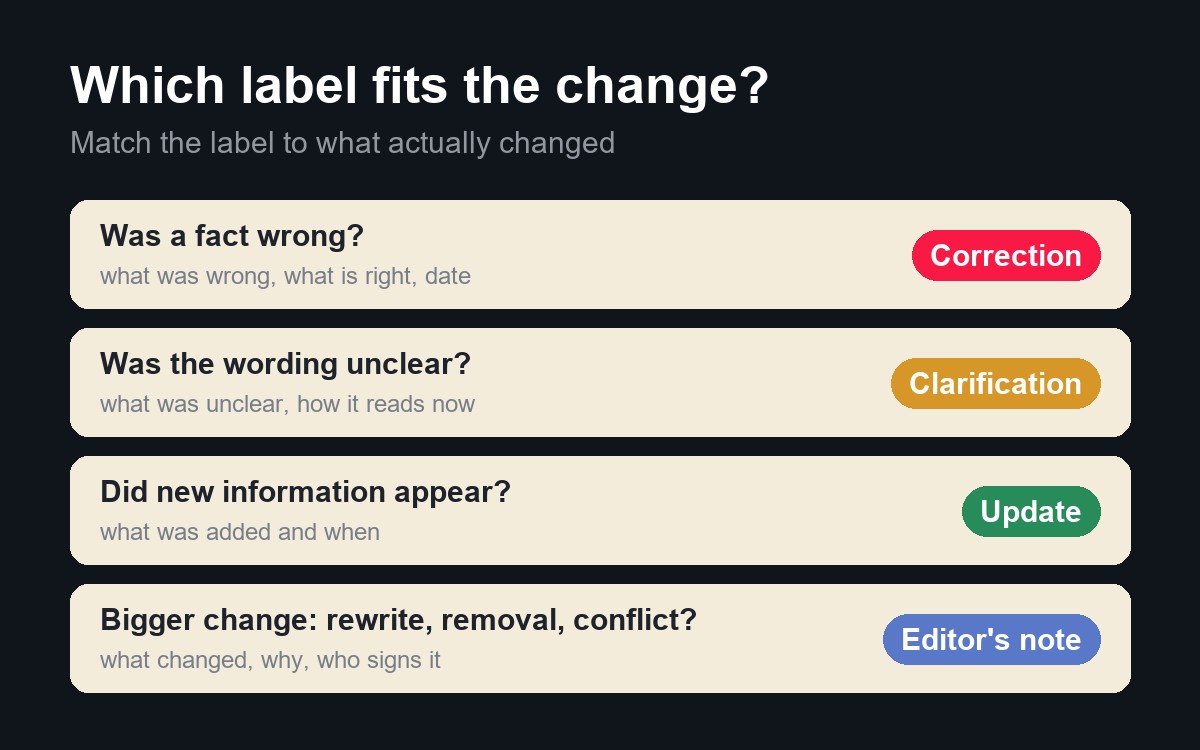
Not every edit is a correction. Mixing the labels is one of the most common ways to confuse readers, so start by separating them. There is no single industry definition; the table below reflects common newsroom practice.
| Label | When to use it | What the note says |
|---|---|---|
| Correction | A fact was wrong: a number, name, date, quote, attribution or technical detail | What was wrong, what is right, the date |
| Clarification | The facts were right, but the wording was ambiguous or easy to misread | What was unclear and how it now reads |
| Update | Nothing was wrong; new information appeared after publication | What was added and when |
| Editor's note | Something larger than a single fact: a substantial rewrite, a disclosed conflict of interest, removed material | What changed and why, signed by the person responsible |
Spelling and grammar fixes that change no meaning usually need no note.
The distinction matters because the labels say different things. An "update" says the world moved. A "correction" says we were wrong. In our view, calling a correction an update shifts responsibility away from the publisher.
What the standards say
The main codes agree on three points: correct significant errors, do it quickly, and do it visibly.
IPSO Editors' Code, Clause 1 (UK). "A significant inaccuracy, misleading statement or distortion must be corrected, promptly and with due prominence, and — where appropriate — an apology published" [1]. (Industry code, enforced by the UK regulator IPSO for its member publishers.)
SPJ Code of Ethics (US). Under "Be Accountable and Transparent", journalists should acknowledge mistakes and correct them "promptly and prominently", and explain corrections and clarifications carefully and clearly [2]. (Voluntary code; it gives no deadlines or definition of "prominently". Quoted from secondary sources: the SPJ page could not be opened.)
Associated Press. AP's News Values and Principles state that "a correction must always be labeled a correction" and list euphemisms it does not use, such as "recasts", "fixes", "clarifies", "minor edits" or "changes" [3]. (Newsroom policy.) On a website, a labelled note is often the only signal a reader gets that something was wrong.
Trust Project and IFCN. One of the Trust Project's trust indicators asks whether a publisher corrects its errors quickly, clearly and prominently [4]. The International Fact-Checking Network's Code of Principles includes an open and honest corrections policy as one of its five commitments [5]. (Industry standards for signatories.)
Machine-readable markup. Schema.org defines a correction property for an article and a correctionsPolicy property for a news organization [6]. We found no Google documentation that uses these properties for ranking or display, so treat them as good practice, not an SEO tactic. (Vocabulary standard.)
What the research says
The research answers three questions: do publishers correct openly, do corrections build trust, and do corrections change what readers believe? The answers are less comfortable than the standards.
In one large study, most error fixes were silent. Yoram Timmerman, Sarah Van Leuven and Antoon Bronselaer scraped six Flemish news sites between April 2019 and March 2021, revisiting each article every 15 minutes for 24 hours. Of roughly 300,000 articles, about 35% were updated at least once. Only around 4% of the updates corrected factual or substantive errors, and according to a conference summary of the study, almost all error corrections were made silently [7]. (Peer-reviewed content analysis, Journalism Practice; the "silently" figure comes from a conference summary of the study.)
So the gap between what codes require and what newsrooms do is not hypothetical. In the one large measurement we found, it was the norm, not the exception.
Corrections do not reliably build trust. In a Swedish study of citizens' attitudes, Michael Karlsson, Christer Clerwall and Lars Nord found strong expectations of accuracy and low tolerance for errors, but only people who already trusted the media appreciated corrections [8]. In an earlier Swedish experiment with 1,320 participants, the same team found that transparency features in general had little effect on how credible readers found a story [9]. (Peer-reviewed survey and experiment.)
Placement matters, but not in a simple way. Alyssa Appelman and Kirstie Hettinga ran an experiment (386 participants, according to the Penn State Page Center's summary) in which a correction appeared at the top or bottom of an article on The New York Times or Yahoo. Placement affected how credible and important readers judged the correction to be, but the effect depended heavily on which outlet published it [10]. (Peer-reviewed experiment, Journalism Practice, 2021.)
Corrections reduce belief in an error, but do not erase it. A meta-analysis by Nathan Walter and Sheila Murphy covering 65 studies found a moderate average effect of corrections on belief in misinformation (r = .35). The effect was much weaker for real-world misinformation (r = .14) than for misinformation invented for experiments (r = .48) [11]. Patrick Rich and Maria Zaragoza found that corrections to news stories faded: readers relied more on the original false detail two days after a correction than immediately after it, even though they still remembered the correction [12]. (Peer-reviewed; laboratory settings.)
Explaining works better than retracting. A widely cited review by Stephan Lewandowsky and colleagues concluded that retracting a claim reduces but does not eliminate its influence, and that a correction works better when it offers an alternative explanation to fill the gap left by the retracted claim [13]. (Peer-reviewed review.)
What follows for a correction note. None of these studies tested a website's correction box, so the following is an inference, not a finding. A note that only says "this was wrong" leaves a gap. A note that gives the right fact, and says what it changes, gives the reader something to replace the error with. Because a reader may have seen only one version, the fixed text and the note both need to stand on their own.
A worked example
The article in this example is fictional.
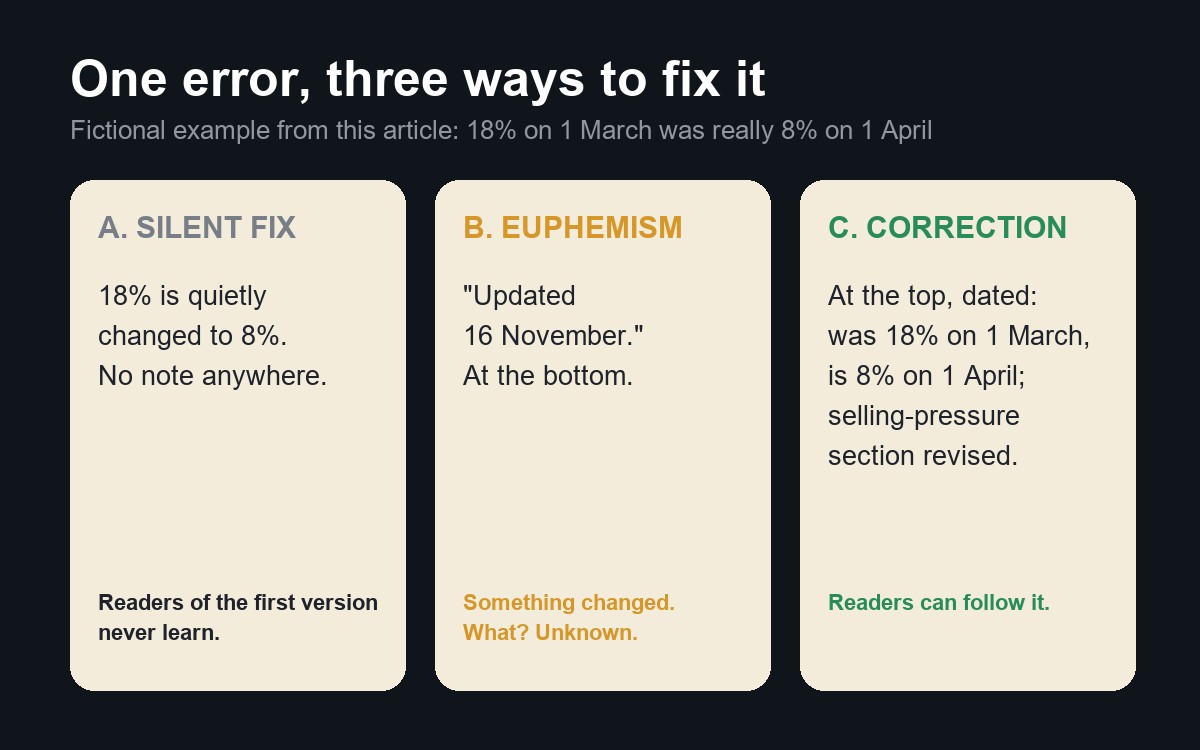
An analysis of a token's supply schedule says: "On 1 March, 18% of the total supply unlocks, which could add significant selling pressure." Two days later a reader points to the project's on-chain vesting contract (the code that releases tokens on a schedule). The correct figure is 8%, and the date is 1 April.
Version A, the silent fix. The editor changes 18% to 8% and March to April. Nothing else changes. A reader who quoted the original figure in a forum has no way to learn it was wrong, and the "significant selling pressure" sentence now rests on a smaller number without saying so.
Version B, the euphemism. At the bottom: "Updated 16 November." This tells readers that something changed, but not what, and the word "updated" suggests new information rather than an error. AP's rule against such euphemisms exists for this reason [3].
Version C, a correction readers can follow. At the top of the article:
Correction, 16 November 2026: An earlier version of this article said that 18% of the total supply unlocks on 1 March. The project's vesting contract shows that 8% unlocks on 1 April. The section on selling pressure has been revised: at 8%, the effect is likely to be smaller than we first suggested. We have also corrected our post on X.
In the body, the sentence now reads correctly, with a link to the vesting contract. On social media, a reply under the original post repeats the correction, because the post cannot always be edited and many readers saw only that.
What each element does:
- "An earlier version said…" tells readers of the first version exactly which detail to discard.
- "The contract shows…" gives the right fact and its source, filling the gap instead of only removing a claim [13].
- "The section… has been revised" answers the reader's real question: does the conclusion still hold?
- The date lets readers match the note to the version they saw.
- Placement at the top makes sense here because the error affected the main claim. A minor factual error that does not touch the conclusion can go at the end, with a short dated "Corrected" line under the headline pointing to it.
- The social reply reaches readers who never return to the article.
A template you can copy
NEAR THE HEADLINE (when the note sits at the end):
Corrected [date]. See the note at the end.
CORRECTION, [date]:
An earlier version of this article said [the wrong statement].
In fact, [the correct statement] ([source]).
[Effect on the article: "This does not change the conclusion." /
"The section on X has been revised accordingly." /
"The conclusion has changed: [how]."]
CLARIFICATION, [date]:
An earlier version said [ambiguous wording], which could be read as [X].
It now reads [new wording].
UPDATE, [date]:
This article was updated to include [new information].
EDITOR'S NOTE, [date]:
[What changed and why.] — [name, role]
Decision rule: which label, and where?
- Spelling or grammar only, with no change in meaning? (A misspelt name is not "only".) → No note. Otherwise go to 2.
- Is the change larger than one fact, or does it involve a conflict of interest or removed material? → Editor's note. Otherwise go to 3.
- Was a fact, number, name, date, quote, attribution or technical detail wrong? → Correction. Otherwise go to 4.
- Were the facts right but the wording misleading? → Clarification. Otherwise go to 5.
- Did new information appear after publication? → Update.
Placement: if the correction affects the headline, the main claim or the conclusion, put it at the top. Otherwise put it at the end, with a dated "Corrected" line near the headline. Always: fix the body text, keep the note permanently, and correct social copies with a reply or a new post.
Common mistakes and how to fix them
1. Fixing silently. It was the norm in the largest study we found [7], and it leaves readers of the first version with the wrong fact. Fix: any change to a fact gets a dated note.
2. Calling a correction an update. It blurs who was wrong. Fix: label a repaired error a correction; AP explicitly rules out softer words [3]. Keep "update" for new information.
3. Admitting an error without replacing it. "An earlier version contained an error about the unlock date" leaves the reader with the wrong date and no replacement. Fix: state the wrong claim once, then the right one with its source [13].
4. Not saying whether the conclusion changed. The question a reader most needs answered is whether the article still holds. Fix: end every correction with one sentence about its effect.
5. Correcting only the page. Social posts, newsletters and syndicated copies keep spreading the original. Fix: correct every copy you control, and note on the page that the social post was corrected too.
What corrections cannot do
A correction reduces the harm of an error but does not undo it, especially once the error has spread [11][12]. It also may not win back readers who did not trust you to begin with [8]. The goal is not to look good. It is to keep the record accurate and show readers, in a form they can check, where your work changed.
How this article was made
| Task | What the AI did | What a person did | How it was checked |
|---|---|---|---|
| Research | Searched for studies, codes and newsroom policies; summarized them | Chose the questions and the sources to rely on | IPSO [1], AP [3] and the Timmerman study summary [7] opened and compared with the original pages |
| Draft | Wrote the first draft from the notes | Edited the text and the structure | A separate fact-check compared figures with the research notes |
| Images and video | Generated the cover illustration; produced the narration voice of the companion video | Chose the illustration; designed the explanatory diagrams; wrote the narration script | Labelled as AI-generated in captions and alt text |
| Not done by AI | — | The decision to publish and responsibility for the text | — |
Conflicts of interest: none. The author holds none of the tokens discussed; the example token is fictional.
Responsible for this article: Dmitriy Lastovka, author. Corrections: contact form.
Sources
Labels: code, policy, standard, research (peer-reviewed unless noted).
- IPSO, Editors' Code of Practice (2025), Clause 1 Accuracy. Code. https://www.ipso.co.uk/editors-code-of-practice/
- Society of Professional Journalists, SPJ Code of Ethics. Code. https://www.spj.org/spj-code-of-ethics/
- Associated Press, News Values and Principles, "Telling the Story" (corrections). Policy. https://www.ap.org/about/news-values-and-principles/telling-the-story/
- The Trust Project, Trust Indicators. Standard. https://thetrustproject.org/trust-indicators/
- International Fact-Checking Network, Code of Principles, the commitments. Standard. https://ifcncodeofprinciples.poynter.org/the-commitments
- Schema.org, correction and correctionsPolicy. Standard. https://schema.org/correction ; https://schema.org/correctionsPolicy
- Timmerman, Y., Van Leuven, S., & Bronselaer, A. News in Motion: A Quantitative Analysis of Incremental News Updates by Flemish Online News Outlets. Journalism Practice, 19(7), 2025. Research. https://www.tandfonline.com/doi/full/10.1080/17512786.2023.2262976 ; conference summary: https://snurb.info/node/2853
- Karlsson, M., Clerwall, C., & Nord, L. (2017). Do Not Stand Corrected. Journalism & Mass Communication Quarterly, 94(1). doi:10.1177/1077699016654680. Research.
- Karlsson, M., Clerwall, C., & Nord, L. (2014). You Ain't Seen Nothing Yet: Transparency's (Lack of) Effect on Source and Message Credibility. Journalism Studies, 15(5), 668–678. doi:10.1080/1461670X.2014.886837. Research. https://kau.diva-portal.org/smash/record.jsf?pid=diva2%3A699706
- Appelman, A., & Hettinga, K. (2021). Correcting Online Content: The Influence of News Outlet Reputation. Journalism Practice, 15(10). doi:10.1080/17512786.2020.1784776. Research. Summary: https://pagecenter.psu.edu/blog/correction-placement-affects-perceived-importance-and-credibility
- Walter, N., & Murphy, S. T. (2018). How to unring the bell: A meta-analytic approach to correction of misinformation. Communication Monographs, 85(3), 423–441. doi:10.1080/03637751.2018.1467564. Research.
- Rich, P. R., & Zaragoza, M. S. (2020). Correcting misinformation in news stories: An investigation of correction timing and correction durability. Journal of Applied Research in Memory and Cognition, 9(3), 310–322. doi:10.1037/h0101850. Research.
- Lewandowsky, S., Ecker, U. K. H., Seifert, C. M., Schwarz, N., & Cook, J. (2012). Misinformation and Its Correction: Continued Influence and Successful Debiasing. Psychological Science in the Public Interest, 13(3), 106–131. doi:10.1177/1529100612451018. Research.











