
AI tools helped gather research and write the first draft of this article. I edited it and checked the quotes against the original documents (FTC, Google, AP, BMJ, Futurism, AHCJ). The cover illustration and the video narration are AI-generated. Details at the end.
One sentence can quietly invent an experience. "I tested this wallet for a month and it never lost a transaction" reads as first-hand evidence: someone sat with the app, sent funds, watched what happened. If the testing was actually done by a security lab, and the writer read the lab's report, the sentence is not a summary. It is a claim about the writer's own life that is not true.
Most writers who do this are not trying to deceive. The first person is simply the easiest voice to write in, and a report you have read closely can start to feel like something you did. But readers weigh first-hand experience differently from a summary of someone else's work, and that is exactly why the difference matters. The fix is simple: say who did the work, and how you know about it.
This article explains how to apply that rule. The previous parts of this series dealt with showing your evidence, explaining how AI tools were used and correcting mistakes visibly. This is the same idea applied to sources: readers can judge a claim only if they know where it came from.
Three kinds of claims
Almost every factual sentence in a crypto article belongs to one of three types. Each one deserves different wording.
| Type | What you actually did | Honest wording |
|---|---|---|
| Experience | You used the product, ran the test, visited the event | "I sent 20 transfers over two weeks; all arrived." |
| Observation of a public record | You looked at something any reader can open: a contract, a block explorer, a dashboard | "The vesting contract shows 8% unlocking on 1 April." |
| Report of someone else's work | You read a study, an audit, a press release or another outlet's story | "A 2026 audit by X found no critical issues, according to its published report." |
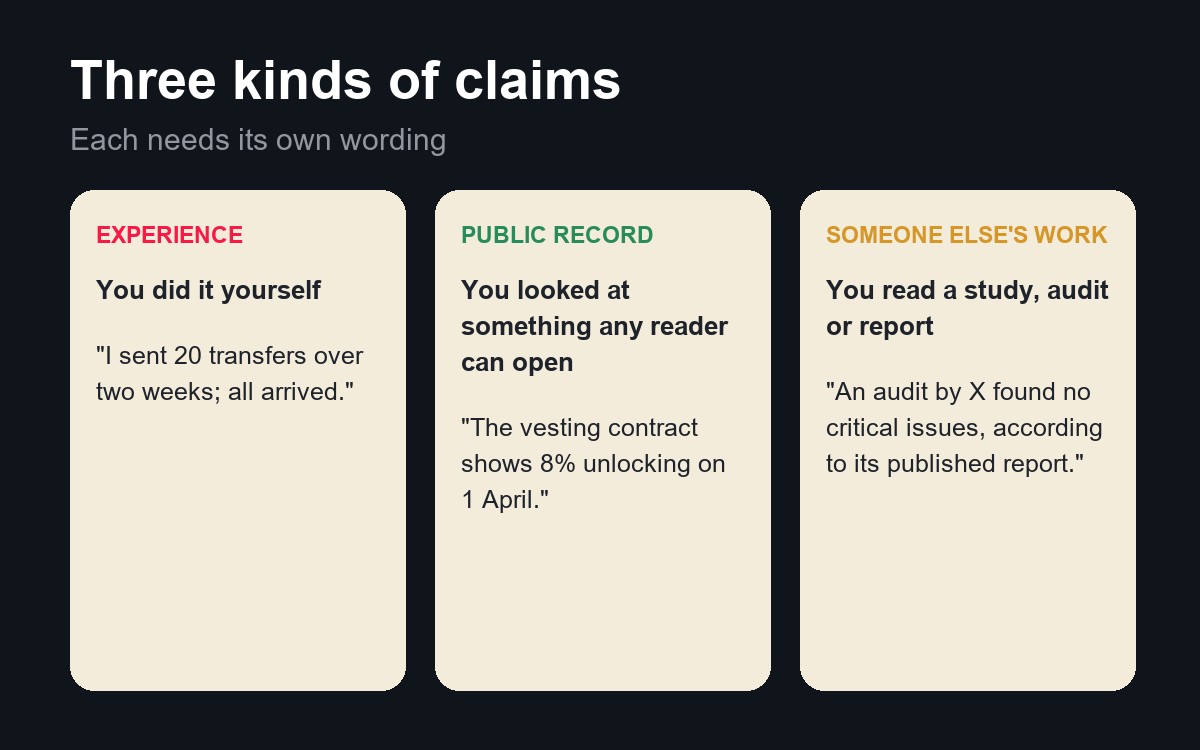
The trouble starts when a sentence of the third type is written in the voice of the first. "We found no critical issues" sounds like your team audited the code. "Tests show the bridge is safe" hides who ran the tests, what they covered and whether you saw the results or only a press release about them.
What the rules say
None of the codes below was written for crypto media, but together they draw a clear line.
US Federal Trade Commission, Endorsement Guides. The FTC's guides on endorsements say that "endorsements must reflect the honest opinions, findings, beliefs, or experience of the endorser," and that when an advertisement says an endorser uses a product, "the endorser must have been a bona fide user of it at the time the endorsement was given" [1]. (US regulation, 16 CFR 255.1. It applies to advertising and endorsements, not to journalism as such, but it is the clearest legal statement that claimed use has to be real use.)
FTC rule on consumer reviews (2024). A newer FTC rule (final in August 2024, in force since October 2024) makes it an unfair or deceptive practice for a business to write, create or sell a consumer review or testimonial that materially misrepresents "the reviewer's or testimonialist's experience with the product, service, or business" [2]. (US regulation, 16 CFR 465.2. It covers reviews and testimonials; an editorial article that pretends to be a hands-on review sits uncomfortably close to it.)
Google Search documentation. When Google added "Experience" to its quality-rater framework in 2022, it described it as asking whether content was "produced with some degree of experience, such as with actual use of a product, having actually visited a place" [3]. Its guidance on reviews asks writers to "provide evidence such as visuals, audio, or other links of your own experience with what you are reviewing" and to "share quantitative measurements" [4]. (Search-engine guidance. Google says the rater guidelines do not directly change rankings; we cite it because it defines experience concretely, not as an SEO tactic.)
Associated Press. AP's News Values and Principles say: "Anything in the AP news report that could reasonably be disputed should be attributed." And: "If we quote someone from a written document – a report, email or news release – we should say so." Information from the internet "must be vetted according to our standards of accuracy and attributed to the original source" [5]. (Newsroom policy, checked against AP's current PDF.)
Read together: if you claim experience, it must be yours; if it is someone else's, name them and say how you got it.
What goes wrong in practice
Invented experience at scale. In November 2023, Futurism reported that Sports Illustrated's website carried product reviews under bylines of writers who did not appear to exist. One profile said "Drew has spent much of his life outdoors"; the photo next to it was for sale on a site selling AI-generated headshots, described as a "neutral white young-adult male with short brown hair and blue eyes." The Arena Group, which published SI, said the articles "were licensed content from an external, third-party company, AdVon Commerce," that AdVon had assured it they were "written and edited by humans," and that the allegation of AI-generated articles "is not accurate." It acknowledged that AdVon writers used pen names, removed the content and ended the partnership. The author profiles disappeared after Futurism asked about them [6]. (News report.) Whether or not AI wrote the text, the point is that a review's credibility was borrowed from a personal history that nobody had lived.
The press release problem. A study in the BMJ compared 462 press releases from 20 leading UK universities with the research papers behind them and with 668 news stories. Compared with the papers, 40% of the releases contained exaggerated advice, 33% contained exaggerated causal claims drawn from correlational research, and 36% contained exaggerated inference to humans from animal research. The authors concluded that "exaggeration in news is strongly associated with exaggeration in press releases" [7]. (Peer-reviewed content analysis of health science, not crypto.) A writer who reports a study from its press release and writes "the study found" is passing on someone else's summary as if they had read the paper.
The single anecdote. The HealthNewsReview project, which reviewed more than 2,600 health news stories against ten criteria, asked among other things whether a story "seem[s] to grasp the quality of the evidence" and whether it "appear[s] to rely solely or largely on a news release." Its list of common failures included "the tyranny of the anecdote" [8]. (Criteria from a now-closed watchdog project, quoted from the Association of Health Care Journalists' 2024 republication.) Crypto writing has the same problem in a different costume: one user's story about a token or a wallet standing in for evidence about everyone.
A worked example
The wallet, the lab and the study below are invented for illustration.
A security lab publishes a report on a self-custody wallet. Its researchers ran the app for 30 days on four devices, sent 500 test transactions and reported that none were lost. They also found one medium-severity issue in how the app stored a backup file, which the developer says it has fixed. The writer has read the full report but has not used the wallet.
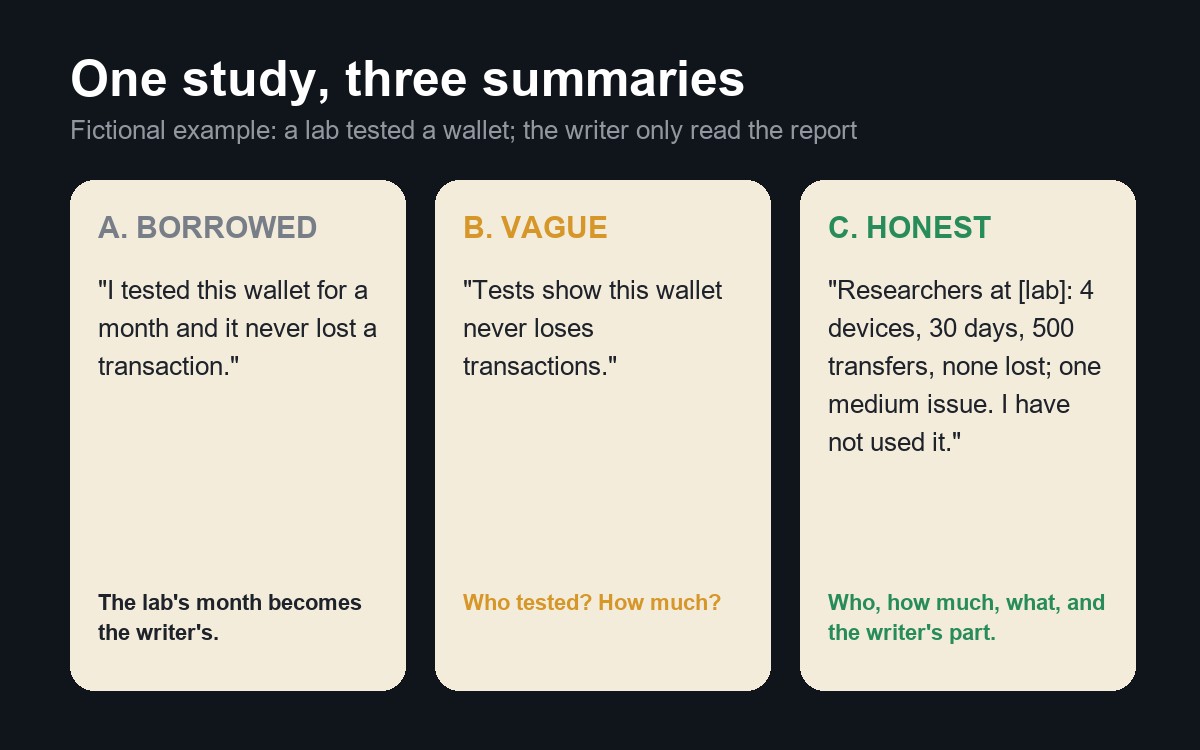
Version A, borrowed experience. "I tested this wallet for a month and it never lost a transaction. Solid choice." Every factual claim here belongs to the lab. The writer has turned the lab's month into their own, dropped the medium-severity issue and added a verdict the report does not make.
Version B, vague attribution. "Tests show this wallet never loses transactions." Better, but the reader cannot tell who tested, how much, or whether "never" means 500 transactions or five million. "Tests show" turns a specific result into a general law.
Version C, honest summary. "Researchers at [lab] ran the wallet on four devices for 30 days and reported no lost transactions across 500 test transfers (report linked below). They also found a medium-severity issue in backup storage, which the developer says has been fixed; we have not verified the fix. I have not used the wallet myself."
Version C is longer, but nothing in it is padding. It says who did the work, how much work it was, what it found including the inconvenient part, what the writer did and did not check, and where the reader can look. If the writer later installs the wallet and sends a few transfers, that becomes a separate, clearly first-person sentence: "I also sent five transfers on Android; all arrived."
A phrasing guide
| What you did | Write | Avoid |
|---|---|---|
| Read the full study or audit | "The report found…", "According to [lab]'s audit…" | "We found…", "I tested…" |
| Read only the abstract or a press release | "According to the university's press release…", "The abstract reports…" | "The study proves…" |
| Read another outlet's story about it | "[Outlet] reported that…" | Repeating the claim as your own finding |
| Checked a public record yourself | "The contract shows…", "On the block explorer, the address holds…" | "Sources say…" (if you looked yourself, say so) |
| Used the product yourself | "I used it for two weeks on iOS…" with numbers, dates, screenshots | "In my experience" with no details |
| Asked the project and got an answer | "The team told Dapp.Expert that…" | Stating their answer as fact |
Two small habits help most. First, put the source in the same sentence as the claim, not in a footnote three paragraphs later. Second, match the verb to the evidence: researchers report, found or estimate; press releases claim or announce; you checked, saw or used only what you checked, saw or used.
A checklist before publishing
- For every sentence with "I" or "we": did I, or we, actually do this?
- For every finding: is the person or organization that produced it named in the same sentence?
- Did I read the original, or a summary of it? If a summary, does the text say so?
- Did I keep the limitations and the inconvenient findings, not just the headline result?
- Is there a link the reader can open to check?
- Does any verdict ("safe", "solid", "best") go further than the source does? If so, is it clearly marked as my opinion?
Common mistakes and how to fix them
1. The borrowed first person. "I tested" when someone else tested. Fix: name who tested. If you also used the product, add that as a separate, specific sentence.
2. "Studies show." One study, unnamed, becomes a consensus. Fix: name the study, say what kind it was (survey, experiment, audit, content analysis) and how large.
3. Reporting the press release as the paper. The BMJ study found that exaggeration in news was strongly associated with exaggeration in the press release [7]. Fix: read the paper if you can; if you cannot, say "according to the press release".
4. Dropping the caveats. The audit's medium-severity issue, the study's small sample, the fact that it was tested on one network. Fix: keep at least the limitation that would change a reader's decision.
5. Laundering a verdict. The source reports results; the article adds "safe" or "recommended". Fix: separate what the source found from what you think, and label your opinion.
6. The anecdote as evidence. One user's story about a lost seed phrase or a 10x token. Fix: use it to illustrate, not to prove, and say how typical it is if you know. HealthNewsReview listed "the tyranny of the anecdote" among common failures [8].
What we could not find
We looked for research that directly measures how readers react when a writer presents someone else's test as personal experience, and found no study we could verify. There is a long line of research comparing anecdotal and statistical evidence in persuasion, but we could not open the original papers in time to cite their findings accurately, so we have left them out. The case for honest attribution in this article rests on codes, regulations and documented failures, not on a measured effect on trust. And honest attribution does not make a weak source strong: a clearly attributed press release is still a press release.
How this article was made
| Task | What the AI did | What a person did | How it was checked |
|---|---|---|---|
| Research | Searched for regulations, newsroom policies, studies and cases; summarized them | Chose the questions and the sources to rely on | FTC rules [1][2] (via Cornell LII), Google pages [3][4], AP's PDF [5], Futurism [6] and the BMJ study via PubMed Central [7] opened and compared with the quotes |
| Draft | Wrote the first draft from the notes | Edited the text and the structure | A separate fact-check compared figures and quotes with the sources |
| Images and video | Generated the cover illustration; produced the narration voice of the companion video | Chose the illustration; designed the explanatory diagrams; wrote the narration script | Labelled as AI-generated in the disclosure line and alt text |
| Not done by AI | — | The decision to publish and responsibility for the text | — |
Conflicts of interest: none. The author has no relationship with the companies named; the wallet and lab in the example are fictional.
Responsible for this article: Dmitriy Lastovka, author. Corrections: contact form.
Sources
Labels: regulation, guidance, policy, news report, research (peer-reviewed unless noted).
- US Federal Trade Commission, Guides Concerning the Use of Endorsements and Testimonials in Advertising, 16 CFR 255.1, paragraphs (a) and (c). Regulation. https://www.law.cornell.edu/cfr/text/16/255.1
- US Federal Trade Commission, Trade Regulation Rule on the Use of Consumer Reviews and Testimonials, 16 CFR 465.2(a)(3). Regulation. https://www.law.cornell.edu/cfr/text/16/465.2
- Google Search Central Blog, "Our latest update to the quality rater guidelines: E-A-T gets an extra E for Experience" (15 December 2022). Guidance. https://developers.google.com/search/blog/2022/12/google-raters-guidelines-e-e-a-t
- Google Search Central, "How to write high quality reviews". Guidance. https://developers.google.com/search/docs/specialty/ecommerce/write-high-quality-reviews
- Associated Press, News Values and Principles, section "Attribution" (PDF). Policy. https://www.ap.org/wp-content/uploads/2024/02/ap-news-values-and-principles.pdf
- Harrison Dupré, M. Futurism, "Sports Illustrated Published Articles by Fake, AI-Generated Writers" (27 November 2023). News report. https://futurism.com/sports-illustrated-ai-generated-writers
- Sumner, P., Vivian-Griffiths, S., Boivin, J., et al. (2014). The association between exaggeration in health related science news and academic press releases: retrospective observational study. BMJ, 349, g7015. doi:10.1136/bmj.g7015. Research. https://pmc.ncbi.nlm.nih.gov/articles/PMC4262123/
- Schwitzer, G. "Writing about health care interventions? The HealthNewsReview criteria are as relevant as ever." Association of Health Care Journalists, 23 July 2024. News report (republished criteria). https://healthjournalism.org/blog/2024/07/writing-about-health-care-interventions-the-healthnewsreview-criteria-are-as-relevant-as-ever/











