

Orbit (Orbit Money), formerly known as Eclipse Fi, has become a rare and profound example of transforming a Web3 project into a Web2.5 fintech product. The team abandoned its role as a Cosmos launchpad and shifted its focus toward building a service for subscription management, expense tracking, and a future crypto virtual card. At the same time, the blockchain legacy, the Equinox economic model, and Eclipse smart contracts continue to function, preserving value for the early community. Orbit aims to combine simple UX with crypto-infrastructure to create a sustainable product for the mass market.
- Orbit Money: context, project goals and reboot logic
- Eclipse Fi history: architecture, features and key ecosystem components
- Transition from Eclipse Fi to Orbit: Web2.5 approach and product strategy
- Economy and legacy: contracts, Equinox and the future token
- Orbit перспективы, риски и положение в Web2.5-финтех экосистеме
1. Orbit Money: context, project goals and reboot logic
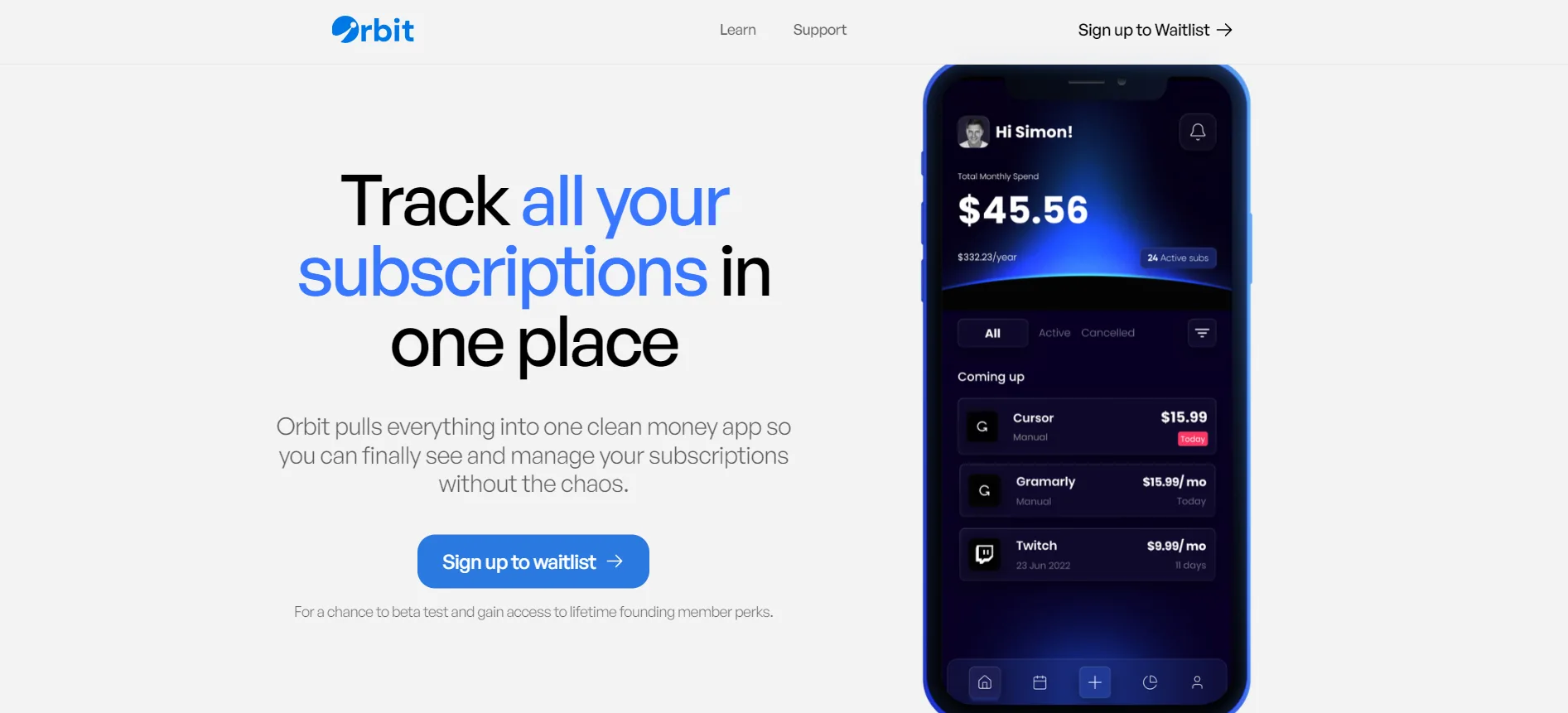
Orbit Money is a Web2.5 fintech platform built on the expertise of the Eclipse Fi team. Its main task is to help users manage subscriptions, control recurring charges, and improve financial habits. The project aims to solve the problem of “subscription overload,” when a user has dozens of services that are difficult to track manually.
The transition from Eclipse Fi was a response to market behavior changes. Most users prefer simple fintech tools rather than complex Web3 interfaces that require wallet setup and understanding of on-chain mechanics. The team decided to preserve the technical foundation but shift the target audience — from DeFi participants to the mass market.
Orbit is designed as a hybrid platform: the user interacts with a familiar interface, while tokenization elements, subscription logic, and hidden crypto-infrastructure may operate behind the scenes. This approach allows the project to combine practical functionality with Web3 heritage without complicating the user experience.
2. Eclipse Fi history: architecture, features and key ecosystem components
Eclipse Fi was a modular multichain launchpad in the Cosmos ecosystem, developing tools for fair token launches, liquidity management, and staking distribution. It targeted an advanced Web3 audience and offered flexible token-interaction mechanics through the Equinox system.
Main features of Eclipse Fi included:
-
Modular token launches: IDO, LBP auctions, lockdrop schemes.
-
Integrations with Cosmos and other networks, providing multichain access.
-
Equinox module, enhancing governance power through derivatives.
-
eclipASTRO token, giving increased influence on liquidity distribution.
-
Incentives for early participants, including staking and governance mechanisms.
Eclipse Fi occupied the niche of a “new generation” launchpad, offering more advanced distribution mechanics than classic IDO models. The architecture allowed projects to launch with considerations of liquidity, fairness, and holder behavior, making it a notable component of the Cosmos ecosystem.
3. Transition from Eclipse Fi to Orbit: Web2.5 approach and product strategy
The transition from Eclipse Fi to Orbit became a strategic shift toward the mass market. The team abandoned high-risk IDOs and focused on creating a tool that millions can use — a subscription and personal finance manager.
Orbit implements the Web2.5 concept, where blockchain is used only when it provides true value. The product is presented as a standard fintech service, but inside it may incorporate:
-
reward tokenization mechanics;
-
integrations with the future crypto card;
-
a loyalty system powered by on-chain logic;
-
technical security and infrastructure inherited from Eclipse Fi.
The user sees only a simple interface with charge notifications, duplicate subscription detection, expense analytics, and optimization tools.
The main goal of Orbit is to create a unified financial space that merges Web2 transactions and Web3 assets, built on simplicity, convenience, and gradual crypto-integration.
4. Economy and legacy: contracts, Equinox and the future token
Despite the shift in direction, Orbit retains Eclipse Fi’s technical legacy. The team confirms that old contracts remain active, and users who participated in staking may receive an airdrop if the Orbit token is launched. This helps maintain trust among the old community and provides a smooth bridge between the Web3 past and the Web2.5 present.
Below is the structured state of key system components:
| Component | Current state | Value for users |
|---|---|---|
| Eclipse Fi contracts | Active, frontend disabled | Accessible via on-chain interaction |
| Equinox module | Operational, not expanding | Retains governance and liquidity history |
| eclipASTRO | Active | May be considered in future rewards |
| Orbit token | Not launched | Potential airdrop for Eclipse stakers |
| Eclipse frontend | Planned migration | Team preparing continued access |
The economic model of Orbit may potentially combine Web2 and Web3 elements: cashback, loyalty points, token-based rewards, and interactions with the crypto card. Thanks to Eclipse Fi’s experience, the team is capable of building a sustainable and transparent tokenomics model, avoiding typical Web3 mistakes.
5. Orbit перспективы, риски и положение в Web2.5-финтех экосистеме
Orbit has significant potential in the subscription management and personal finance space. The team aims to build a product that can compete with major Web2 apps while leveraging the advantages of blockchain. In the future, the key growth driver will be the crypto virtual card, which unifies user expenses, subscriptions, and crypto balances within a single interface.
However, Orbit’s development involves several risks: regulation of crypto cards, competition with Web2 fintech platforms, the need to meet expectations of the old Eclipse Fi community, and the challenge of building fair tokenomics. Nevertheless, Orbit already stands out through its technical expertise, transparent transition, and Web2.5 strategy.
If the project manages to balance convenience, functionality, and hidden Web3 capabilities, it may secure a unique position between fintech and blockchain infrastructure.











