
Pepeto is a crypto project that combines the $PEPETO meme token with a planned infrastructure for digital asset trading. The ecosystem concept includes PepetoSwap with a proposed zero-fee swap model, a cross-chain bridge connecting Ethereum, BNB Chain, and Solana, token screening tools, and staking. Unlike a traditional memecoin, the project aims to connect its token with a broader set of DeFi tools, although much of the model's value depends on how these products perform and whether they gain actual usage after launch. Pepeto should therefore be evaluated separately as a token, a technology platform, and a project developing its own Web3 ecosystem.
Contents
- What Is Pepeto and How Does Its Ecosystem Work?
- How PepetoSwap, the Cross-Chain Bridge, and AI Token Screening Work
- Pepeto Compared with Memecoins and DeFi Platforms
- $PEPETO Token, Tokenomics, and Staking
- Risks and Prospects of Pepeto as a Web3 Project
1. What Is Pepeto and How Does Its Ecosystem Work?
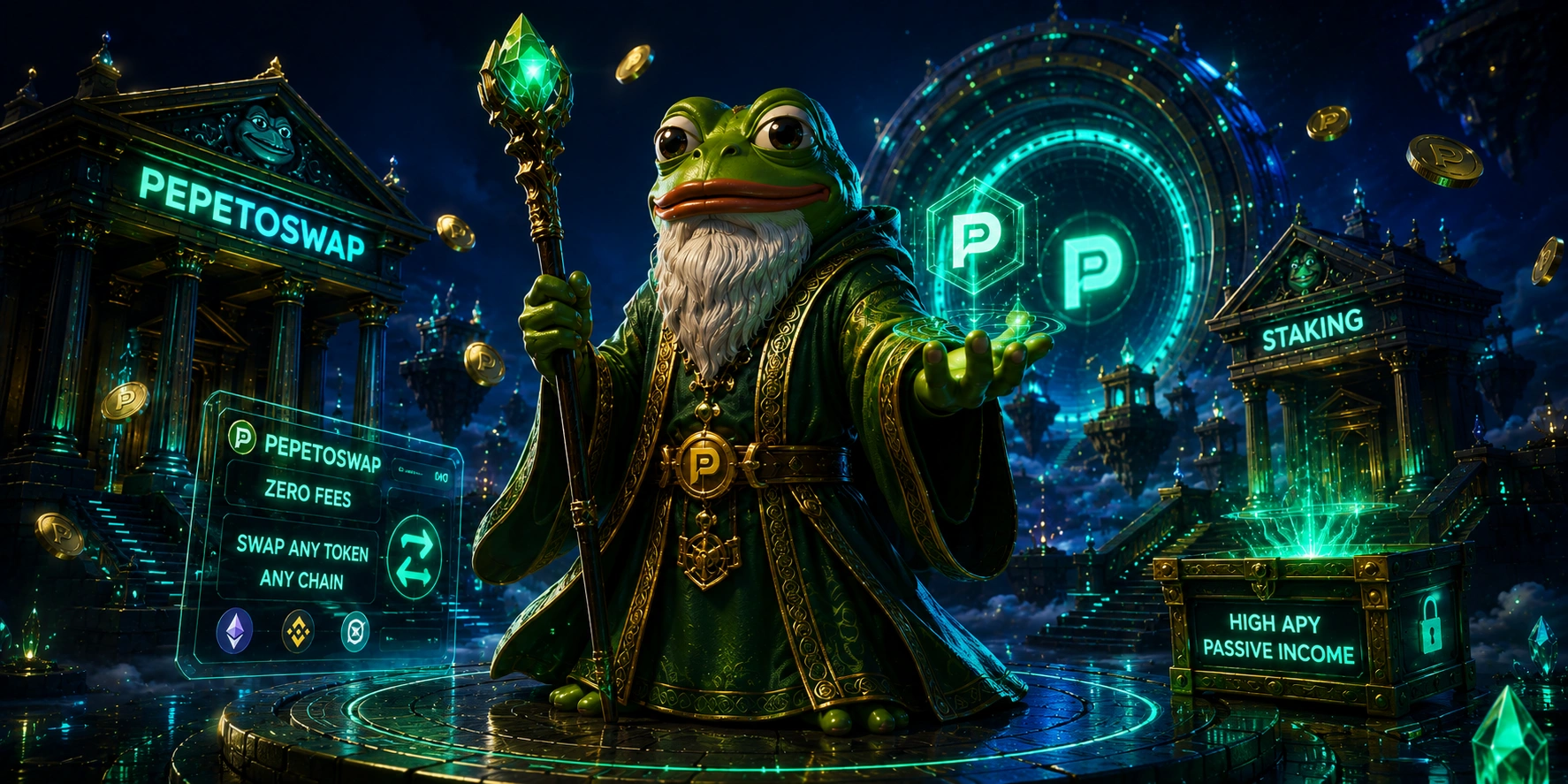
Pepeto belongs to the memecoin segment but is positioned as more than a standalone crypto asset. The project is building its concept around infrastructure for meme tokens, combining asset swaps, cross-chain transfers, and contract screening tools. The ecosystem's native asset is $PEPETO, which is connected to staking and other platform functions.
Ethereum serves as the foundation of the project. According to the ecosystem's description, $PEPETO is used within Pepeto's infrastructure, while the cross-chain model is intended to enable interaction with BNB Chain and Solana. This approach allows the project to operate across multiple networks, but it also increases technical complexity because different blockchains use their own standards and execution models.
The central idea behind Pepeto is to create a unified environment where users can swap meme tokens and move assets between supported networks. Within this model, PepetoSwap serves as the decentralized trading component, while Pepeto Bridge is intended to provide cross-chain asset transfers.
The project should be distinguished from a conventional DEX. Its concept also includes token screening before assets are added to the trading infrastructure, along with automated smart contract analysis. However, the effectiveness of these mechanisms depends not on the number of proposed features but on implementation quality, liquidity, and the system's ability to identify actual risks.
2. How PepetoSwap, the Cross-Chain Bridge, and AI Token Screening Work
PepetoSwap is presented as non-custodial trading infrastructure with zero platform fees for swaps. A non-custodial model means that users interact with the protocol through their own wallets rather than transferring assets to an account controlled by a centralized exchange. However, zero platform trading fees do not mean that transactions are entirely free, as blockchain operations may still require network gas fees.
The second component is Pepeto Bridge. The project describes a lock-and-mint mechanism in which an asset is locked by a contract on the source network and an equivalent amount is minted on the destination network. This model is designed to preserve the overall supply when representations of an asset are transferred between Ethereum, BNB Chain, and Solana.
Lock-and-mint is an established approach to cross-chain bridges, but its security depends on how the destination network verifies that assets have actually been locked on the source chain. Evaluating a specific implementation requires examining the message verification architecture, administrator permissions, smart contract security, key management, and procedures for handling failures. The ability to transfer assets across chains therefore does not by itself determine the security of a bridge.
Another proposed component is AI Token Screening. Its purpose is to analyze token contracts and identify potentially dangerous functionality, including hidden minting capabilities, honeypot mechanisms, and other risk indicators. Automated screening can provide an additional filter, but it cannot guarantee safety because economic attacks, contract modifications, and actions by project owners cannot always be detected through code analysis alone.
3. Pepeto Compared with Memecoins and DeFi Platforms
Memecoins traditionally rely on recognizable branding, community activity, and market liquidity, while their technical functionality may remain limited. DeFi protocols, by contrast, are typically built around specific financial operations such as swapping, lending, liquidity provision, or moving assets between blockchain networks.
Pepeto attempts to combine these two models. The meme token serves as the center of the brand and economy, while PepetoSwap, the Bridge, and contract screening tools are intended to form an infrastructure layer. This makes the project closer to a meme ecosystem than to a conventional token without additional products.
| Model | Main Element | Infrastructure | Primary Source of Utility |
|---|---|---|---|
| Pepeto | $PEPETO | Swap, bridge, token screening | Trading, cross-chain functionality, and staking |
| Traditional Memecoin | Token | Minimal | Community and market demand |
| DEX | Liquidity | Swap smart contracts | Decentralized trading |
| Cross-Chain Bridge | Cross-chain assets | Contracts and message passing | Moving liquidity between networks |
| Token Scanner | Contract data | Analytics infrastructure | Identification of potential risks |
The advantage of an integrated model is that users could theoretically access several tools within a single ecosystem. However, each additional component introduces separate security requirements. A vulnerability in a DEX can affect liquidity, a bridge failure can put cross-chain assets at risk, and an inaccurate scanner can create a false sense of security.
For this reason, evaluating Pepeto requires more than comparing the market capitalization or popularity of $PEPETO with other memecoins. Relevant factors include PepetoSwap liquidity, actual bridge usage, contract transparency, the effectiveness of token screening, and the sustainability of the broader economic model.

4. $PEPETO Token, Tokenomics, and Staking
$PEPETO is the native token of the ecosystem. According to the distribution model published by the project, 30% of the total supply is allocated to the presale, while another 30% is reserved for staking. Marketing receives 20%, liquidity is allocated 12.5%, and the remaining 7.5% is designated for further project development.
Staking and the presale therefore account for 60% of the total supply combined. This structure makes the pace of reward distribution and the actual circulating supply particularly important. Even a fixed maximum supply does not prevent changes in market dynamics when significant amounts of tokens gradually become available to participants.
- 30% of the total supply is allocated to the presale.
- 30% is reserved for staking rewards.
- 20% is allocated to project marketing.
- 12.5% is designated for liquidity.
- 7.5% is allocated to further development.
- $PEPETO serves as the native asset of the ecosystem.
- Staking is used as a mechanism for distributing part of the token supply.
- PepetoSwap is presented as the trading component of the platform.
- The Bridge is intended to connect Ethereum, BNB Chain, and Solana.
The staking model should be distinguished from Proof-of-Stake consensus. Locking $PEPETO to receive token rewards does not mean that a participant becomes an Ethereum validator or contributes directly to the consensus security of the underlying network. In this case, staking primarily functions as part of the project's own economic model.
A high nominal yield denominated in tokens also does not translate into an equivalent return in fiat terms. The actual outcome depends on the price of $PEPETO, liquidity, the rate of reward distribution, and token availability after unlocking. The larger the share of supply used to incentivize holders, the more important external demand becomes after the initial distribution phases are completed.
5. Risks and Prospects of Pepeto as a Web3 Project
The primary risk for Pepeto is that PepetoSwap, the cross-chain bridge, and AI Token Screening need to be evaluated after full deployment, the emergence of meaningful liquidity, and real user activity. The bridge deserves particular attention because the security of a lock-and-mint model depends on smart contract implementation, cross-chain verification mechanisms, and administrative permissions.
Economic risks are connected to the distribution of $PEPETO: 30% of the supply is allocated to staking and another 20% to marketing. Distribution schedules, circulating supply, liquidity, and demand beyond token rewards are therefore important factors when assessing the sustainability of the model.
AI Token Screening may serve as an additional tool for analyzing smart contracts, but it cannot guarantee the safety of an asset. Pepeto's prospects will depend on actual usage of PepetoSwap and the Bridge, the reliability of its infrastructure, and its ability to generate sustainable demand for $PEPETO beyond the presale and staking incentives.
The project also depends on broader activity in the memecoin market, where interest can change rapidly regardless of infrastructure development. If Pepeto can convert its initial audience into users of its Swap, Bridge, and other services, the ecosystem could generate activity beyond trading $PEPETO itself. Transparency of technical documentation, audits, and product usage statistics will also be important indicators of the project's maturity.











