
AI tools helped gather research and write the first draft of this article. I edited it and checked every quote and figure against the source page listed at the end, read on 18 November 2026. The cover illustration is AI-generated. Details at the end.
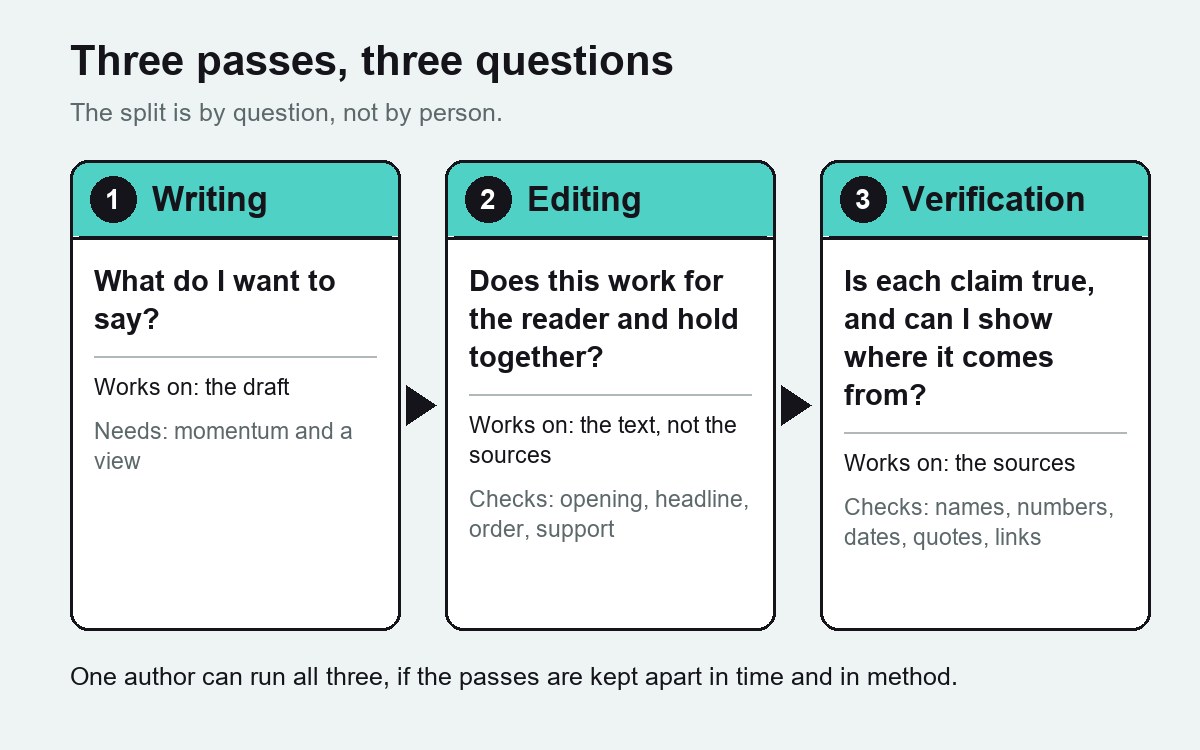
Writing, editing and verification are three different jobs, and the useful split is by question rather than by person. The writer asks "what do I want to say?", the editor asks "does this work for the reader and hold together?", and the verifier asks "is each claim true, and can I show where it comes from?" A single pass trying to answer all three tends to answer the first well and the others loosely. Even a one-person publication can run three passes if it keeps them apart in time and in method.
This article describes the three functions, shows what each catches in a short fictional story, and gives a hand-off sheet for a team or for one author. It is practical, and the pass design is a proposal rather than an industry standard. It makes no claim that separating the passes reduces errors by any measured amount.
The three functions
Writing produces the draft: the structure, the sentences, the choice of what to include. A writer needs momentum and a view. The question is "what is the story?"
Editing judges the draft as a reader would. Is the point in the opening? Is the headline supported by the text? Are the paragraphs in a sensible order? Does the story say anything it cannot support? The editor works on the text, not the sources.
Verification goes back to the evidence. Every name, number, date, quote and link is compared with its source. The verifier does not need to like the draft. The question is "does the page, document or person say what the story says they say?"
Poynter's published ethics guidelines treat editing as an organisational commitment: "We create and edit our journalism in ways aimed at anticipating problem areas, reducing mistakes", and "We apply appropriate scrutiny to work by staff and contributing writers to prevent plagiarism" [1]. The page does not prescribe who does what. It names the purpose, anticipating problems before readers meet them; the idea that the scrutiny should come from someone other than the author, where possible, is this article's reading, not the page's wording.
The Trust Project's "References" indicator asks, for in-depth or controversial stories, whether the journalist "provide[s] sources for each claim" [2]. That is the verification standard in one line: each claim has a place a reader can go to check it.
Why the passes should not be merged
This section is reasoning, not a finding, and it is labelled so. Each function wants a different state of mind, and the three get in each other's way.
- A writer who verifies while writing breaks momentum and tends to verify what they already believe.
- An editor who also verifies tends to treat polished text as checked text. The sentence reads well, so it feels settled.
- A verifier who starts rewriting stops comparing and starts composing, and the check loses its discipline.
The second point is the most common failure: smooth prose is mistaken for supported prose. A separate verification pass, with its own list and sources open beside the text, is the guard.
What each pass catches: a fictional example
The following example is invented. Example Stable is a made-up stablecoin issuer; its attestation, the figures and the errors are fictional and are used to show what each pass finds.
Draft opening, as written:
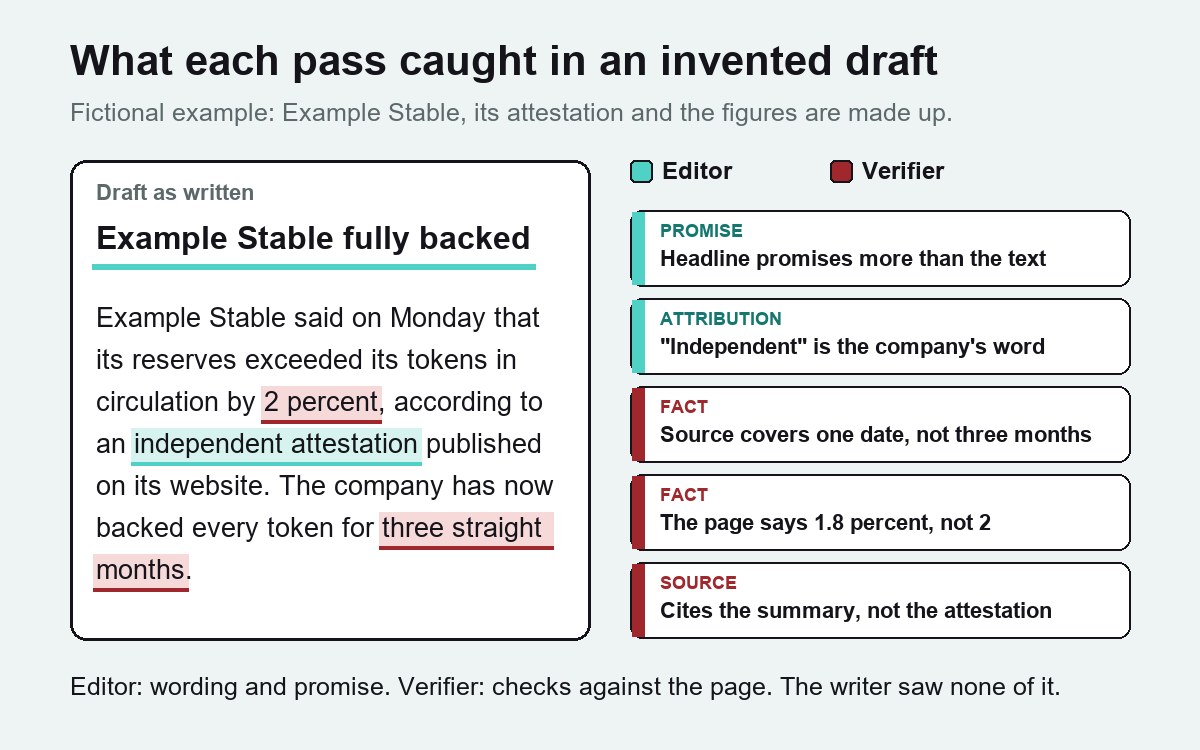
Example Stable said on Monday that its reserves exceeded its tokens in circulation by 2 percent, according to an independent attestation published on its website. The company has now backed every token for three straight months.
Writer's pass produced the draft above. It is clear and short, and the writer believes it.
Editor's pass asks about the reader and the claim:
- "Independent attestation" is the company's word. Is it independent? Who signed it? The editor flags this and marks the phrase for attribution to the company.
- "Has now backed every token for three straight months" is a stronger claim than "exceeded by 2 percent on one date". The editor asks what the source says about the earlier months.
- The headline promised "Example Stable fully backed", which is stronger than the text. The editor proposes a headline that matches what the attestation says.
Verifier's pass opens the attestation and the company's page:
- The attestation covers a single date, not three months. The "three straight months" claim has no source and must go or be reattributed.
- The figure on the page is 1.8 percent, not 2 percent.
- The attestation was published by the firm that prepared it, and the company's page links to a summary. The verifier records which of the two the story should cite.
The error log:
| Pass | Found | Type |
|---|---|---|
| Editor | "Independent" is the company's description | Attribution |
| Editor | Headline stronger than the text | Promise |
| Verifier | "Three straight months" unsupported | Fact |
| Verifier | 2 percent should be 1.8 percent | Fact |
| Verifier | Cites the summary, not the attestation | Source |
The two editor findings are about wording and promise, not about numbers, which is why the editor is not a verifier. The three verifier findings are checks against the page, which is why the verifier is not an editor. Nothing here was visible to the writer, who had read the draft many times.
A one-person publication: three passes in time
If you write, edit and check your own stories, you cannot be a different person, but you can be a different pass. These adjustments make the separation real:
- Put time between passes. Edit after a break, not immediately. How long is your call; the point is that the draft stops feeling like yours.
- Change the medium. Edit from a printout or a different layout, and verify from a list, not from the draft.
- Verify from a claim list. Extract every checkable statement into a separate list (name, figure, date, quote, link), then check each against its source. Do not read the draft top to bottom while checking.
- Find an outside reader for what matters most. For a story with an accusation, a financial claim or a technical explanation, ask someone else to read the draft and the sources. A named reader is better than an anonymous one, and their role should be stated in the article's disclosure.
- Record who did what. A short "How this article was made" block, as at the end of this article, states which steps the author did and which a tool or another person did.
When an AI tool writes the first draft
The Reuters Institute's Digital News Report 2025 notes that over the last year more journalists have used generative AI in newsrooms for research, transcription and suggested headlines or summaries, among other purposes [3]. When an AI tool drafts text, the separation matters more. The tool may be fluent in exactly the way that makes an editor trust a sentence. The practical rule is that a model should not verify its own draft: verification means a human opening the source and comparing it with the text. Google's guidance on helpful content asks whether the use of automation, including AI generation, is self-evident to visitors through disclosures [4], so say in the article what the tool did and what a person checked.
Four mistakes and fixes
1. Verification as proofreading. Reading the draft again for typos is not verification. Fix: use a claim list and compare each claim with its source.
2. The editor who adds facts. An editor inserting a number from memory brings an unverified claim into a checked text. Fix: new facts go back through verification.
3. Verification by the same sources. Checking a company's figure against the company's own summary confirms the summary. Fix: where possible, go to the primary document, and say when the story relies on a party's own statement.
4. A checked story that changes afterwards. An edit after verification, even a small one, may have changed a fact. Fix: lock the verified version; any change to a claim returns to the verifier.
A hand-off sheet to copy
For each story, record on one page:
- Draft by: name or tool, date.
- Edit by: name, date; notes on headline, structure, attribution.
- Claim list: each checkable statement, its source address, whether it was opened, result (confirmed, corrected, removed).
- Verified by: name, date, version checked.
- Open questions: anything the story states as unknown.
- Approved for publication by: the person responsible.
What this article does not settle
It does not show that separation lowers error rates; the cited pages state standards and practice, not measured outcomes. The three-pass design is a proposal, and the example is invented. The Poynter page does not say who should do each function. The Reuters Institute page reports how AI is used, not how well. A very small publication may have only one person; the article describes how to make the passes distinct, not a guarantee that they are independent. Corrections, bylines and conflicts of interest are separate questions.
How this article was made
| Task | What the AI did | What a person did | How it was checked |
|---|---|---|---|
| Research | Gathered candidate sources and drafted notes | Chose the question and which pages to rely on | Every quote checked against the page named in the sources, read on 18 November 2026 |
| Draft | Wrote the first draft from the notes | Edited the text, the example and the hand-off sheet | An independent review compares claims with the sources before publication |
| Images | Generated the cover illustration | Chose and checked it | Labelled as AI-generated in the disclosure line and alt text |
| Not done by AI | — | The decision to publish and responsibility for the text | — |
Conflicts of interest: none. The author has no commercial relationship with the organisations named here.
Responsible for this article: Dmitriy Lastovka, author. Corrections: contact form.
Sources
Labels: policy (a published organisational standard), standard (a published industry framework), report (survey report), guidance (a platform's documentation).
- Poynter, ethics guidelines page. https://www.poynter.org/guidelines-2/ Policy.
- The Trust Project, page listing the Trust Indicators. https://thetrustproject.org/trust-indicators/ Standard.
- Reuters Institute, "Overview and key findings of the 2025 Digital News Report". https://reutersinstitute.politics.ox.ac.uk/digital-news-report/2025/dnr-executive-summary Report; online survey, 48 markets.
- Google Search Central, guidance page on creating helpful content (the "Who, How, Why" section). https://developers.google.com/search/docs/fundamentals/creating-helpful-content Guidance.