
AI tools helped gather research and write the first draft of this article. I edited it and checked every quote and figure against the source page listed at the end, read on 18 November 2026. The cover illustration is AI-generated. Details at the end.
Almost every sentence in a news story belongs to one of three layers. It states something that can be checked, it reports what someone said, or it offers a conclusion the writer drew. The reader should be able to tell which layer they are in without guessing. The simplest working rule is to attach a visible marker to each: a source for the fact, a name and a verb for the quote, and a plain signal such as "this suggests" or a labelled section for the interpretation.
This article describes the three layers, marks up a short fictional story line by line, gives a list of attribution verbs and a template, and covers four mistakes that blur the layers. It is written for people who produce short factual stories on AI, finance, blockchain and games, often alone and often fast. It does not claim to be a complete ethics code.
Why readers need the layers
A story that blends the layers asks the reader to do the sorting. Some will not, and take a company's claim as established or a writer's inference as reported fact. The Trust Project lists "Labels" among its eight Trust Indicators and says stories "should be clearly labeled if they are designed to persuade us to agree" [1]. In the same list, "References" asks whether the journalist "provide[s] sources for each claim" for in-depth or controversial stories [1]. Both are the same idea at two scales: say what kind of statement this is, and show where it comes from.
Google's guidance for creating helpful content points the same way. One of its questions asks whether content presents information in a way that makes you want to trust it, "such as clear sourcing, evidence of the expertise involved" [2]. Clear sourcing is a property of individual sentences, not just of a reference list at the end.
Nielsen's 1997 usability research adds a practical angle. In that study, a version of a page written in objective language scored 27% better on measured usability than the same page in promotional language. The authors' conjecture was that promotional language imposes a burden on users, who must spend effort "filtering out the hyperbole to get at the facts" [3]. A paragraph in which fact and spin are mixed asks for the same filtering. The page is old, does not state the sample size and offers the explanation as a conjecture, so treat it as a pointer to reader effort rather than a settled measurement.
The three layers
Fact. A statement that can be checked against a record, a document, a dataset or a direct observation. "The patch was released on Tuesday." "The network halted for 40 minutes." A fact should have a source the reader can follow, or be something the writer saw themselves. A fact the writer cannot check should not be written as a fact; it becomes a claim attributed to someone.
Quote. What a person or an organisation said, written or published. A quote is a fact about the statement, not about the world. "The studio said the patch fixed the bug" is checkable (they said it), and says nothing yet about whether the bug is fixed. Quotes need three things: who, where or when it was said, and the exact words if they are in quotation marks.
Interpretation. What follows, in the writer's judgement: why something happened, what it means, whether it is good or bad, what will happen next. Interpretation is legitimate and often the most useful part. It becomes a problem when it arrives dressed as a fact.
A fictional story, marked up
The following example is invented. Example Studio is a made-up game developer; its patch, the numbers and the statement are fictional.
Here is a short draft, then the same text with each sentence tagged.
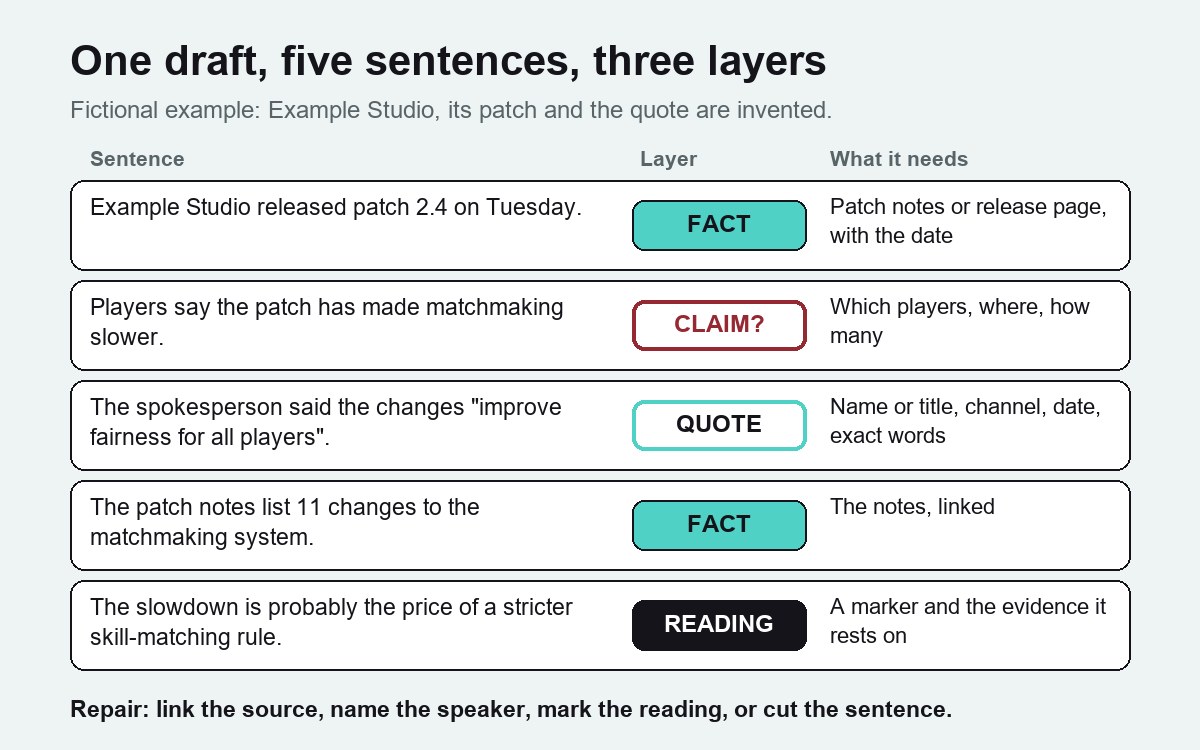
Example Studio released patch 2.4 on Tuesday. Players say the patch has made matchmaking slower. The studio's spokesperson said the changes "improve fairness for all players" and that wait times would settle within a week. The patch notes list 11 changes to the matchmaking system. The slowdown is probably the price of a stricter skill-matching rule, and it will likely hurt the game's player count.
| Sentence | Layer | What it needs |
|---|---|---|
| Example Studio released patch 2.4 on Tuesday. | Fact | The patch notes or the release page, with the date |
| Players say the patch has made matchmaking slower. | Quote or claim, loosely attributed | Which players, where, how many. "Players say" with no source is a claim about an unseen crowd |
| The studio's spokesperson said... | Quote | The name or title, the channel, the date, the exact words in quotation marks |
| The patch notes list 11 changes. | Fact | The notes, linked |
| The slowdown is probably the price of a stricter rule... | Interpretation | A signal that this is the writer's reading, and the evidence it rests on |
Three repairs make the paragraph honest:
- Replace "Players say" with "Posts on the studio's forum report waits of several minutes", only if the writer has read such posts and links them, and say how many were read. If not, drop the sentence or ask the studio.
- Keep the spokesperson's words in quotation marks and attribute them to a named person or office. If the claim that waits "would settle within a week" is a prediction, label it as the studio's expectation.
- Move the last sentence under a marker: "This suggests the slowdown may come from the stricter matching rule described in the patch notes, though the studio has not confirmed this." The claim about the player count has no evidence in the draft and should be removed.
None of this removes the writer's view. It tells the reader which sentences they can check and which they are being asked to consider.
Verbs and attribution
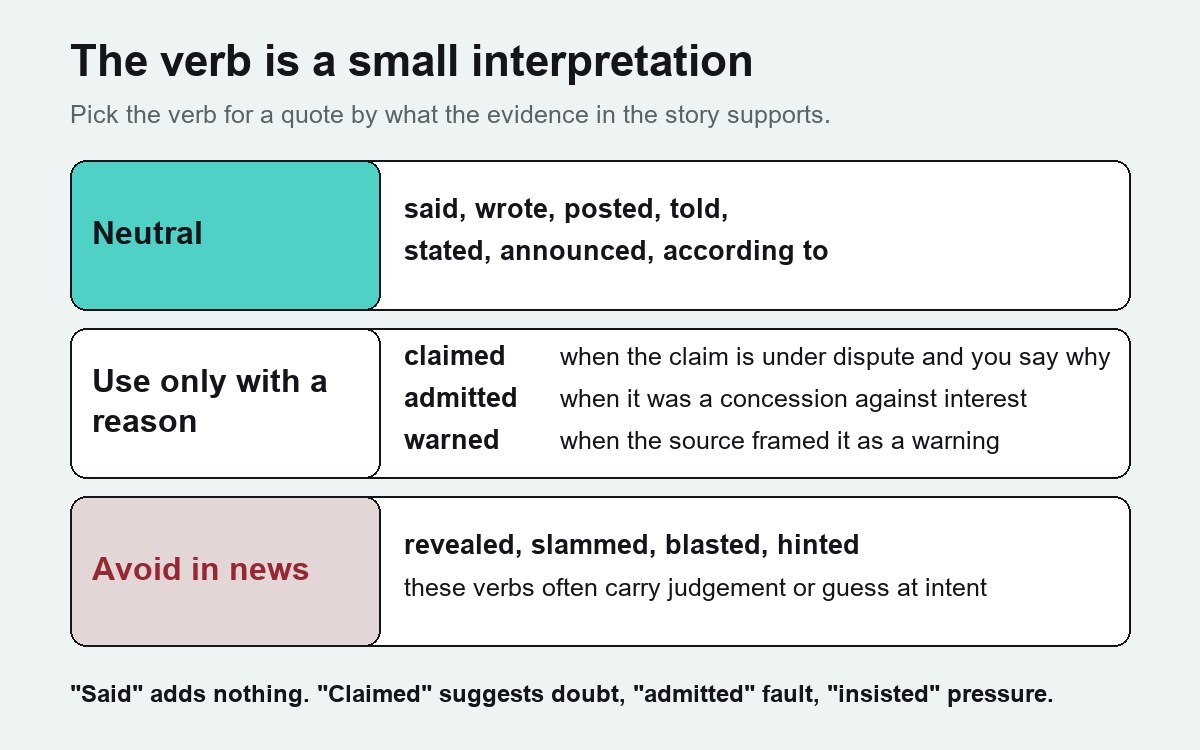
The verb chosen for a quote is itself a small interpretation. Compare "said", "claimed", "admitted" and "insisted". Only the first adds nothing. "Claimed" suggests doubt, "admitted" suggests fault and "insisted" suggests pressure. Use them only when the evidence in the story supports that colouring. A short working list:
- Neutral: said, wrote, posted, told, stated, announced, according to.
- Use only with a reason: claimed (when the claim is under dispute and you say why), admitted (when it was a concession against interest), warned (when the source framed it as a warning).
- Avoid in news: revealed, slammed, blasted, hinted, because these verbs often carry judgement or guess at intent.
Anonymous sources are a separate decision. Schema.org defines an unnamedSourcesPolicy property for news organisations, described as "a statement about policy on use of unnamed sources and the decision process required" [4]. The point for a small publication is not the markup but the idea: decide in advance when an unnamed source is acceptable, who approves it, and how the story tells the reader what is not known about the source. A small publication can adopt the safer default: use named, checkable sources, and treat an unnamed one as an exception that needs a reason.
Four mistakes and their fixes
1. The "fact" that is a claim. "The studio improved fairness" repeats the studio's own description as a fact. Fix: "The studio says the changes improve fairness." Then, if you have data, state what the data shows.
2. The edited quote. Tidying a quotation, even for grammar, changes what the person said. Fix: quote exactly or paraphrase. If a quote is partial, use quotation marks only around the words actually said. Trim only with a clear mark such as an ellipsis, and never so that it changes the meaning.
3. "Sources say". Unattributed claims push the reader to trust the writer without a way to check. Fix: name the source, or state what kind of source it is and why it cannot be named, and who else confirmed it. Do not present one source as several because it was reported several times.
4. Interpretation in the opening. An analytical judgement in the first sentence reads as the headline fact. Fix: open with what happened and who says what; place analysis later under a label, or in a separate piece.
A template to copy
For each paragraph, before publishing, tick one line per sentence:
- F (fact): source linked or observed by the writer; date and unit present.
- Q (quote): speaker named; place or date given; quotation marks only on exact words; verb neutral.
- I (interpretation): marked by wording or placement; evidence stated; not in the headline unless the headline is labelled as analysis.
- ? (unsure): rewrite as an attributed claim, find a source, or cut.
For stories involving an accusation against a named company or person, add a line: R (response), with their reply or a note that one has been requested.
What this article does not cover
It does not give a legal test for defamation or a full code of ethics; those depend on the jurisdiction and on the publication. It says nothing about how many readers actually notice the markers; the cited sources are statements of principle and one old usability study, not measurements of comprehension. The example story is invented, so it shows a method rather than a case. Headline wording, story structure, mobile layout and the handling of updates are separate questions.
How this article was made
| Task | What the AI did | What a person did | How it was checked |
|---|---|---|---|
| Research | Gathered candidate sources and drafted notes | Chose the question and which pages to rely on | Every quote and figure checked against the page named in the sources, read on 18 November 2026 |
| Draft | Wrote the first draft from the notes | Edited the text, the example and the template | An independent review compares claims with the sources before publication |
| Images | Generated the cover illustration | Chose and checked it | Labelled as AI-generated in the disclosure line and alt text |
| Not done by AI | — | The decision to publish and responsibility for the text | — |
Conflicts of interest: none. The author has no commercial relationship with the organisations named here.
Responsible for this article: Dmitriy Lastovka, author. Corrections: contact form.
Sources
Labels: standard (published industry framework), guidance (a platform's published guidance), research (published usability research), schema (a public vocabulary definition).
- The Trust Project, page listing the Trust Indicators. https://thetrustproject.org/trust-indicators/ Standard.
- Google Search Central, guidance page on creating helpful content (the "Expertise questions" list). https://developers.google.com/search/docs/fundamentals/creating-helpful-content Guidance.
- Jakob Nielsen, "How Users Read on the Web", Nielsen Norman Group, 30 September 1997. https://www.nngroup.com/articles/how-users-read-on-the-web/ Research; sample size not stated on the page.
- Schema.org, "NewsMediaOrganization" (property unnamedSourcesPolicy). https://schema.org/NewsMediaOrganization Schema.