
AI tools helped gather research and write the first draft of this article. I edited it and checked every quote and figure against the source page listed at the end, read on 18 November 2026. The cover illustration is AI-generated. Details at the end.
A news story can be built in two broad ways. It can lead with the conclusion and add detail in descending order of importance, or it can build toward the conclusion step by step. Choose by asking one question: what must a reader be able to say if they stop after the first two paragraphs? If the answer is "what happened and what it means for me", lead with the conclusion. If the answer needs context before it makes sense, build the context first, but say in the opening what the story is about and what it will show.
This article explains the two structures, writes one fictional story both ways, gives a short test for choosing, and lists four mistakes that come from choosing by habit. It is a practical guide for people who write short factual stories, whether in an editorial team or alone. It is not a style law, and it does not rank the two structures.
The two structures
The inverted pyramid puts the most important information first. The Nielsen Norman Group describes it as a structure in which "the most important information (or what might even be considered the conclusion) is presented first", and calls it "perfectly suited for the web - on any screen size" [1]. The rest of the story follows in order of decreasing importance: supporting facts, then background, then detail that a reader could skip without losing the point.
An explanatory structure moves the other way for at least part of the piece. It sets the situation, shows the evidence or the sequence of events, and arrives at the conclusion later. Magazine features and long investigations often work like this. It asks more of the reader, because the reward comes after the effort.
The two are not opposites in every paragraph. Most useful stories mix them: a pyramid opening, then an explanatory middle. The choice that matters is what goes first.
Why the opening carries so much weight
Readers do not give every sentence the same attention. In a usability study published by Jakob Nielsen in 1997, 79 percent of test users "always scanned any new page they came across", and only 16 percent read word by word [2]. The page does not state the sample size, and the study is old, so treat the figures as evidence of a habit rather than a precise rate today.
A later Nielsen study of how 232 users looked at web pages described the F-shaped reading pattern: two horizontal sweeps near the top, then a vertical pass down the left edge. Its advice is blunt: "The first two paragraphs must state the most important information" [3]. A related practice is to start subheads, paragraphs and bullet points "with information-carrying words" [3].
The Reuters Institute's Digital News Report 2025 adds a modern detail. The report, which covers 48 markets, says mobile notifications from aggregators, often driven by AI, are now one of the main ways of getting breaking news, especially in mobile-majority countries such as Kenya and India [4]. A notification, a search snippet and a feed preview all show the opening and little else. Whatever structure you choose, the start is what most people see first and sometimes the only part they see.
None of this proves that every story should lead with its conclusion. It shows the cost of hiding the point: a reader who leaves early leaves with nothing.
One story, written two ways
The following example is fictional. Example Chain is an invented blockchain network; its outage, numbers and the quoted statement are made up to show the structures.
Facts available to the writer:
- Block production on Example Chain stopped for 40 minutes on Tuesday.
- Transactions sent during the halt were not confirmed. They were confirmed once the network restarted.
- The foundation that maintains the software said a faulty update caused the halt. It published a fix.
- No funds were lost, according to the foundation.
- This is the second halt of the network this year.
Version A, inverted pyramid:
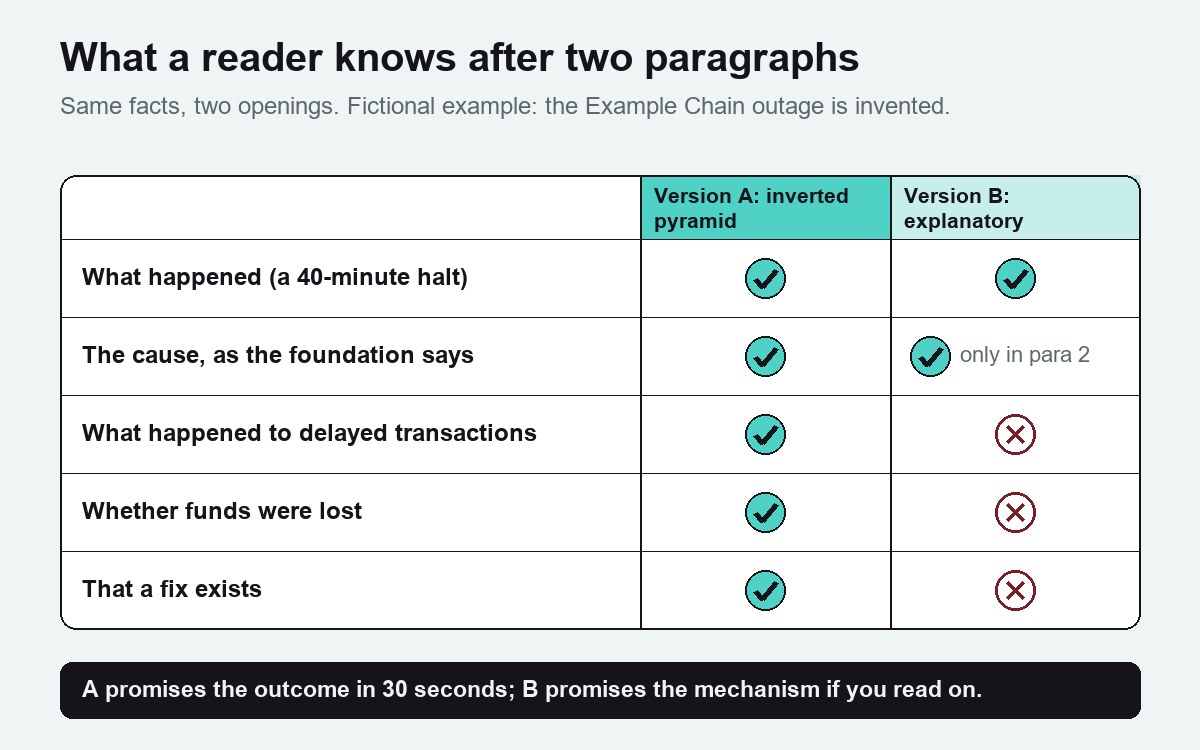
Example Chain stopped producing blocks for 40 minutes on Tuesday after a faulty software update, according to the foundation that maintains it. Transactions sent during the halt were confirmed after the restart, and the foundation says no funds were lost.
The foundation has published a fix. It is the second halt of the network this year.
The reader who stops here knows what happened, what the cause is said to be, what the effect was and that a fix exists.
Version B, explanatory:
Blockchain networks depend on a steady stream of new blocks. When that stream stops, transactions cannot be confirmed. On Tuesday, that happened to Example Chain.
The network paused for 40 minutes. The foundation that maintains it says a faulty update was the cause. Here is what happened to transactions sent during the halt, and what the foundation changed to prevent a repeat.
Version B gives the reader a reason to continue, but a reader who stops after two paragraphs knows less: the cause arrives only in the second paragraph, and nothing is said about the delayed transactions, about funds or about the fix. For a breaking story, B asks the reader to keep going for the answer. It could be the right choice for a different story, for example a piece titled "How a software update stopped a blockchain" published a week later, where the reader came for the explanation.
The facts are the same. What changes is the promise the opening makes. A makes the promise "you will know the outcome in 30 seconds". B makes the promise "you will understand the mechanism if you read on". Both are honest if the rest of the story delivers on them.
A one-question test
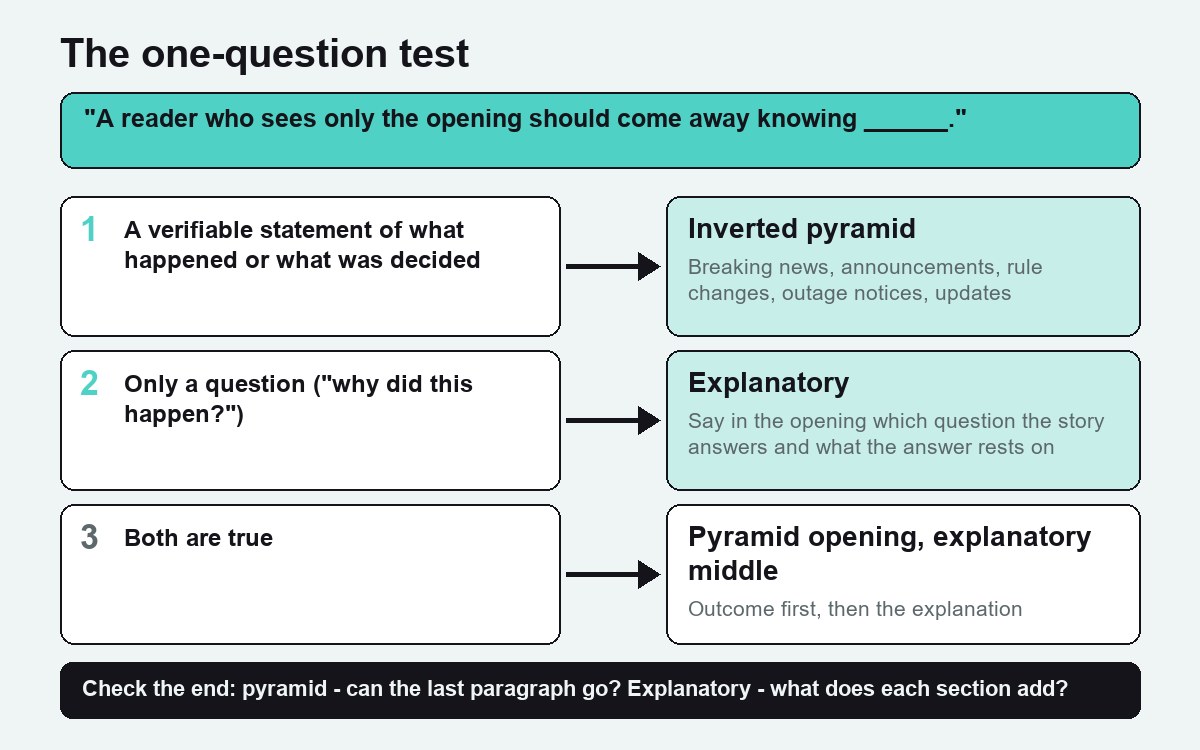
Before writing, finish this sentence: "A reader who sees only the opening should come away knowing ______."
- If the blank can be filled with a verifiable statement of what happened or what was decided, use the inverted pyramid. That includes most breaking news, announcements, rule changes, price or outage notices, and updates to a story already published.
- If the blank can only be filled with a question ("why did this happen?"), the story is explanatory. Say in the opening what question the story answers and what the answer will rest on. Do not delay the reader's orientation, only the conclusion.
- If both are true, write the pyramid opening and make the middle explanatory.
A second check applies to the end. For an inverted pyramid, test the cut: could an editor remove the last paragraph without changing the meaning? If not, something important is buried. For an explanatory story, test the thread: could a reader state what each section adds? If not, the sections are not doing work.
Four mistakes and how to fix them
1. Starting with background because the topic feels big. An opening such as "Blockchain technology has transformed finance" is true of every story in the category and informative about none. Fix: write the opening as the answer to "what is new?" and move the background below it.
2. Putting the conclusion first, then proving something different. A headline or first paragraph promises more than the evidence further down supports. The structure is not at fault; the promise is. Fix: write the opening last, after the facts are checked, and compare each word with what the sources say. Use "according to" when the source is a party to the event, as with the foundation in the example.
3. Using the pyramid for a story that needs a sequence. A story about how an exploit worked or how a game's economy broke has steps that depend on each other. Putting the last step first can confuse. Fix: open with a one-sentence summary and then tell the steps in order.
4. Ending an explanatory story without a conclusion. The reader who made the effort needs a landing. Fix: finish with what the evidence supports and what it does not.
A template to copy
For a fast factual story:
- Opening, one or two sentences. What happened, who says so, and what it changes for the reader.
- Second paragraph. The most important qualification or the number the opening could not carry.
- Body, in descending importance. Each paragraph should be understandable without the one before it.
- Context. What led up to it, clearly set apart from what is new.
- What is not yet known. One short paragraph, if the story is still developing.
For an explanatory story:
- Opening. The question and what the answer will rest on.
- Situation. The minimum background needed.
- Evidence in order. Each step labelled by what it adds.
- Conclusion. What follows, and its limits.
What this article does not settle
It does not prove that one structure produces more reading or trust in general. The cited studies are about web reading habits and usability, not about news structure and comprehension of facts, and the 1997 and 2006 studies are old. The Reuters Institute data describes how people reach news, not how they read it. The Example Chain story is invented. The article also does not cover headlines, quotes, mobile layout or updates; those are separate questions with their own checks.
How this article was made
| Task | What the AI did | What a person did | How it was checked |
|---|---|---|---|
| Research | Gathered candidate sources and drafted notes | Chose the question and which pages to rely on | Every quote and figure checked against the page named in the sources, read on 18 November 2026 |
| Draft | Wrote the first draft from the notes | Edited the text, the example and the test | An independent review compares claims with the sources before publication |
| Images | Generated the cover illustration | Chose and checked it | Labelled as AI-generated in the disclosure line and alt text |
| Not done by AI | — | The decision to publish and responsibility for the text | — |
Conflicts of interest: none. The author has no commercial relationship with the organisations named here.
Responsible for this article: Dmitriy Lastovka, author. Corrections: contact form.
Sources
Labels: research (published usability research), report (survey report), explainer (published guidance from a research firm).
- Amy Schade, "Inverted Pyramid: Writing for Comprehension", Nielsen Norman Group, 11 February 2018. https://www.nngroup.com/articles/inverted-pyramid/ Explainer.
- Jakob Nielsen, "How Users Read on the Web", Nielsen Norman Group, 30 September 1997. https://www.nngroup.com/articles/how-users-read-on-the-web/ Research; sample size not stated on the page.
- Jakob Nielsen, "F-Shaped Pattern For Reading Web Content (Original Study)", Nielsen Norman Group, 16 April 2006. https://www.nngroup.com/articles/f-shaped-pattern-reading-web-content-discovered/ Research; 232 users.
- Reuters Institute, "Overview and key findings of the 2025 Digital News Report". https://reutersinstitute.politics.ox.ac.uk/digital-news-report/2025/dnr-executive-summary Report; survey data from 48 markets.