
AI tools helped gather research and write the first draft of this article. I edited it and checked every quote against the source page listed at the end, read on 18 November 2026. The cover illustration is AI-generated. Details at the end.
A large investigation produces more material than one article can carry. You have a pile of documents, a dataset, a dozen interviews and a conclusion. Put it all into one piece and many readers will not reach the end. Cut it down and you throw away evidence that could have anchored a second story.
A large investigation turns into standalone articles when each article answers one question a reader could ask, carries enough context to be read alone, and draws on one shared, checked set of facts. This article gives six steps, a shared-facts sheet to copy, rules for keeping the series consistent, and a look at how a well-known investigation presents its separate stories. It is the last part of the block on research and the form of an evidence-based answer, after parts on reporting, interviews, timelines, live blogs and datasets, and it stands alone. The next block moves to choosing the structure of a news story.
What the split is for
The point of splitting is not to publish more. It is that different readers arrive with different questions. A reader who wants to know whether a company named in the documents did something wrong, a reader who wants the method and a reader who wants the overview are not served by one long text.
A real example is the International Consortium of Investigative Journalists' Panama Papers page. It describes a "giant leak of more than 11.5 million financial and legal records" [1]. The page does not present one long article. It lists separate pieces, each with its own headline, author and date. On 3 April 2016 it carried an overview, "Giant Leak of Offshore Financial Records Exposes Global Array of Crime and Corruption", by ICIJ; a piece on the Panamanian law firm at the centre of the records, "Panamanian Law Firm Is Gatekeeper To Vast Flow of Murky Offshore Secrets"; a piece on a money network linked to Russia's president, "All Putin's Men: Secret Records Reveal Money Network Tied to Russian Leader"; and a piece on Iceland's prime minister. On 4 April came "Global Banks Team with Law Firms To Help the Wealthy Hide Assets", summarised on the page as showing that hundreds of banks and their subsidiaries and branches registered nearly 15,600 shell companies; and another on companies and people blacklisted by US authorities. On 7 April came "The Art of Secrecy", about the art world. The page also carried a later piece, dated 2 April 2026, looking back ten years after the investigation [1].
What the structure shows is a pattern, not a recipe: one body of evidence, several questions, each in its own article with its own byline and date. I read the page, not the underlying stories, so I do not describe how those articles were built or checked.
Step 1: write the evidence inventory first
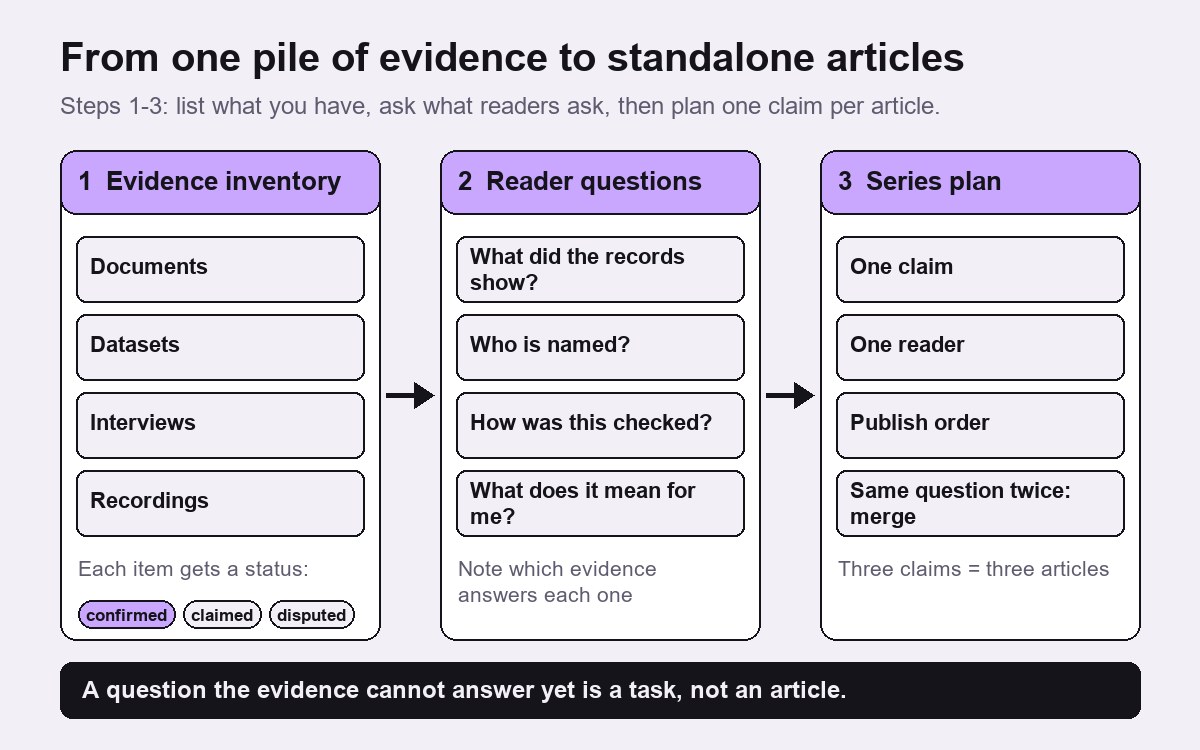
Before you plan articles, list what you have, in plain terms: documents, datasets, interviews, recordings, with their source, how you got them, what you have verified and what you have not. Mark each item's status the way the timeline article marked entries: confirmed, claimed or disputed.
This inventory is the shared base. Every article in the series will draw on it, and none should rely on something not in it.
Step 2: list the reader questions the evidence can answer
Write each question as a reader would ask it. "What did the leaked records show about banks?" "Who is named, and what do the documents say about them?" "How was this checked?" "What does this mean for me?"
For each question, note which evidence answers it and which does not. A question the evidence cannot answer yet is not an article; it is a task, or an open question to state honestly.
Step 3: give each article one claim and one reader
Choose the questions that deserve their own article. For each, write one sentence: the claim the article will make, and the reader it is for. If an article needs three claims, it is three articles, or one article with a weak spine.
Check the overlap. If two articles would answer the same question for the same reader, merge them. If an article would only make sense after reading another, it is not standalone; it is a chapter.
Step 4: make each article standalone, and link them logically
Each piece needs a short paragraph of context, so a reader who arrives from a search can follow it without reading the rest. Then link to the related articles at the point where a reader would want them, such as "the method is described here", not in a list at the bottom that nobody uses.
Repeat only what is necessary. The context paragraph should be rewritten for each piece, not pasted, so that it fits that article's claim.
Step 5: share facts, methods and caveats across the series
The risk of a series is inconsistency: a figure that is 15,600 in one article and 15,000 in another, a name spelled two ways, a caveat in one piece and not in the next.
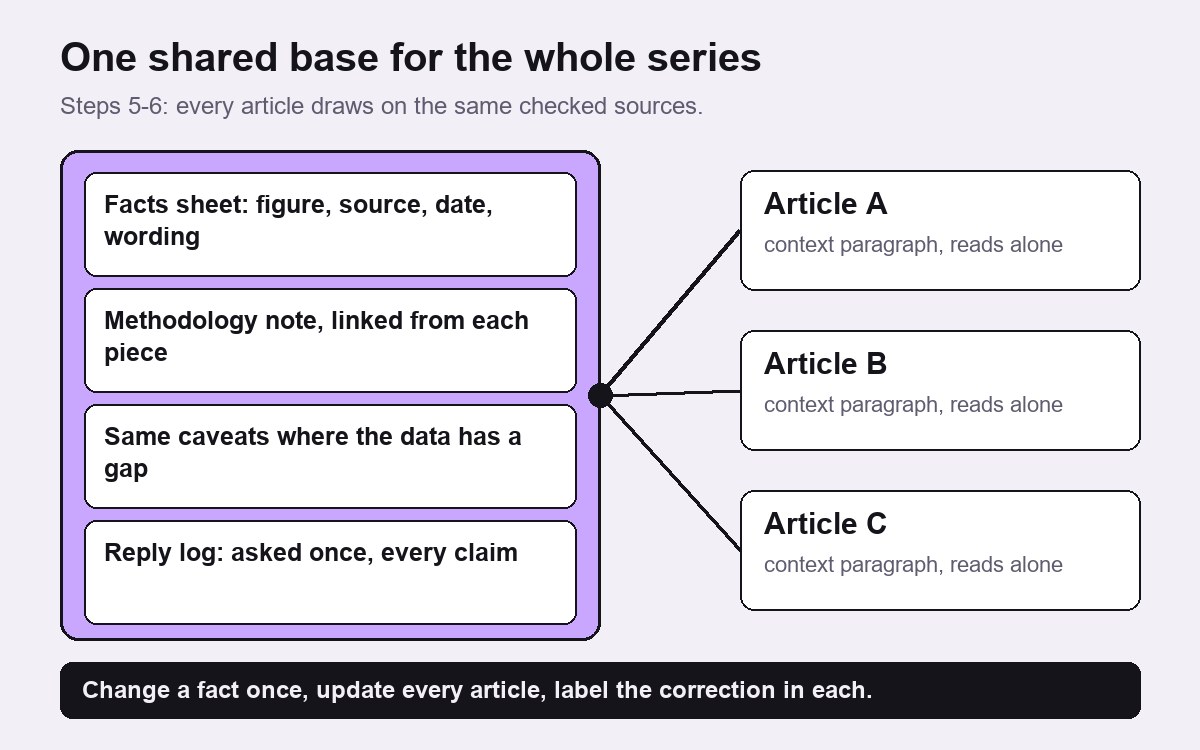
- One facts sheet. Keep a single list of the facts used across the series: the figure, its source, the date it was checked, and the wording you will use. Every article draws from it. Change it once, and update every article.
- One methodology note. The AP's rule for lengthy stories is that "attribution can be contained in an extended editor's note detailing interviews, research and methodology" [2]. In a series, write that note once and link it from each article, so the method is stated in full and the articles stay readable.
- The same caveats. If the data has a known gap, every article that relies on it carries the caveat.
Step 6: handle replies, corrections and publication order together
Right of reply. The AP says it must "make significant efforts to reach anyone who may be portrayed in a negative way in our content", and must give them "a reasonable amount of time to get back to us" [2]. The IPSO Editors' Code, a UK press code, says in its accuracy clause, which covers replies to inaccuracies, "a fair opportunity to reply to significant inaccuracies should be given, when reasonably called for" [3]. In a series, the same person can be named in several articles. Ask once, in writing, covering every claim that concerns them, and record the answer. If they reply after the first article is out, update the others.
Corrections. An error in the facts sheet is an error in every article that used it. Fix the sheet, fix the articles, and say so in each. The AP's rule that a correction "must always be labeled a correction" applies to each piece [2].
Order. Decide what comes first. An overview that states the main finding and names the series gives each later piece somewhere to point. Do not publish a detail piece that relies on a claim the reader has not seen supported.
A worked example (invented)
The example below is invented to show the method. The investigation, the data and the series are made up.
Suppose you have spent three months on a fictional marketplace, Example Market, and its sellers' reviews. You hold a dataset of two million reviews, forty seller interviews, and a set of the marketplace's public policy pages.
Inventory. The dataset was downloaded on a given date and checked for duplicates and blanks; the interviews are first-hand accounts, marked as claims; the policy pages are archived with dates.
Questions. "How many reviews look duplicated or copied?" "What did sellers say happened when they complained?" "What does the marketplace's policy say it does about fake reviews?" "How did you measure this?"
Series plan.
- Article A, for general readers: the main finding on duplicated reviews, stated with its caveat, linking the others.
- Article B, for sellers: what forty sellers described, labelled as their accounts, with the marketplace's reply.
- Article C, for people who check: how the duplication was measured, with the method log and limits.
- A short methods note, linked from all three.
Shared facts. One sheet: the number of reviews analysed, the number flagged, the rule used to flag them, the date checked, the wording "flagged as duplicated by this method", not "fake". Every article uses that wording.
Reply. You send the marketplace one written list of every claim about it, with a deadline, once. Its answer appears in A and B. If it answers late, you update both and say so.
Note the checks. Each article has one claim and one reader. Each can be read alone. None states more than the sheet supports.
Common mistakes, and fixes
Splitting by length, not by question. Cutting a long text in three equal parts. Fix: split by reader question.
Articles that only work together. Fix: add a context paragraph and a clear claim to each.
Numbers that drift. Fix: one facts sheet; change it once, update everywhere.
Different replies for the same person. Fix: ask once, covering everything, and reuse the answer.
Method buried or repeated. Fix: one methodology note, linked from each article.
A template to copy
Evidence inventory (item | source | how obtained | status: confirmed / claimed / disputed): Reader questions (question | evidence that answers it | gap): Series plan (article | one claim | one reader | publish order): Shared facts sheet (fact | source | date checked | exact wording): Methodology note: where it lives, which articles link it Right of reply: who, what claims, asked when, answer or no answer Corrections: who updates the sheet and the articles
What this article cannot tell you
It does not describe how any real investigation was run internally. I read the ICIJ Panama Papers page as a published list of stories, and I did not read the stories themselves, so I say nothing about their quality or how they were checked. I also did not use claims I saw elsewhere about how long investigations take, what they cost or a fixed number of steps, because I could not verify them. Replying to people named, and legal exposure, depend on your jurisdiction and need advice for your situation. The AP and IPSO rules are written for their own newsrooms and are not universal. The marketplace in the worked example is invented, and nothing in it is a statement about a real company. I ran no investigation for this article; it describes a method and cites sources.
How this article was made
| Task | What the AI did | What a person did | How it was checked |
|---|---|---|---|
| Research | Gathered candidate standards and an example page and drafted notes | Chose the question and which sources to rely on | Every quote and title checked against the page named in the sources, read on 18 November 2026 |
| Draft | Wrote the first draft from the notes | Edited the text, the template and the invented example | An independent review compares claims with the sources before publication |
| Images | Generated the cover illustration; diagrams built in code | Chose the illustration and checked the diagrams | Labelled as AI-generated in the disclosure line and alt text |
| Not done by AI | — | The decision to publish and responsibility for the text | — |
Conflicts of interest: none. The author has no commercial relationship with any organisation named here.
Responsible for this article: Dmitriy Lastovka, author. Corrections: contact form.
Sources
Labels: journalism (a published investigation page), standard (published editorial rules).
- ICIJ, "The Panama Papers: Exposing the Rogue Offshore Finance Industry" (investigation page, with its list of stories). https://www.icij.org/investigations/panama-papers/ Journalism (page read, stories not).
- The Associated Press, News Values and Principles: "Telling the Story" (attribution notes, responses, corrections). https://www.ap.org/about/news-values-and-principles/telling-the-story/ Standard.
- IPSO, "The Editors' Code of Practice", clause 1 (Accuracy). https://www.ipso.co.uk/editors-code-of-practice/ Standard (UK press).