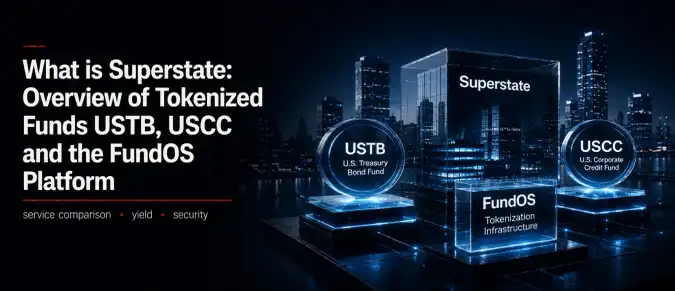

Superstate is a U.S.-based financial technology company developing infrastructure for bringing regulated investment funds and securities onto public blockchains. One of the project's main areas of focus is its tokenized funds, USTB and USCC, whose shares can exist either as traditional book-entry records or as onchain assets across Ethereum, Solana, and Plume. Unlike crypto protocols that issue synthetic tokens, Superstate works with legally structured investment products and uses blockchain as an additional layer for recording ownership, transferring shares, and enabling onchain utility. In 2026, the company also opened its FundOS technology to third-party asset managers, expanding its model from proprietary funds into a broader tokenization infrastructure platform.
Contents
- What Is Superstate and How Fund Tokenization Works
- USTB and USCC Tokenized Funds: Structure and Differences
- FundOS, Ethereum, Solana, and Plume: Superstate Infrastructure
- Features, DeFi Integrations, and Risks of Tokenized Funds
- Superstate and the Development of Tokenized Securities

1. What Is Superstate and How Fund Tokenization Works
Superstate was founded by Robert Leshner, who previously created the Compound DeFi protocol. The company has taken a different approach to connecting traditional finance with blockchain: instead of issuing decentralized synthetic assets, it builds infrastructure for regulated securities that can be recorded and transferred through public blockchain networks.
At the center of this model is Superstate Services, a registered transfer agent. It maintains shareholder records and connects the traditional securities ownership system with investors' blockchain addresses. As a result, a fund share can exist in conventional book-entry form or be represented as a token on a supported network without creating a separate economic asset.
Access to these instruments differs from purchasing a freely transferable crypto token. Investors must complete identity verification and satisfy the eligibility requirements of the relevant fund. Once approved, their wallet is added to an allowlist, enabling them to receive, hold, and transfer tokenized shares within the permitted infrastructure.
Blockchain is primarily used in this architecture as a new settlement and operational layer. It can support stablecoin payments, faster transfers of shares between approved addresses, and connections between regulated assets and compatible DeFi protocols. Portfolio management, custody, and the legal structure of the fund, however, remain connected to traditional financial infrastructure.
2. USTB and USCC Tokenized Funds: Structure and Differences
Superstate's first major product was USTB, which focuses on short-term U.S. government securities. In 2026, the product is presented as the Invesco Short Duration US Government Securities Fund. Its portfolio primarily consists of short-term U.S. Treasury bills, while fund shares can be held either through traditional book-entry records or on supported blockchains.
USTB is designed for investors seeking an onchain instrument with returns linked to short-term government securities. Unlike a conventional stablecoin, the value of a fund share does not have to remain fixed at one dollar. Portfolio income is reflected in the investment instrument's value, while actual returns change with interest rates, portfolio composition, fees, and other factors.
| Component | Purpose | Primary Role |
|---|---|---|
| USTB | Tokenized fund | Exposure to short-term U.S. government securities |
| USCC | Crypto carry fund | Strategies involving crypto assets, staking, basis trades, and government securities |
| FundOS | Tokenization infrastructure | Bringing private funds, mutual funds, and ETFs onchain |
| Superstate Allowlist | Compliance infrastructure | Controls eligible investors and approved wallets |
| Stablecoins | Settlement instrument | Subscription and redemption of shares using supported digital currencies |
| DeFi Integrations | Onchain functionality | Use of fund shares within compatible financial protocols |
The second major product is USCC, which in 2026 was renamed the Bitwise Crypto Carry Fund. Its strategy differs significantly from USTB. The fund uses crypto assets, staking, government securities, and derivatives positions to implement strategies that include crypto basis and carry trades. As a result, USCC has a more complex risk profile than a short-term Treasury fund.
USCC is also available in tokenized form and can be used within supported DeFi protocols. Superstate therefore demonstrates how the same infrastructure can support different categories of investment strategies, ranging from relatively conservative government securities to funds operating across cryptocurrency and derivatives markets.
3. FundOS, Ethereum, Solana, and Plume: Superstate Infrastructure
Superstate's tokenized funds were initially focused primarily on Ethereum. In July 2025, the company began its multichain expansion by adding Solana and Plume. As a result, investors gained the ability to hold supported USTB and USCC shares across multiple blockchains or continue using the traditional book-entry format.
The multichain model is relevant to tokenized funds because different networks have their own liquidity markets and DeFi ecosystems. Ethereum has an established lending and RWA infrastructure, Solana focuses on high throughput and low latency, while Plume specializes in infrastructure for real-world assets. Expanding a fund to another network, however, does not remove compliance requirements.
In April 2026, Superstate introduced FundOS, an infrastructure platform based on the technology used for USTB and USCC. It is designed for asset managers seeking to tokenize existing or new private funds, mutual funds, and ETFs without completely replacing their administrators, custodians, and other service providers.
FundOS connects traditional fund operations with blockchain through a portal, APIs, and operational workflows. Asset managers can select supported networks, determine permitted DeFi integrations, and use USD or USDC for settlement. Superstate provides the shareholder registry infrastructure and controls the movement of tokenized shares between authorized participants.

4. Features, DeFi Integrations, and Risks of Tokenized Funds
A key difference between Superstate and conventional fund digitization is the ability to use fund shares directly within an onchain environment. A tokenized security can be held in an approved wallet, transferred between eligible participants, and interact with integrated applications. At the same time, the transfer agent continues to track the actual registered owners.
For example, tokenized USCC shares are supported by selected DeFi lending protocols. This makes it possible to use a regulated fund as a financial instrument within blockchain markets when the relevant integration and investor eligibility rules permit it. This type of composability is one of the main differences between a tokenized fund and a traditional share held exclusively within a closed recordkeeping system.
Key Features of Superstate:
- tokenization of regulated investment funds;
- USTB providing exposure to short-term U.S. government securities;
- USCC using crypto carry, staking, and basis-trading strategies;
- support for Ethereum, Solana, and Plume for selected products;
- the option to maintain shares through traditional book-entry records;
- an allowlist model for verified investors and wallets;
- support for USDC and traditional banking settlement;
- integration of tokenized shares with supported DeFi protocols;
- FundOS infrastructure for third-party asset managers;
- registered transfer agent infrastructure for shareholder recordkeeping.
Tokenization does not eliminate the investment risks of the underlying fund. USTB remains exposed to interest rates and the value and liquidity of government securities, while USCC additionally faces risks associated with cryptocurrencies, derivatives, staking, and counterparties. Returns on these instruments are variable and should not be interpreted as guaranteed yields.
Technology introduces additional risks as well. Smart contracts, public blockchains, wallets, and DeFi protocols create interaction points that do not exist with traditional book-entry shares. Allowlisting and a regulated structure can limit some risks associated with unrestricted token transfers, but they do not eliminate technical failures, integration errors, or changes in regulatory requirements.
5. Superstate and the Development of Tokenized Securities
Superstate is developing amid rapid growth in the Real World Assets sector. Tokenized Treasury instruments became one of the earliest institutional RWA use cases because they connect returns from traditional money markets with stablecoin and DeFi infrastructure. Superstate extends this concept by treating blockchain as a general-purpose operational layer for multiple categories of regulated investment funds.
An important milestone was the transformation of the company's proprietary infrastructure into FundOS. While USTB and USCC demonstrated the technology through specific investment products, FundOS enables other asset managers to use a similar architecture. By 2026, Superstate's platform manages more than $1 billion across USTB and USCC combined, illustrating the transition of tokenized funds from small pilot programs toward larger institutional infrastructure.
The company is also expanding beyond investment funds. Its Opening Bell platform is designed to tokenize publicly traded shares directly with the participation of issuers and a registered transfer agent. Under this model, a token represents an official share of the company rather than a third-party synthetic or wrapped instrument. Superstate's fund infrastructure is therefore gradually becoming part of a broader system for onchain capital markets.
Superstate represents a tokenization model in which public blockchains do not replace traditional regulation but instead provide an additional layer for recordkeeping, transfers, settlement, and financial utility. USTB and USCC demonstrate how this architecture can support funds with different investment strategies, while FundOS extends the technology to third-party asset managers. The project's future development will depend on institutional demand, the number of integrated funds, DeFi adoption, regulatory conditions, and the ability of tokenized securities to establish sustainable liquidity within the onchain economy.











