

In the rapidly evolving world of decentralized finance, the emergence of new efficient solutions opens up unique opportunities. Surf Protocol is an advanced decentralized platform for trading perpetual contracts, aiming to become the most convenient and fair venue in its segment. This project attracts attention thanks to its innovative flexible fee model and an unprecedentedly high level of leverage on key assets. At the heart of its operation lies the desire to provide users with transparent, fast, and capital-efficient tools for earning in the cryptocurrency derivatives market.
Contents:
- What is Surf Protocol?
- Key Trading Features of the Platform
- Innovative Fee Model
- Technical Implementation of Surf Protocol and Security
- Significance of the Project for Decentralized Finance
- Conclusion
What is Surf Protocol?
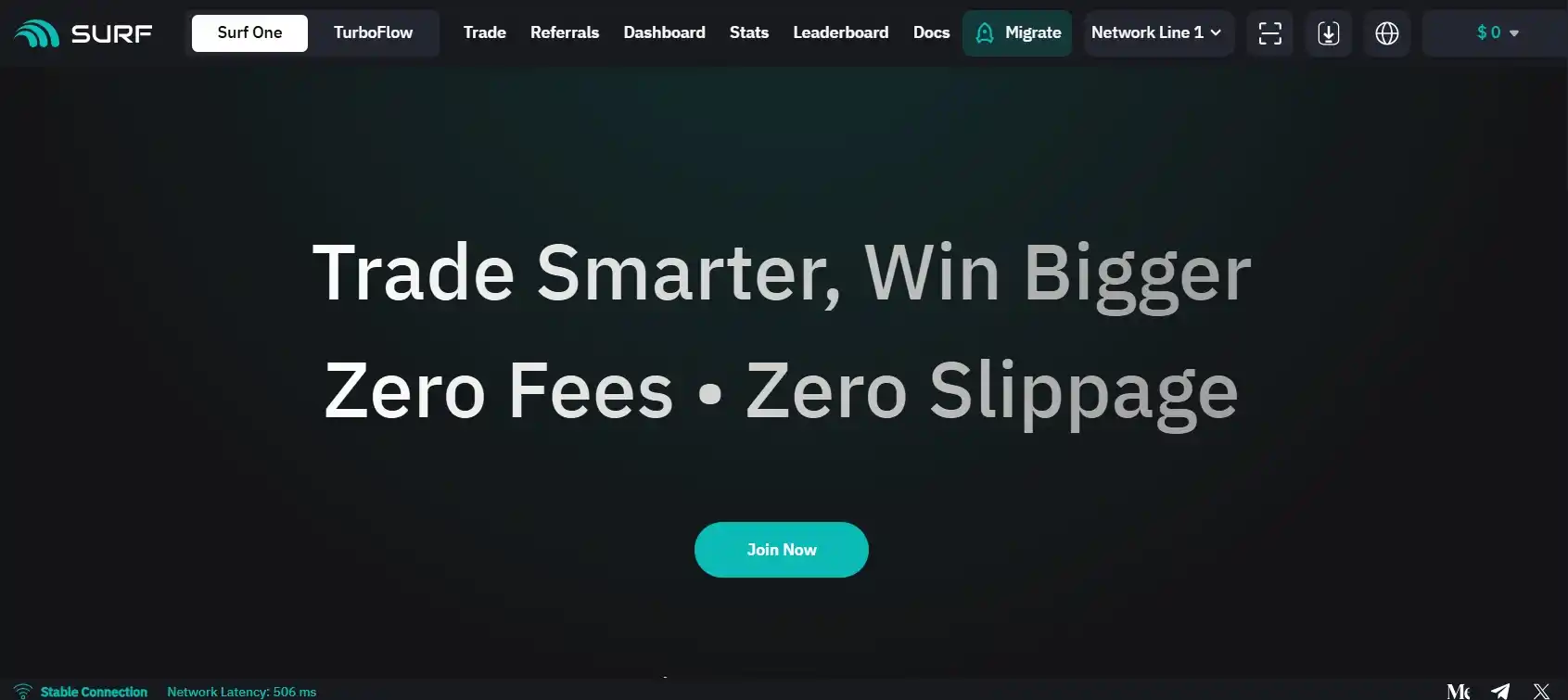
Surf Protocol is a fully decentralized exchange specializing in trading perpetual contracts. The platform is built on its own Surf Chain blockchain infrastructure, ensuring high speed and reliability of trade execution. The main goal of the project is to create the most honest and transparent trading venue for cryptocurrency derivatives, free from the drawbacks of traditional centralized exchanges. The protocol offers users full control over their assets and advanced financial instruments for implementing various trading strategies.
The project positions itself as the most trader-oriented, striving to provide instant order execution and the highest probability of successful trades among all existing platforms. The decentralized architecture eliminates the need to trust funds to intermediaries, as all operations are governed by the open and verifiable code of smart contracts. This creates a fundamentally new trading environment with an increased level of trust and efficiency.
Key Trading Features of the Platform
One of the most outstanding characteristics of Surf Protocol is the provision of the ability to use ultra-high leverage — up to 1000 times for major cryptocurrency assets. This allows market participants to open significant positions with relatively small initial capital, significantly increasing the potential profitability of operations. Such flexibility provides traders with a powerful tool for risk management and strategy optimization.
An important advantage is the execution of trades at the oracle price without slippage, provided the position size is within the established trading limits. This guarantees that users receive exactly the price they see at the moment of making the deal, making the process more predictable and controllable. The combination of high leverage, absence of slippage, and instant execution forms a unique trading proposition that distinguishes the protocol from its analogues in the DeFi space.
Innovative Fee Model
Surf Protocol offers users a choice between the traditional fee model and a unique profit-sharing fee model (Profit-Sharing Fee Model). This innovative system allows for a complete waiver of upfront fees and slippage. Under this model, costs are charged only in the case of a successful trade, which favorably distinguishes the platform from its competitors.
The principle of this system is simple and transparent:
- When opening a position no fee is charged, and the trade is executed strictly at the market price provided by the oracle.
- If a position is closed with a profit, a specific, pre-agreed portion of that profit is distributed to the protocol.
- If the trade is unprofitable, the user does not pay any additional commissions, apart from the incurred market losses.
This cost structure is continuously monitored and adjusted to maintain balance and fairness, and the estimated probability of a trader's success tends towards a 50/50 indicator. This approach creates unprecedentedly comfortable conditions for trading, minimizing costs during periods of failure.
Technical Implementation of Surf Protocol and Security
The stable operation of Surf Protocol is ensured by a reliable and specialized technical architecture. Key processes, including trade execution and risk management, are automated and function based on open-source code, guaranteeing transparency and security for all participants. The following table demonstrates how the main system components interact to achieve this goal:
| System Component | Functional Role | User Advantage |
|---|---|---|
| Surf Chain | The foundational blockchain for executing transactions and running the platform's smart contracts. | High speed, low transaction cost, predictability. |
| Smart Contracts | Automated logic for managing positions, leverage, liquidations, and fees. | Full transparency, no intermediaries, automatic rule enforcement. |
| Price Oracles | External source of reliable market data used for calculations and trade execution. | Accurate execution at the expected price, protection against manipulation, fair determination of liquidations. |
| Fee Model | Programmable logic for selecting and calculating costs, including the profit-sharing model. | Flexibility, reduced costs during losses, alignment of trader and protocol interests. |
The use of its own Surf Chain blockchain infrastructure allows for network optimization for high-frequency operations, ensuring the necessary performance. Together, these elements form a stable environment in which risks associated with human factors or a single point of failure are minimized.
Significance of the Project for Decentralized Finance
The emergence of Surf Protocol marks an important stage in the evolution of decentralized finance, expanding the boundaries of what is possible in the segment of complex derivatives. The protocol does not merely copy the functionality of centralized exchanges but rethinks it by adding principles of transparency, self-sufficiency, and user orientation. This encourages new participants to join DeFi, offering them professional tools without compromising security.
Integration into the broader blockchain ecosystem through its own Surf Chain and external oracles makes the protocol an important infrastructure link. It demonstrates how specialized blockchains can effectively solve specific tasks — in this case, high-speed leveraged trading. The development of such projects strengthens the entire industry, creating more mature, complex, and interconnected financial markets based on distributed ledgers.
Conclusion
Surf Protocol represents a bold and technologically advanced response to the growing demand for decentralized trading platforms. By combining record leverage, an innovative fee model, and execution at the oracle price, the project sets new standards in the DeFi derivatives sphere. Its architecture, built around its own blockchain Surf Chain, provides the necessary performance and security for such a complex financial product.
The significance of this protocol extends beyond just another trading venue. It embodies the principles of the next generation of DeFi, where user experience, capital efficiency, and absolute transparency become the main priorities. Surf Protocol not only provides powerful tools for experienced traders but also makes a significant contribution to the development of a more sustainable, accessible, and innovative decentralized financial ecosystem.











