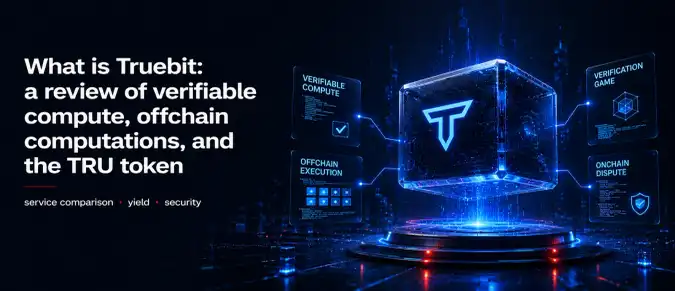

Truebit is a blockchain infrastructure project for verifiable computation, designed to execute complex tasks outside the main chain while allowing the resulting output to be independently verified. The protocol was originally developed to extend Ethereum’s computational capabilities through an interactive verification system known as the Verification Game. The modern Truebit Verify platform expands this concept by combining distributed code execution, external API access, WebAssembly, and cryptographically verifiable execution records. This approach is relevant for applications that need to use external data and computation without moving all logic directly into smart contracts.
Contents
- What Is Truebit and Why Does Blockchain Need Verifiable Computation?
- How Truebit Verify and the Verification Game Work
- Truebit Compared with Other Offchain Computing Technologies
- Core Features, TRU Token, and Use Cases
- Risks and Prospects of Truebit in Web3 Infrastructure

1. What Is Truebit and Why Does Blockchain Need Verifiable Computation?
Truebit emerged as a response to one of the fundamental limitations of blockchains: every network node must be able to verify computational results. This model supports consensus, but it limits the complexity of programs that are economically practical to execute directly on Ethereum. The more computationally intensive an operation becomes, the more resources it requires and the more expensive it is to process on-chain.
The original Truebit research model, developed by Jason Teutsch and Christian Reitwiessner, proposed moving resource-intensive computation outside the main blockchain. Instead of requiring every node to repeat a complex task, external participants perform the computation while the blockchain is used to resolve disputed results and record proofs.
The key concept was the Verification Game, an interactive dispute resolution mechanism between the participant submitting a result and another participant challenging it. If a result is disputed, the computation is progressively divided into smaller segments until the system identifies the specific step where the discrepancy occurred. This makes it possible to verify a large computation without reproducing the entire process inside a smart contract.
Modern Truebit has expanded beyond its original role as an Ethereum scaling solution. The Truebit Verify platform focuses on verifiable offchain processes, including program execution, API access, data processing, and coordination between blockchains and external systems. Truebit on Ethereum remains available, while current development places greater emphasis on the newer Verify architecture.
2. How Truebit Verify and the Verification Game Work
The Truebit Verify architecture includes the Truebit Verify Hub and a network of Verify Nodes. The Hub acts as the coordination layer: it receives tasks, distributes them among compute nodes, compares results, and maintains the execution history. The nodes execute and verify program code, creating a distributed computation layer.
In a standard scenario, multiple Verify Nodes independently execute the same task. If their results match, the system can quickly return a verified output. If different results are submitted, an additional verification process is triggered to identify the source of the discrepancy at the level of individual computation steps.
Truebit uses an isolated WebAssembly-based execution environment. Developers can create tasks using TypeScript, JavaScript, Python, Rust, or C++, after which the code runs in a standardized environment. This allows business logic to remain independent from a specific blockchain and gives developers access to more familiar programming tools than smart contract languages alone.
Each execution can be accompanied by a Certified Transcript, a cryptographically verifiable record containing information about the input data, code, events, and final output. Hashes of these records can be anchored to a public blockchain, creating an auditable trail of operations performed outside the main chain.
3. Truebit Compared with Other Offchain Computing Technologies
Truebit belongs to the broader offchain compute sector, but its purpose differs from most Ethereum scaling solutions. Optimistic Rollups and ZK-Rollups primarily increase blockchain throughput by processing batches of transactions outside L1 and publishing data or proofs back to the base network. Truebit instead focuses on executing and verifying arbitrary computation and external workflows.
The project also differs from traditional blockchain oracles. An oracle typically delivers specific external information to a smart contract, such as an asset price. Truebit can execute program logic on external data, call APIs, transform information, and create a verifiable record of the entire computational process.
| Technology | Primary Purpose | Verification Method | Typical Use Case |
|---|---|---|---|
| Truebit | Verifiable offchain computation | Distributed execution, Verification Game, and cryptographic records | External APIs, business logic, RWA, AI, and complex computation |
| Optimistic Rollup | Transaction scaling | Fraud proofs and challenge periods | Ethereum Layer 2 and dApps |
| ZK-Rollup | Scaling and state verification | Cryptographic validity proofs | Payments, DeFi, and L2 applications |
| Oracle | External data delivery | Depends on the oracle network architecture | Prices, events, and smart contract data feeds |
| Traditional Cloud Service | Backend logic execution | Operator control and system logs | Web2 applications and enterprise services |
Unlike ordinary cloud computing, Truebit aims to make results independently verifiable by multiple participants while preserving a cryptographic history of execution. This matters in scenarios where a single party should not have exclusive control over the result used by a smart contract or digital asset.
However, Truebit should not be viewed as a universal replacement for rollups or cloud platforms. Each architecture solves a different problem: rollups scale transaction environments, cloud services provide general computing resources, while Truebit focuses on making external code, data, and processes verifiable.

4. Core Features, TRU Token, and Use Cases
Modern Truebit architecture is designed for applications that need to connect blockchains with external computation and real-world information. Potential use cases include tokenized assets, compliance systems, financial applications, AI services, and enterprise workflows where the result of an operation must be accompanied by a verifiable execution history.
One area of development involves API Tasks. An application can interact with an external service, such as a market data provider, identity system, or enterprise database, while Truebit creates a verifiable execution record. For private APIs, the platform also uses protected execution environments that help isolate sensitive data and credentials from the public part of the workflow.
- Execution of complex logic outside the main blockchain.
- Independent verification of results by multiple compute nodes.
- Use of the Verification Game when results conflict.
- Code execution in an isolated WebAssembly environment.
- Support for TypeScript, JavaScript, Python, Rust, and C++.
- Access to and processing of public and private API data.
- Creation of Certified Transcripts for auditing operations.
- Workflow orchestration between blockchains and external systems.
- Verifiable processes for RWA, DeFi, AI, and compliance applications.
The ecosystem uses the TRU token. In the current model, one of its main functions is staking by compute node operators, who lock TRU as economic collateral for participating in the Verify Node Network. This structure creates a financial incentive to execute tasks correctly, while rewards for node activity can be distributed separately.
Truebit also supports use cases related to tokenized real-world assets. In such systems, offchain operations may include KYC/AML checks, asset valuation, reserve verification, transfer restrictions, and synchronization of information between enterprise systems and blockchains. The value of a verifiable compute layer in this context lies not in storing the asset itself, but in proving which data and rules were used when a decision was made.
5. Risks and Prospects of Truebit in Web3 Infrastructure
The main complexity of Truebit comes from the additional layers introduced between an application and the blockchain. Reliability depends not only on smart contracts, but also on the Hub, compute nodes, execution environment, external APIs, and verification mechanisms.
Verifiability also does not guarantee the accuracy of source data. If an external source provides incorrect information, the system may prove that it was processed correctly without proving that the data reflected reality. The quality of APIs and other external sources therefore remains a separate risk factor.
Another limitation is the type of computation being performed. Deterministic tasks are easier to verify, while AI models, external services, and hardware-dependent processes may require additional verification methods and isolated execution environments.
At the same time, the growth of RWA, AI agents, automated compliance, and cross-system financial processes is increasing demand for verifiable offchain computation. Such a layer can complement smart contracts where applications need external data and more complex backend logic.
Truebit’s future role will depend on the reliability of Verify Nodes, the TRU economic model, and integration with broader Web3 infrastructure. If demand for verifiable compute continues to grow, the technology could become a connecting layer between blockchains and traditional information systems.











