
AI tools helped gather research and write the first draft of this article. I edited it and checked every quote against the source page listed at the end, read on 18 November 2026. The cover illustration is AI-generated. Details at the end.
A live blog is the format of the moment: a running page of short, timestamped updates about something that is happening now. It feels like the obvious choice for an AI release, a market move or a protocol vote. It is also a format where an error can go out within minutes, before anyone has checked it.
Use a live blog when the story changes while readers are watching and you can keep it updated, sourced and corrected for as long as it runs. If either condition fails, write a regular article. This article gives a five-question test, a short rulebook for entries and corrections, a worked example with an invented launch day, and an honest account of what an early academic study of live blogs does and does not show. It is the fourth part on reporting, following the one on timelines, and it stands alone. The next part turns to datasets.
What a live blog is, and what it is not
A live blog is a page that you add to over time. New entries sit on top or are added in order, each with a time. Readers can arrive at any point, scan what has changed and leave. When the event ends, the page stays as an archive of how it unfolded.
The schema.org vocabulary for such pages, LiveBlogPosting, captures the idea in its fields. A live blog has a coverage start time, "the time when the live blog will begin covering the Event", with the note that "coverage may begin before the Event's start time", and a coverage end time with a matching note that coverage may continue after the Event concludes [1]. It also has updates, which are posts added to the blog [1]. Whether a given search engine or platform does anything special with that markup is a separate question; I could not find Google's own documentation for live blogs, so I make no claim about it.
A live blog is not a timeline, though it produces one. A timeline, as the previous article, Building a Verifiable Timeline, described, is built after the evidence is in, with sources and gaps shown. A live blog is built while the evidence is arriving. That difference is the whole risk.
What the evidence about live blogs shows
An early academic study of the format, from a time when the authors found such research "virtually non-existent", is a case study of Guardian.co.uk by Neil Thurman and Anna Walters, published in 2013 in the journal Digital Journalism [2]. It drew on interviews, a reader survey, content analysis and web metrics. Its findings, as the authors report them, are worth reading carefully.
At the time of the study the Guardian was publishing an average of 146 live blogs a month. In a sample of live blogs from March to May 2011, median unique visitor numbers were 233 per cent higher than for conventional articles and 219 per cent higher than for picture galleries on the same subject; page views were 300 per cent higher than for articles and 22 per cent lower than for galleries [2]. Readers responded to this format in the study's survey, and the authors found that live blogs may increase readers' interest in public-affairs content and their inclination to take part [2].
On accuracy the authors are plain: "Their frequent updates mean factual verification is cursory, but compensatory factors, including their attribution practices, contribute to a positive evaluation of their objectivity by readers" [2]. They found the blogs were rarely written exclusively on location, and that they usually signpost third-party content, citing their sources and flagging corrections [2].
What does this support? That, on one newsroom's pages in one spring, live blogs drew more visitors than other formats on the same stories, and that readers who answered the survey judged them reasonably objective. What does it not support? It does not show that a live blog will do well on your site, or that it is more accurate than an article; the authors themselves name three findings, including that readers are more than twice as likely to take part, that further research should seek to replicate or contradict [2]. The metrics are a descriptive comparison of a sample, not a controlled test, and the study is more than a decade old. Treat it as evidence that the format can attract readers, not as a promise.
The five-question test
Ask these before you open the page.
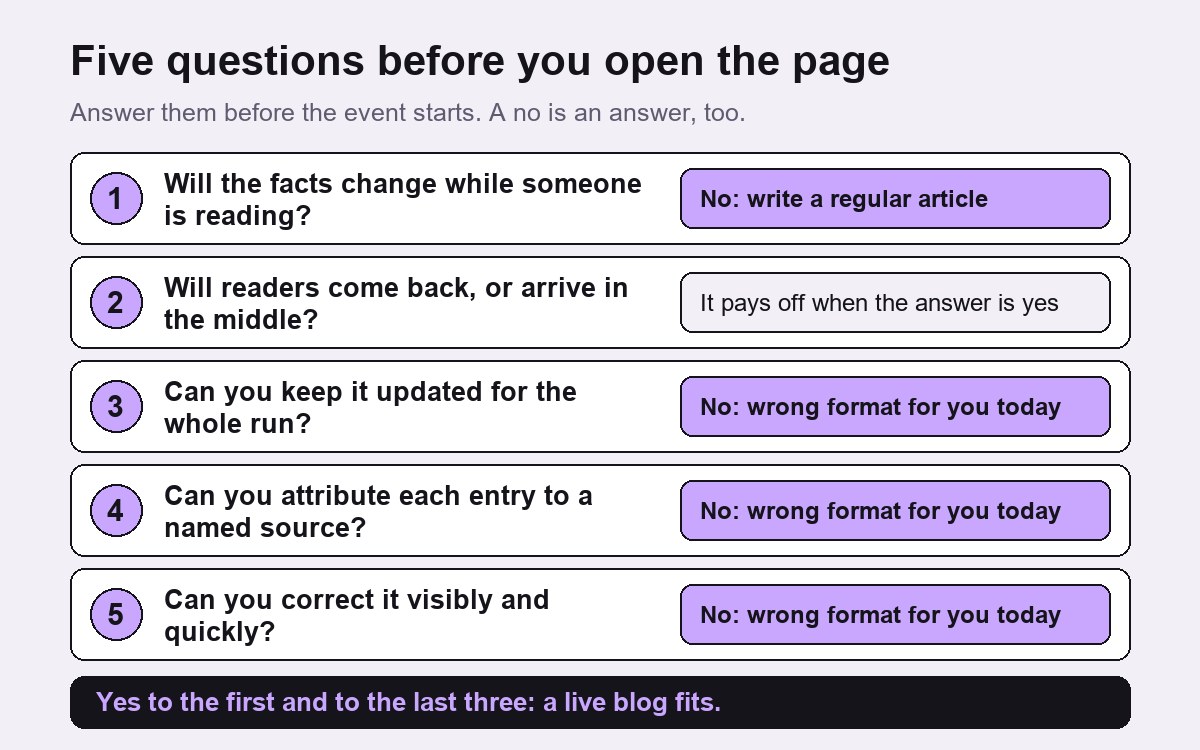
- Will the facts change while someone is reading? A vote count, a launch event, an outage, an election night. If the substance is settled and you want to explain it, write an article.
- Will readers come back, or arrive in the middle? The format pays off when people return to see what is new or land mid-event and need to catch up.
- Can you keep it updated for the whole run? An abandoned live blog is worse than none. If you cannot commit for the length of the event, say so in the first line or choose another format.
- Can you attribute each entry to a source you can name? If most of what you would post is "reports say", you are relaying rumour at speed.
- Can you correct it visibly and quickly? If your tools or process make that hard, the risk is higher.
If you answered no to the first, a regular article fits. If you answered no to the third, fourth or fifth, the format is wrong for you today, however good the story.
The rulebook: entries, corrections, summary
Entries. One event or claim per entry, with a time, a source and its status. Attribute claims. The AP's rule is that "anything in the AP news report that could reasonably be disputed should be attributed" [3], and it holds in a live feed as much as anywhere. Label unverified items as unverified. The BBC's guidelines say that if producers "have been unable to verify material, they should usually say so and attribute the information" [4].
Accuracy in live content. The BBC states the problem directly: "Achieving due accuracy in live content can be challenging, as there may be little opportunity to verify factual claims". Its advice is to identify risks in advance, prepare context and challenge, and correct significant inaccuracies quickly [4]. The same guidelines hold that in news and current affairs, "achieving due accuracy is more important than speed" [4]. Taken together, these suggest a simple house rule: prepare before the event, and when in doubt, post it later.
Corrections. The AP's practice for live online text is specific: "we overwrite the previous version", and it sends separate corrective stories as warranted; a correction must always be labelled a correction, with no euphemisms such as "fixes" or "minor edits" [3]. For a live blog that means: fix the entry, mark that it was corrected and say what changed, and where the error mattered, add a new entry that states the correction. Do not silently edit.
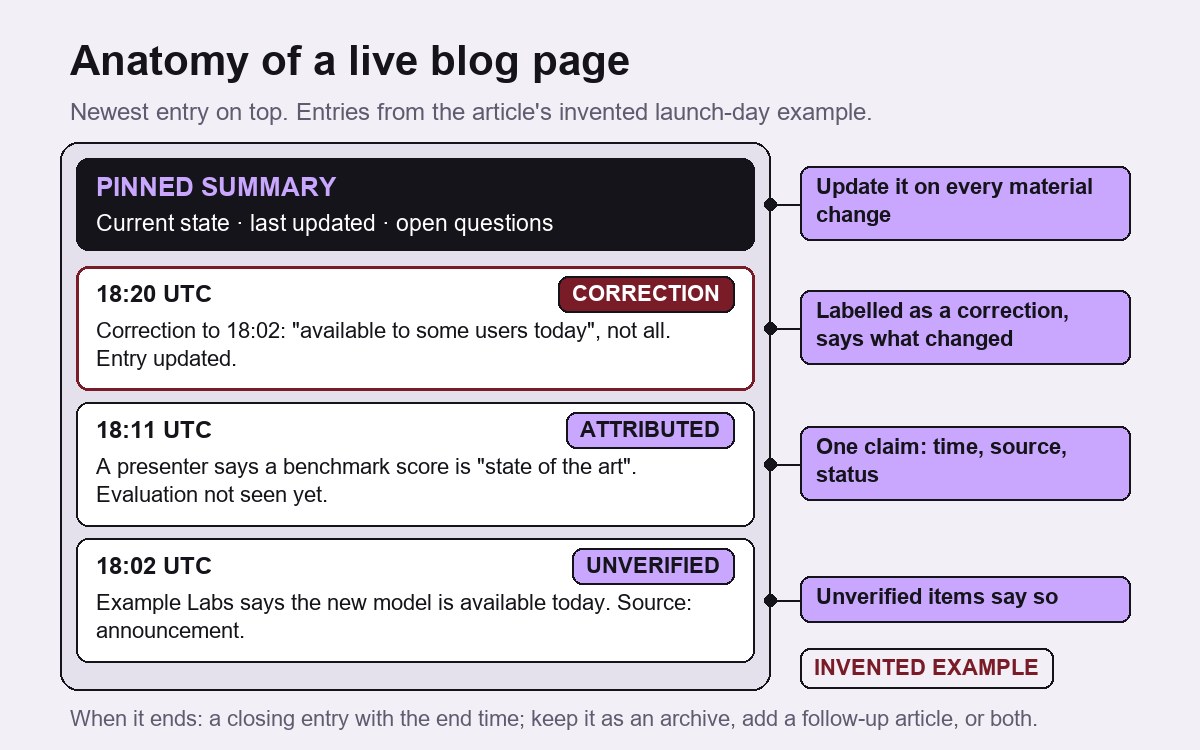
The summary on top. Because readers arrive at any point, keep a short summary pinned at the top with the current state, the time it was last updated and the main open questions. Update it each time something material changes.
Closing. When the event ends, say so, stop adding entries and record the end time. Then decide whether the page should stand as an archive or be followed by a regular article that explains what happened. Often it should be both.
A worked example (invented)
The example below is invented to show the method. The company, the model and the entries are made up.
Suppose Example Labs announces a launch event for a new AI model at a fixed hour, and you plan to cover it live.
Run the test. The facts will change during the event (announcements, demonstrations, pricing). Readers will arrive mid-event. You can commit for the event's length, two hours. Most entries can be attributed: the company's own stream and its blog post. You can edit and mark corrections. A live blog fits.
Before the event. Open the page with a summary: what is expected, when, and what you will and will not cover. Prepare context blocks: what the company said last month, what its previous model did. This is the preparation the BBC guideline describes, so that the content "contains sufficient challenge or context" [4], written in advance.
During. Entries look like this:
- "18:02 UTC. Example Labs says the new model is available today. Source: company announcement, link. Not yet independently verified."
- "18:11 UTC. A presenter says a benchmark score is 'state of the art'. We have not seen the evaluation. We will check against the published paper when it appears."
- "18:20 UTC. Correction to 18:02: the announcement says 'available to some users today', not all. Entry updated."
After. Close with the end time. Pin a summary of what was announced and what remains unverified. Then write a regular article within a day or two, after the claims have been checked.
Note what the live blog did and did not do. It carried what was said and when. It did not decide whether the claims are true. That is the job of the article that follows.
Common mistakes, and fixes
Choosing the format for the traffic. The study above is not a guarantee. Fix: run the five-question test and accept a no.
Posting rumour at speed. Fix: label unverified entries and attribute everything that could be disputed.
Silent edits. Fix: mark every correction as a correction and say what changed.
No summary for latecomers. Fix: pin a current-state summary and update it.
Never closing. Fix: announce the end, record the time and decide about a follow-up article.
A template to copy
Why a live blog (answers to the five questions): Planned run: from / to (UTC), who updates, who checks Summary pinned at top: current state, last updated, open questions
Entry: time (UTC) | one claim | source and link | status (verified / unverified / attributed claim) Correction: time | which entry | what changed | why
Closing entry: end time, final summary, link to the follow-up article
What this article cannot tell you
It does not say that live blogs are better or worse than articles. The study cited is one case, from 2011 data, at one newsroom, and its authors ask for some of its findings to be replicated or contradicted. I did not verify claims I have seen elsewhere about staffing a live blog, its return on effort or how search engines treat it, so I make none. The BBC and AP rules are written for their own newsrooms. The launch day in the worked example is invented, and nothing in it is a statement about a real company. I ran no live blog for this article; it describes a method and cites sources.
How this article was made
| Task | What the AI did | What a person did | How it was checked |
|---|---|---|---|
| Research | Gathered candidate standards and a study and drafted notes | Chose the question and which sources to rely on | Every quote checked against the page named in the sources, read on 18 November 2026 |
| Draft | Wrote the first draft from the notes | Edited the text, the rulebook and the invented example | An independent review compares claims with the sources before publication |
| Images | Generated the cover illustration; diagrams built in code | Chose the illustration and checked the diagrams | Labelled as AI-generated in the disclosure line and alt text |
| Not done by AI | — | The decision to publish and responsibility for the text | — |
Conflicts of interest: none. The author has no commercial relationship with any organisation named here.
Responsible for this article: Dmitriy Lastovka, author. Corrections: contact form.
Sources
Labels: standard (published standard or editorial rules), paper (published research).
- schema.org, "LiveBlogPosting". https://schema.org/LiveBlogPosting Standard (vocabulary definition).
- Neil Thurman and Anna Walters, "Live Blogging: Digital Journalism's Pivotal Platform?", Digital Journalism 1(1), 2013, pp. 82-101, doi 10.1080/21670811.2012.714935. Author's manuscript (the repository notes it may differ from the published version; figures and quotes here are from it): https://openaccess.city.ac.uk/id/eprint/1742/ Paper.
- The Associated Press, News Values and Principles: "Telling the Story" (attribution, corrections). https://www.ap.org/about/news-values-and-principles/telling-the-story/ Standard.
- BBC Editorial Guidelines, Section 3 Accuracy, guidelines 3.4.1 to 3.4.15 (including 3.4.2, 3.4.6, 3.4.7). https://www.bbc.co.uk/editorialguidelines/guidelines/accuracy/guidelines Standard.