
AI tools helped gather research and write the first draft of this article. I edited it and checked every quote against the source page listed at the end, read on 18 November 2026. The cover illustration is AI-generated. Details at the end.
Many articles about a fast-moving subject, such as an AI model release, a protocol upgrade or a game patch, are summaries. A summary is not a bad thing. It saves a reader time. But when every outlet has read the same announcement and written the same five paragraphs, a sixth copy, however long, adds nothing the reader could not have found in the first five.
Reporting begins where the summary stops: it adds one thing the sources did not hand the reader. That can be something you saw, a document you read in full, a person you asked, a number you checked or two accounts you reconciled. This article gives a one-sentence test for it, a ledger that shows which paragraph came from where, and a short worked example. It is the fifth part of a block on research and the form of an evidence-based answer, and it stands alone: you do not need the earlier parts on web tools to use it. Later parts in the block are planned to cover interviews, timelines, live blogs, datasets and splitting a large investigation into standalone articles.
What a summary is, and what it is not
A summary takes material that already exists in public and restates it in a new order. Done well, it chooses what matters, cuts what does not, and explains the terms. That is real editorial work, and it is the right form for many questions.
What a summary cannot do is answer a question the sources left open. If the announcement says a network upgrade "improves security", the summary says it improves security, perhaps with more adjectives. A reported piece asks what changed in the code or the rules, who checked it, and what the announcement did not say.
Search guidance from Google puts the same line in a list of questions publishers can ask about their own pages. One is: "Does the content provide original information, reporting, research, or analysis?" Another asks whether, if the content draws on other sources, it will "avoid simply copying or rewriting those sources, and instead provide substantial additional value and originality" [1]. Those are questions Google suggests for self-assessment of content quality, not a ranking promise, and they are a useful editorial test whatever search engine you care about.
News agencies hold their own staff to a version of it. The Associated Press says a staff reporter "must use original content, language and phrasing", and that information and quotes from a news release may be used, but the reporter "must judge the material's credibility, augment it with information from other sources" and then write their own story [2]. The AP statement is written for its own journalists. It still shows the practical difference: a release is a starting point, not a finished source.
The test: what did this piece add?
Before writing, finish this sentence in one line:
A reader who has already read the sources will learn from this piece that ______, which none of them said.
If the blank is "the same thing in plainer words", you are writing a summary. That may be the right job, but call it one. If the blank holds a fact, a finding, a contradiction or a verified detail, you have reporting to do, and the blank tells you what to go and get.
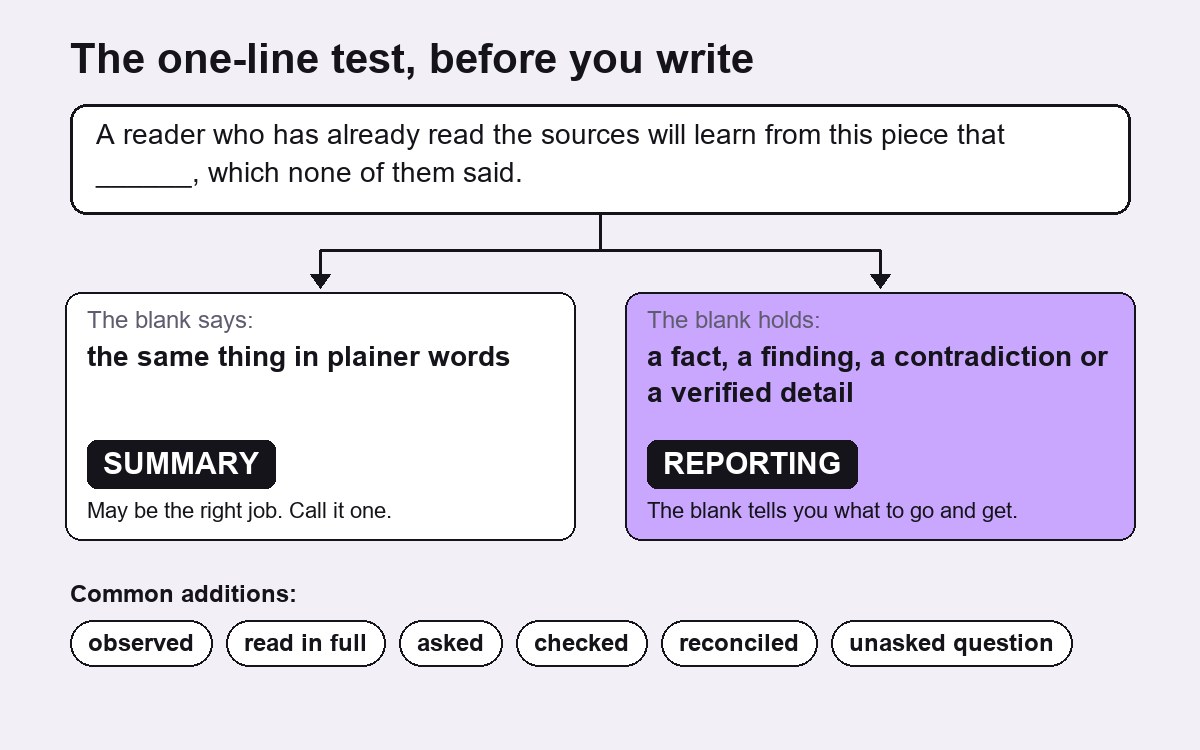
Six kinds of addition are common. The first four have a matching standard in the BBC's published accuracy guidelines; the last two are this article's own suggestions.
| What you add | What it looks like | Standard it has to meet |
|---|---|---|
| First-hand observation | You used the product, ran the test, read the contract code | The BBC says producers "should try to witness events and gather information first hand"; where they cannot, they should talk to first-hand sources [3] |
| A document read in full | The filing, the terms of service, the governance proposal | Documents and digital material "must be checked and verified" [3] |
| A person asked | An interview with someone who made the decision | Be "reluctant to rely on a single source"; a named, on-the-record source is preferable [3] |
| A number checked | Recalculating a figure, finding its denominator | Numbers should be "explained clearly, put into context, weighed, interpreted and, where appropriate, challenged" [3] |
| Two accounts reconciled | The press release and the changelog disagree | Say which you could verify and which you are reporting as a claim |
| A question the sources did not raise | What the announcement left out | Say that you asked and what answer, if any, came back |
The BBC guidelines are written for broadcast and online news. They are a useful reference for anyone who publishes claims, but they are one organisation's rules, not a law of publishing.
The ledger: which paragraph came from where
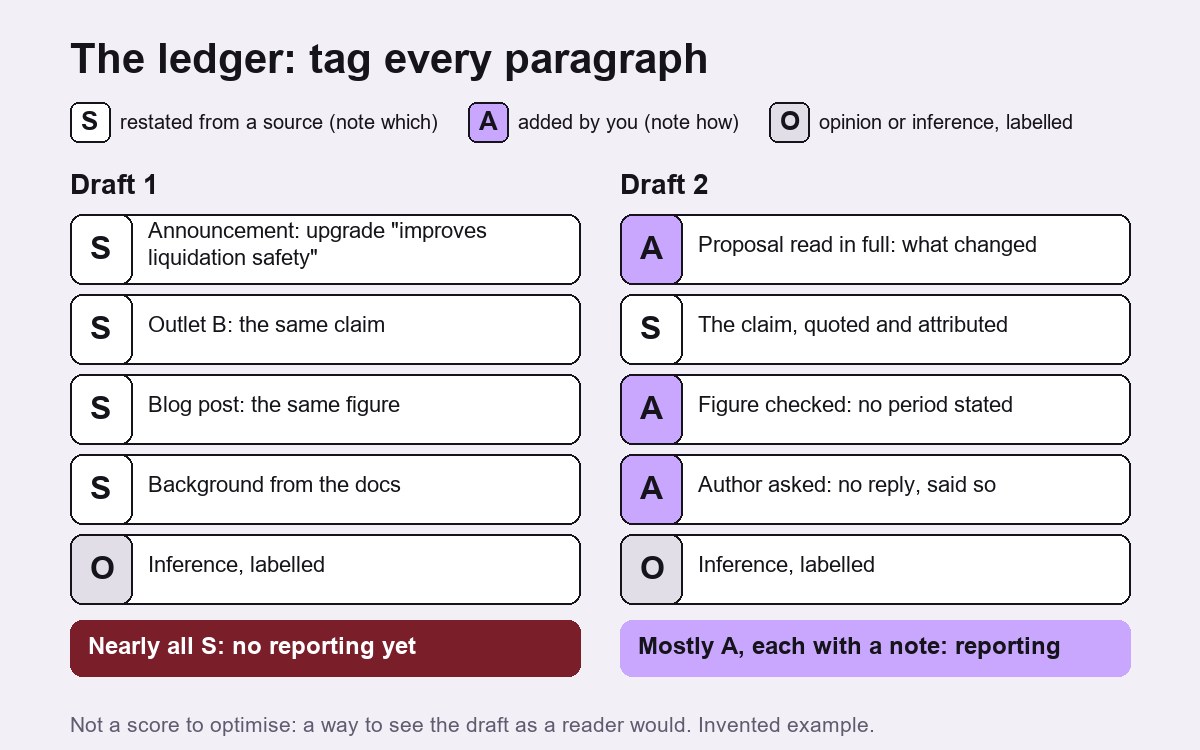
The simplest way to see whether a draft is a summary is to mark where each paragraph's content came from. Take your draft and give every paragraph one tag:
- S: restated from a source someone else published. Note which.
- A: added by you. Note how (observed, read in full, asked, checked, reconciled).
- O: your opinion or inference, labelled as such in the text.
Then count. A draft that is nearly all S has no reporting in it yet. A draft that is mostly A with each A traceable to a note is reporting. This is not a score to optimise. It is a way to see the draft as a reader would.
Two habits make the ledger honest. First, attribution: the AP's standard is that "anything in the AP news report that could reasonably be disputed should be attributed", that a quotation from a written document such as a report, email or news release should say so, and that information "taken from the internet must be vetted according to our standards of accuracy and attributed to the original source" [2]. Second, saying what you could not verify. The BBC puts it plainly: if content producers "have been unable to verify material, they should usually say so and attribute the information" [3]. A reported piece can carry unverified claims, but it labels them.
A worked example (invented)
The example below is invented to show the method. The protocol, the dates and the quotes do not exist.
Suppose a lending protocol called Example Finance announces "Version 3", and its blog post says the upgrade "improves liquidation safety". Three outlets summarise the post. You want to write something different.
Step 1: write the blank. "Version 3 changes who can trigger a liquidation, which the announcement did not say." You do not know this yet. It is a hypothesis you can test.
Step 2: choose the additions that can test it.
- A document read in full. The upgrade proposal and the change description in the project's public repository. Reading them is first-hand work. What does the code change, in the proposal's own words?
- A person asked. One of the proposal's named authors, with a short list of questions. If the author declines, you say you asked.
- A number checked. The announcement cites a figure for liquidations "avoided". Where does it come from, and over what period?
Step 3: write down what each step returned, including the nothing. Perhaps the proposal confirms the change in who can trigger liquidations. Perhaps the author does not reply. Perhaps the "avoided" figure has no stated period. Each of these is a result.
Step 4: write the piece around what you found. The opening states the finding, attributed to the proposal. A paragraph reports the unanswered question about the figure and states that you asked. The announcement's claims are quoted and labelled as the company's claims. The sources you could not check are labelled.
Notice what did not happen: no insider was invented, no number was estimated, no "sources say" was used. If the author never replied and the proposal was thin, the honest piece is shorter. That is a better result than a long piece that sounds like reporting without being it.
Three tests of your own draft
- The removal test. Delete every sentence that merely restates a source. Does a piece remain? If it does, that is the reporting.
- The question test. Can you name a question your piece answers that none of the cited sources answers?
- The trace test. For each A paragraph, could you show a colleague the note, link or recording that supports it?
Common mistakes, and fixes
Length mistaken for depth. Seven thousand words that restate three sources are still a summary. Fix: run the removal test and report what remains.
Several outlets treated as several sources. Four articles repeating one press release are one source. Fix: trace each claim back to where it started, and cite that.
Reworded quotes. A model or an editor tidies a sentence from a source and leaves the quotation marks on. The AP says it does not "alter quotations, even to correct grammatical errors or word usage" [2]. Fix: either quote exactly, or paraphrase and remove the marks.
Invented presence. Writing "I tested it" or "I spoke to" without having done it. Fix: only claim the action you took, and if you did not take it, make the piece about the documents.
Opinion filed as fact. Your inference is an addition, but it needs a label. The IPSO Editors' Code, a UK press code, says the press, while free to editorialise and campaign, "must distinguish clearly between comment, conjecture and fact" [4]. Fix: use "I infer" or "the record suggests", and keep it apart from what the source states.
A template to copy
Question this piece answers: What the sources already say (S): What I added (A) and how: - observed / read in full / asked / checked / reconciled What I could not verify, and how it is labelled: What I asked for and did not get: Opinion (O), labelled in the text:
If the "What I added" line is empty, decide whether to publish it as a summary and say so, or to do the work that fills it.
What this article cannot tell you
It does not say that summaries are inferior, or that every article must contain new facts. A clear summary of a complex announcement is useful, and many readers need exactly that. It does not tell you how to get an interview or how to build a timeline; those are separate questions. The standards cited come from Google's self-assessment guidance, the AP's rules for its own staff, the BBC's guidelines and a UK press code. They are good references, but they are not universal rules, and none of them was written for crypto, AI or games specifically. The protocol in the worked example is fictional, and no claim in it should be taken as a statement about a real project. I ran no interview or test for this article. It is a method piece, and it cites rules rather than reporting of its own.
How this article was made
| Task | What the AI did | What a person did | How it was checked |
|---|---|---|---|
| Research | Gathered candidate standards and drafted notes | Chose the question and which standards to rely on | Every quote checked against the page named in the sources, read on 18 November 2026 |
| Draft | Wrote the first draft from the notes | Edited the text, the ledger and the invented example | An independent review compares claims with the sources before publication |
| Images | Generated the cover illustration; diagrams built in code | Chose the illustration and checked the diagrams | Labelled as AI-generated in the disclosure line and alt text |
| Not done by AI | — | The decision to publish and responsibility for the text | — |
Conflicts of interest: none. The author has no commercial relationship with any organisation named here.
Responsible for this article: Dmitriy Lastovka, author. Corrections: contact form.
Sources
Labels: official (the organisation's own page), standard (published editorial rules).
- Google Search Central, "Creating helpful, reliable, people-first content". https://developers.google.com/search/docs/fundamentals/creating-helpful-content Official guidance.
- The Associated Press, "Telling the Story" (News Values and Principles): sections on use of others' material, attribution, quotations. https://www.ap.org/about/news-values-and-principles/telling-the-story/ Standard.
- BBC Editorial Guidelines, Section 3 Accuracy, guidelines 3.4.3, 3.4.4, 3.4.6 and 3.4.8. https://www.bbc.co.uk/editorialguidelines/guidelines/accuracy/guidelines Standard.
- IPSO, "The Editors' Code of Practice", clause 1 (Accuracy), point iv. https://www.ipso.co.uk/editors-code-of-practice/ Standard (UK press).