
AI tools helped gather research and write the first draft of this article. I edited it and checked every quote against the source page listed at the end, read on 18 November 2026. The cover illustration is AI-generated. Details at the end.
A timeline looks like proof. Dates down the left, events down the right, and a reader assumes someone checked. In practice many timelines are a list of times copied from different places, in different time zones, some of them the time a story was posted rather than the time something happened. The order looks tidy. The evidence under it may not be.
A verifiable timeline is a table in which every entry says what happened, when, how precisely that time is known, in which time zone, where the claim comes from, and whether it is confirmed or only claimed. This article shows how to build one in five steps, with a template and an invented worked example. It is the third part on reporting, after "Reporting Beyond a Long Summary" and "Preparing an Interview That Adds Evidence", and it stands alone.
Why timelines go wrong
Four faults account for most of the damage.
Event time and publication time are mixed. A post about an outage is dated after the outage. If the table uses the post's date for the event, it is wrong by an unknown amount.
Time zones are silent. "14:05" on its own is not a time. It is a time in some place.
Precision is hidden. "Around noon", "the morning of the 3rd" and "14:05:12" appear in the same column as if they were equally exact.
One source, many rows. Ten entries that all came from one account are one source, ten times.
A fifth fault belongs to the reader's side. A clean timeline invites trust the evidence has not earned, so the method below puts the uncertainty in the table where the reader can see it.
Step 1: fix the columns before you collect anything
Decide what each row must carry. A workable minimum:
| Column | What goes in it |
|---|---|
| When (stated precisely) | The time, with its precision and time zone, or an earliest and a latest bound |
| What happened | One event, one sentence, no interpretation |
| Source | Address or document, who produced it, the date you read it |
| Source type | First-hand record, official statement, news report, social post, archive copy |
| Status | Confirmed (two independent sources, or a primary record), claimed (one source), or disputed |
| Notes | What would settle it, what conflicts with it |
Adding columns later is fine. Collecting without them is how the problems above creep in.
Step 2: write times in one format, with the zone
Pick one format and use it everywhere. A good default is the one defined in RFC 3339, "a date and time format for use in Internet protocols", which is a profile of the ISO 8601 standard [1]. A timestamp there looks like 2026-11-03T14:05:12Z. The letter Z stands for a UTC offset of 00:00, and an explicit offset such as +03:00 says how far local time is from UTC [1].
Two practical rules follow.
- Store in UTC, show the local time next to it if your reader needs it. Converting between zones in your head, at publication time, is where mistakes appear.
- Say when you do not know the offset. RFC 3339 has a way of saying that: if the time in UTC is known but the offset to local time is not, it can be written with an offset of -00:00 [1]. You do not have to use that notation, but you do have to say in the table that the zone is unknown. A time without a zone is a guess dressed as a fact.
For precision, write only what you know. If a source gives a day, write the day: 2026-11-03. If it says "morning", write that in the notes and use bounds, described next.
Step 3: keep an earliest and a latest bound
Often you cannot know when something happened, only a window. Bellingcat's guide to working out when a photo was taken says so directly: in most cases "it will only be possible to figure out the earliest possible date or latest possible date that an image was taken, rather than the precise date and time" [2]. Researchers, it adds, often already hold a latest possible date at the start, which is likely the date the image was uploaded to the platform where they found it [2]. To keep track, the same guide suggests that "we can create a timeline and update it as we go" [2].
That gives a rule you can use for any evidence about time. For each entry, record two things:
- Not before: the earliest time the event can have happened, and why.
- Not after: the latest time, and why.
A post cannot describe an event that has not happened, so its date is not an earlier bound of the event. It is the later bound. Earlier bounds come from the content: a building that opened in a given month cannot appear in a photo taken before that month.
The same guide works through a photo posted to Facebook on 11 October 2014 from Prague. The posting date is the latest possible date. Letters on a gallery building in the background matched other photos of that building from mid-June 2014, while photos uploaded on 4 and 14 June showed different signage. That put the photo between mid-June and 11 October 2014, a window rather than a date [2]. Sometimes one clue is enough: in a photo outside a New York baseball stadium, a charity's campaign banner and the campaign's launch date pointed to 3 April 2017, the team's opening game of that season, and the guide suggests contacting the charity for further assurance [2]. The lesson is not about galleries or stadiums. It is that each clue gives a bound, and the bounds are written down, not averaged.
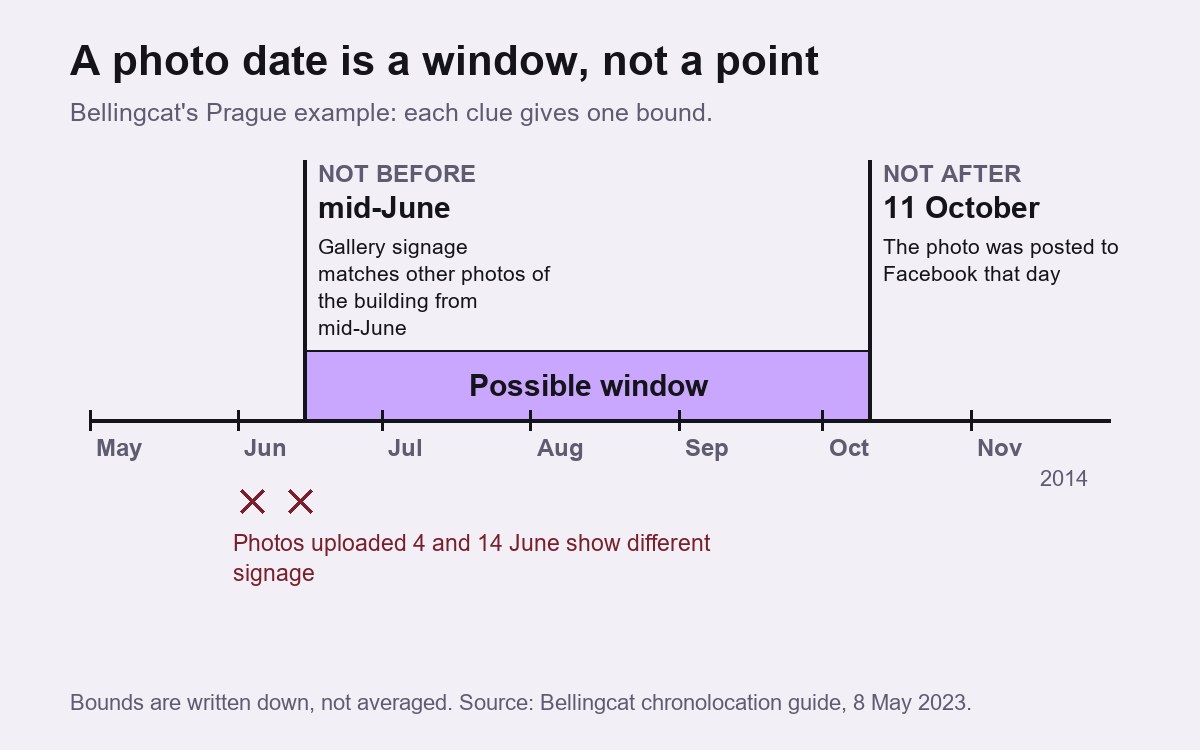
When you work from a photo or a video, the same guide places the time question after the place question: once a location has been established, chronolocation helps determine the time an event happened [3].
Step 4: say how many sources stand behind each entry
The BBC's guidelines say content producers should be reluctant to rely on a single source, and that where they do, a named, on-the-record source is always preferable. They also say information, facts, documents and digital material "must be checked and verified", and that if a producer has been unable to verify material, "they should usually say so and attribute the information" [4]. In a timeline this becomes the Status column (the three-way split below is this article's rule, not the BBC's):
- Confirmed: a primary record (a log, a filing, a recording you have), or two sources that did not get it from each other.
- Claimed: one source. Name it.
- Disputed: sources conflict. Show both rows; do not choose.
Two more habits keep entries honest. Mark archive material as archive material: the AP's rule is that file, library or archive photos, audio or videos "must be identified as such" [5]. And separate where something happened from where it was reported. The AP's rules, for example, say a dateline tells the reader where the basic information for a story was obtained [5]. In a table, a column for the source's location and date prevents a report written from the other side of the world being read as an observation on the spot.
The Berkeley Protocol on Digital Open Source Investigations, a joint publication of the Human Rights Center at UC Berkeley and the UN human rights office, outlines "the minimum professional standards for the identification, collection, preservation, verification, and analysis of digital open source information" [6]. I read only its summary page, not the full text, so I do not describe its detailed steps here. The five verbs are still a useful checklist for a timeline: where did each entry come from, how was it collected, was a copy kept, how was it checked, and what does it mean.
Step 5: mark the gaps and the contradictions
A timeline with no gaps is suspicious. Add rows for what is missing: "No source found for 14:10 to 14:40." Add the contradictions as rows, side by side, with their sources. Do not fill a gap with what probably happened; if you want to say what probably happened, say it in a clearly separate note and label it as inference.
Finally, state the cut-off. A timeline is a record as of a date. Write "Entries as of 2026-11-18, 20:00 UTC" at the top, and update it openly when something changes.
A worked example (invented)
The example below is invented to show the method. The company, the outage and every time are made up.
Suppose a trading platform called Example Exchange had an outage. Its status page, a user's post and a news site each give a time. You want a timeline you can defend.
First, the raw claims:
- The status page: "Investigating connectivity issues", with a time shown as 14:05, no zone.
- A user's post: "Can't log in", posted at 14:20 UTC.
- A news article, published 2026-11-03T16:00:00Z: "The outage began in the afternoon and lasted about two hours."
Now the table:
| When | What happened | Source | Type | Status | Notes |
|---|---|---|---|---|---|
| Not before: unknown; not after: 2026-11-03T14:20Z | Users could not log in | User's post, read 2026-11-18 | Social post | Claimed | The post is a later bound for the start, not the start. |
| 14:05, zone not stated | Status page began "investigating" | Status page entry, read 2026-11-18 | Official statement | Claimed | Zone unknown; ask the company, or find an archived copy that shows the zone. |
| Not before: unknown; not after: 2026-11-03T16:00Z | Outage reported as lasting "about two hours" | News article | News report | Claimed | "Began in the afternoon" gives no bound; the article's publication time is the later bound for its own report. |
| Gap | No source found for the end of the outage | Ask the company whether a post-incident note exists. |
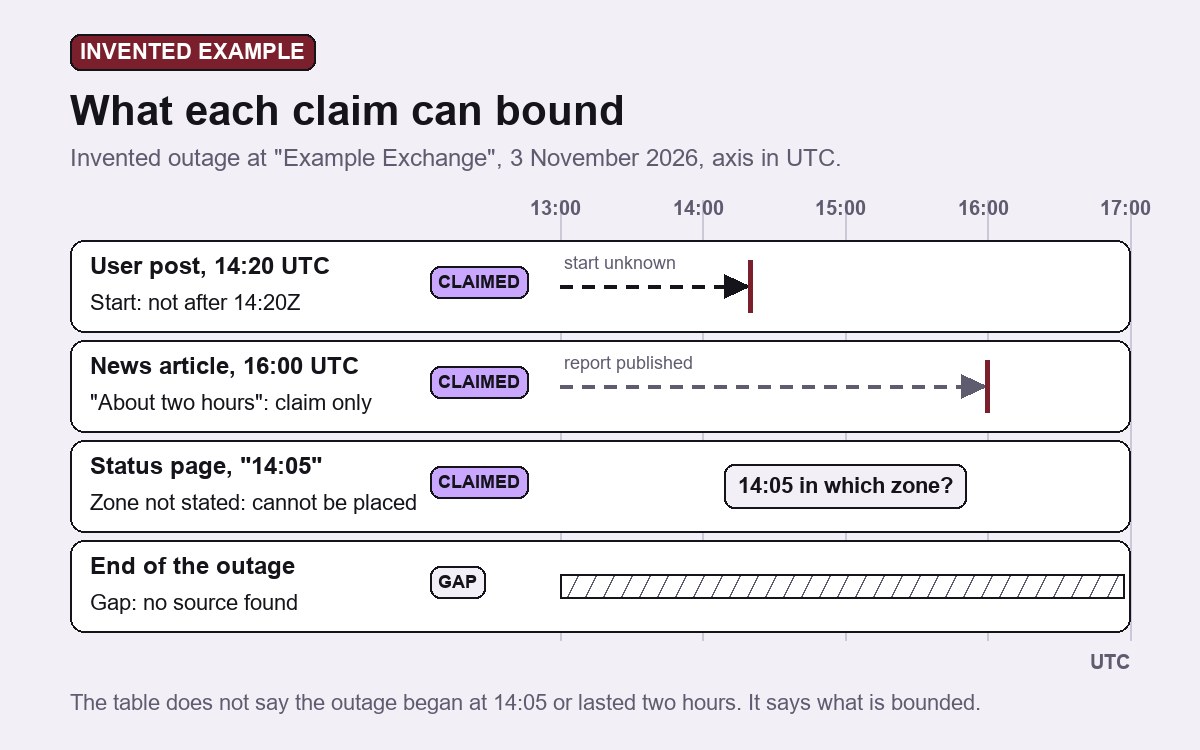
Look at what the table refuses to do. It does not say the outage began at 14:05, because the zone is unknown. It does not say it lasted two hours, because one article's "about" is a claim, not a measurement. It shows what is bounded, what is not and what to ask next. If the company later publishes a post-incident note with UTC times and a second source agrees, the Status moves to confirmed and the bounds close.
Common mistakes, and fixes
Using the publication date as the event date. Fix: a post is a later bound, not the event.
Zones left out. Fix: store UTC, note the local zone, and write "zone unknown" when it is.
False precision. "Around 2pm" typed as 14:00:00. Fix: write the precision you have, and use bounds.
Two outlets, one source. Fix: trace the claim to its origin, and count origins, not articles.
Gaps filled by guesswork. Fix: leave the gap, label inference, and list what would close it.
A template to copy
Timeline as of: (date, time, zone) Time standard used: (e.g. RFC 3339, UTC)
| When (precision, zone) or Not before / Not after | What happened | Source and date read | Source type | Status (confirmed / claimed / disputed) | Notes: what would settle it |
Gaps (no source found for): Contradictions (both rows shown): Inference, clearly labelled:
What this article cannot tell you
It does not tell you how to authenticate a photo or video, which needs its own methods and tools; the Bellingcat guides cited here are a place to start. It does not describe the full Berkeley Protocol, which I did not read beyond its summary. RFC 3339 is a format standard, so it tells you how to write a time, not how to know it. The editorial rules quoted come from the BBC and the AP and are written for their own newsrooms. The outage in the worked example is invented, and nothing in it is a statement about a real exchange. I built no timeline from real events for this article; it describes a method.
How this article was made
| Task | What the AI did | What a person did | How it was checked |
|---|---|---|---|
| Research | Gathered candidate standards and drafted notes | Chose the question and which standards to rely on | Every quote checked against the page named in the sources, read on 18 November 2026 |
| Draft | Wrote the first draft from the notes | Edited the text, the table and the invented example | An independent review compares claims with the sources before publication |
| Images | Generated the cover illustration; diagrams built in code | Chose the illustration and checked the diagrams | Labelled as AI-generated in the disclosure line and alt text |
| Not done by AI | — | The decision to publish and responsibility for the text | — |
Conflicts of interest: none. The author has no commercial relationship with any organisation named here.
Responsible for this article: Dmitriy Lastovka, author. Corrections: contact form.
Sources
Labels: standard (published standard or editorial rules), guide (a published method).
- IETF, RFC 3339, "Date and Time on the Internet: Timestamps". https://www.rfc-editor.org/rfc/rfc3339 Standard.
- Bellingcat, "Chronolocation: Determining When a Photo Was Taken Using Facebook, Google Street View and Assorted Tiny Details", 8 May 2023. https://www.bellingcat.com/resources/2023/05/08/chronolocation-determining-when-a-photo-was-taken-using-facebook-google-street-view-and-assorted-tiny-details/ Guide.
- Bellingcat, "A Beginner's Guide to Social Media Verification", 1 November 2021. https://www.bellingcat.com/resources/how-tos/2021/11/01/a-beginners-guide-to-social-media-verification/ Guide.
- BBC Editorial Guidelines, Section 3 Accuracy, guidelines 3.4.4 and 3.4.6. https://www.bbc.co.uk/editorialguidelines/guidelines/accuracy/guidelines Standard.
- The Associated Press, News Values and Principles: "Telling the Story" (attribution, archive material, datelines). https://www.ap.org/about/news-values-and-principles/telling-the-story/ Standard.
- Human Rights Center, UC Berkeley, "Berkeley Protocol on Digital Open Source Investigations" (project page). https://humanrights.berkeley.edu/projects/berkeley-protocol-on-digital-open-source-investigations/ Guide (summary page only).