
AI tools helped gather research and write the first draft of this article. I edited it and checked every quote against the source page listed at the end, read on 18 November 2026. The cover illustration is AI-generated. Details at the end.
You have read the documents and still have a question they do not answer. Why was the decision taken? What happened in the room? Where is this recorded? An interview is the tool for exactly that. It is also the tool most often wasted: half an hour of general questions yields a few quotable lines and no new fact.
An interview adds evidence when you go in with a specific gap, ask for things a person can know first-hand, and leave with a record you can quote exactly and check afterwards. This article gives five preparation steps, a question list to copy, the vocabulary of on the record and off the record that you must settle before the first answer, and what to do with the result. It is the second part on reporting, following the one on what separates reporting from a long summary, and it stands alone. It covers preparation. It does not cover how to get a person to agree to talk.
What an interview can add, and what it cannot
A person can tell you things no document contains: why a choice was made, what they saw, what they did, what they do not know. They can point you to a record you did not know existed. They can confirm or dispute a number you computed.
A person cannot make a claim true by saying it. What an interviewee says is a claim, attributed to them. The BBC's accuracy guidelines say that content producers "should try to witness events and gather information first hand", and where that is not possible, talk to first-hand sources and corroborate where practicable. They also say a producer should be reluctant to rely on a single source, and that "a named, on-the-record source is always preferable" [1]. Those are one broadcaster's rules, but they describe a sound habit: an interview is one source, and what it contributes is strongest when something else can back it.
Step 1: write the gap before the questions
Start from the test sentence in the previous article, Reporting Beyond a Long Summary: a reader who has already read the sources will learn from this piece that ____, which none of them said. Now ask which part of the blank only a person can fill.
- If a document would answer it, read the document. Do not spend a person's time on a question the filing, the changelog or the public repository answers.
- If the blank is a reason, a sequence of events or a first-hand observation, it needs a person.
- If the blank is a number, ask where the number is recorded, rather than asking for the number from memory.
Write the gap as one line at the top of your notes. Everything you ask should serve it.
Step 2: choose the right person for the gap
Ask who could know this first-hand. The person who announced a decision may not be the person who made it. A spokesperson can confirm an official position and often cannot say what happened internally. Someone who was present can say what they saw; someone who heard it from them can only say what they heard, which is second-hand.
Write down, for each candidate, what they could know and how. If your only available source is second-hand, you can still use them, but the piece must say so.
Step 3: build a question list that fetches evidence
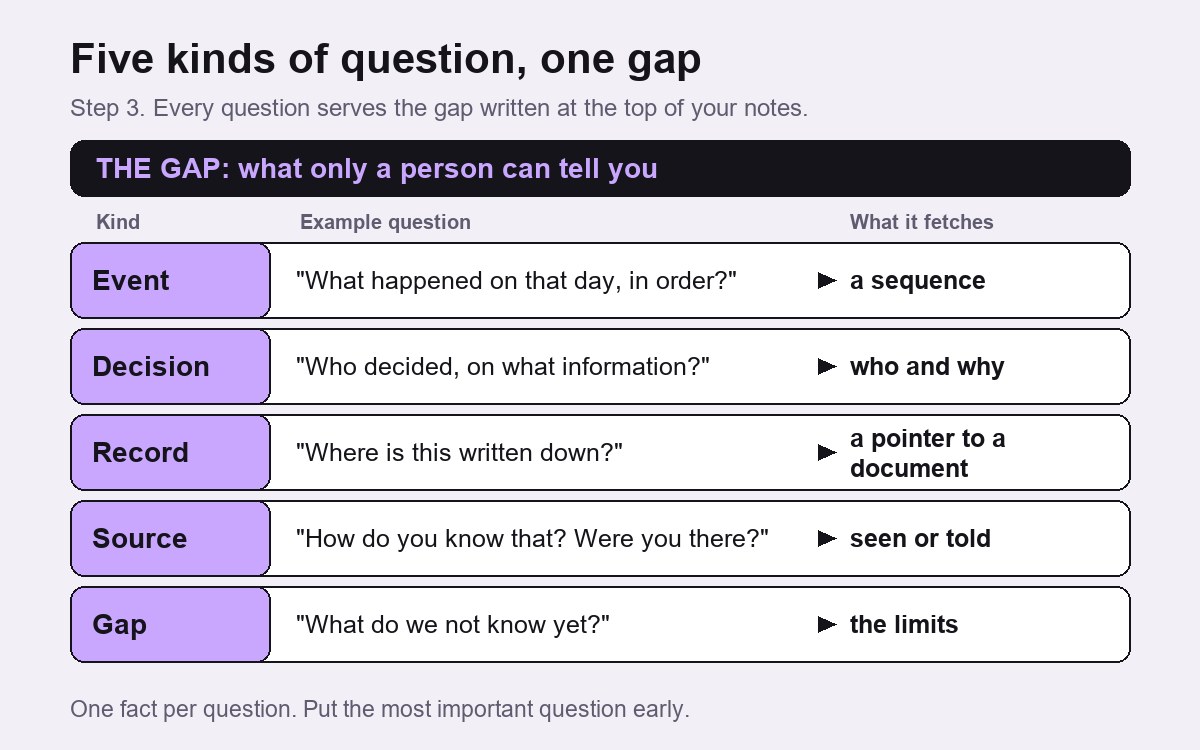
A useful list has questions of five kinds.
- Event questions. "What happened on that day, in order?" People can tell a sequence far better than they can summarise a period.
- Decision questions. "Who decided, on what information, and what else was considered?"
- Record questions. "Where is this written down? Can you point me to it?" A pointer to a document is worth more than a paraphrase.
- Source questions. "How do you know that? Were you there?" Asked politely, this separates what the person saw from what they were told.
- Gap questions. "What would change your view?" and "What do we not know yet?" These keep an honest piece from overclaiming.
Keep each question to one fact. "Why did you delay the release and who approved it?" is two questions, and the answer to the second will vanish. Avoid questions that contain the answer you want. A neutral version of "Don't you agree this was a mistake?" is "How would you describe the outcome?".
Put your most important question early. Interviews run short, and the best material is not always at the end.
Step 4: settle the ground rules before the first answer
The terms on which information is given decide how you can use it. The AP, in its published rules on sources, tells its reporters to "proceed with interviews on the assumption they are on the record", and that if the source wants conditions, "these should be negotiated at the start of the interview". At the end of the interview, the reporter should try once more to move onto the record some or all of the information given on background [2].
The AP also notes that "not everyone understands 'off the record' or 'on background' to mean the same things", and says that before any interview in which any degree of anonymity is expected, "there should be a discussion in which the ground rules are set explicitly" [2]. Its definitions are a useful starting vocabulary:
| Term | AP definition |
|---|---|
| On the record | "The information can be used with no caveats, quoting the source by name." |
| Off the record | "The information cannot be used for publication." |
| Background | "The information can be published but only under conditions negotiated with the source." |
| Deep background | "The information can be used but without attribution." |
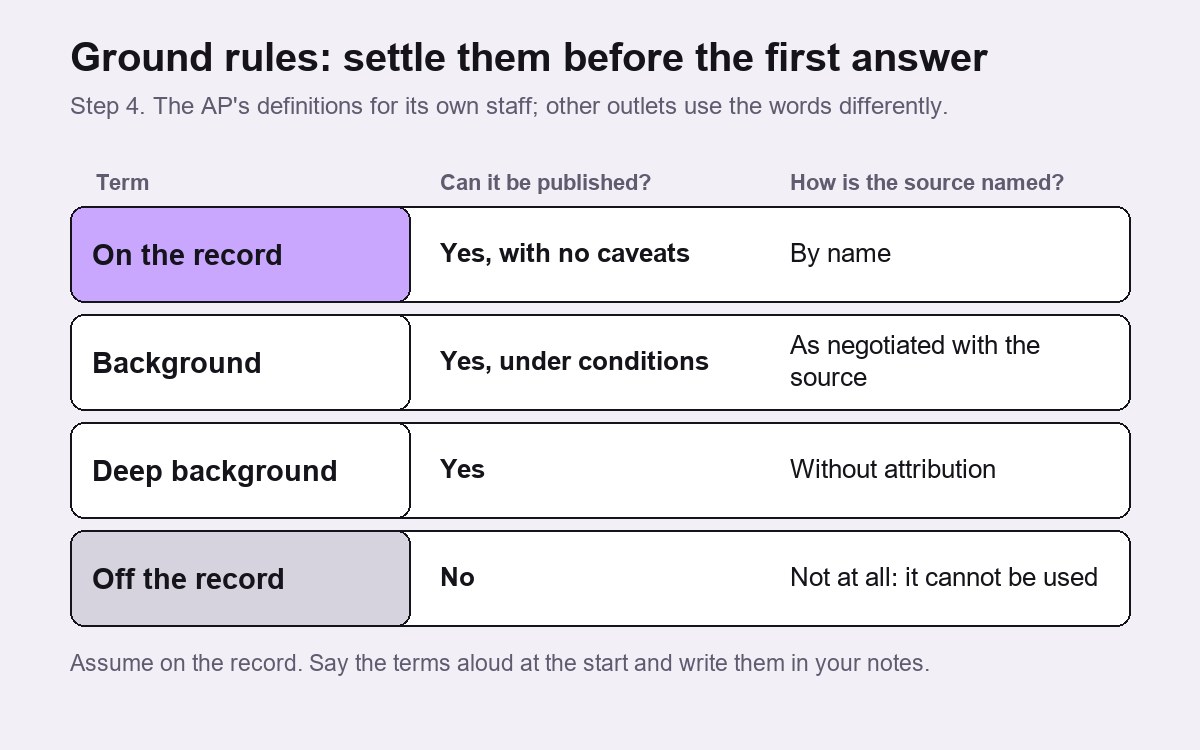
These are the AP's definitions for its own staff. Other publications use the words differently, which is the AP's own point. So say the terms aloud and write them in your notes: "We are on the record unless you tell me otherwise; if you want something off the record, say so before you say it."
On anonymity, the AP lets its reporters use anonymous material only under conditions, including that the material is information and not opinion, that it is vital to the report and not available any other way, and that the source is reliable and in a position to have direct knowledge; the story should also explain why anonymity was requested [2]. If you cannot meet conditions like these, you do not have a usable anonymous source, whatever the person offered.
Step 5: decide how you will record, and what you will do with the answers
Record or take full notes. The BBC says research interviews with sources making serious allegations should, "wherever practicable, be recorded", and where recording might inhibit the source, full notes should be made, "preferably at the time or, if not, as soon as possible afterwards" [1]. That is written for serious allegations, but it is a good floor for any interview you may need to quote or defend. Tell the person you are recording. The IPSO Editors' Code, a UK press code, says the press must not seek to obtain or publish material acquired by using "hidden cameras or clandestine listening devices" [3]; the clause allows exceptions in the public interest. Open recording is simple and avoids the question.
Quote exactly. The AP says it does "not alter quotations, even to correct grammatical errors or word usage". If a quotation is flawed, the guidance is to paraphrase it or not use it, and to use ellipses rarely and never so that they alter the speaker's meaning. It also advises giving the setting in which a quotation was obtained, for example a press conference, phone interview or hallway conversation [2]. If the answers came in writing, say so, as the AP says of a quotation from a written document such as an email [2]; your reader should know whether the person spoke or typed.
Verify what you were told. Treat each factual claim from the interview as a claim until you have checked it against something else. Mark in your notes which claims you could back up, which you could not, and which are only opinion.
Give a right of reply. The AP says it "must make significant efforts to reach anyone who may be portrayed in a negative way", and must give them "a reasonable amount of time to get back to us" [2]. Whatever your own rule, a person criticised in a piece should have the chance to answer. If they do not reply, say that you asked.
A worked example (invented)
The example below is invented to show the method. The studio, the person and the exchange do not exist.
Suppose a game studio called Example Games rolled back a patch within a day, and its announcement said only "we found an issue". The announcement and the patch notes are the documents. They do not say what the issue was or who decided to roll back.
The gap: "The rollback was triggered by a change to how rewards are calculated, which the announcement did not say." You do not know this. It is a hypothesis.
The person: the community lead who wrote the announcement may know the official line but not the technical cause. A developer who worked on the rewards code would know the cause first-hand. You ask for the developer and the lead.
Questions, drawn from the five kinds:
- Event: "Walk me through the day of the rollback, in order."
- Decision: "Who decided to roll back, and what else was considered?"
- Record: "Is there a public incident note or a commit I can read?"
- Source: "Were you in the thread where it was decided?"
- Gap: "What do you still not know about the cause?"
Ground rules: at the start, "We are on the record. If you want to tell me something off the record, say so first." The developer says one point must stay off the record, and you agree before they say it.
After: you record the call with the developer's agreement. The developer names a commit. You read it. It confirms a change in how rewards are computed, but not that this caused the rollback, so the piece states the change as documented and the cause as the developer's account. The lead does not answer; the piece says you asked.
Notice that the interview did not prove the cause. It produced a pointer to a document and a first-hand account, each labelled for what it is.
Common mistakes, and fixes
Asking what the documents already say. Fix: read first, and write the gap before the questions.
Several questions in one. Fix: one fact per question; ask the second one separately.
Leading questions. Fix: ask for the person's description, not their agreement.
Unclear terms. "Off the record" meant one thing to you and another to them. Fix: say the terms at the start, in plain words, and write them down.
Cleaning up quotes. Tidying grammar and leaving the quotation marks. Fix: quote exactly or paraphrase without marks.
A template to copy
Gap this interview fills (one line): Person and what they could know first-hand: Documents read beforehand: Questions: event / decision / record / source / gap Ground rules said aloud at the start (on / off / background): Recording: yes / no, told the person At the end: move anything onto the record? Claims to verify afterwards, and against what: Right of reply: who, when asked, answer or no answer:
What this article cannot tell you
It does not say how to persuade someone to be interviewed, how to handle consent and legal rules in your country, or what to do when a source is at risk; those need advice that fits your situation. The rules quoted come from the AP's guidance for its own staff, the BBC's guidelines and a UK press code, and are not universal. I did not verify claims I have seen elsewhere about approving quotes before publication or about using AI tools to prepare interviews, so this article makes none. The studio and the exchange in the worked example are invented, and nothing in them is a statement about a real company. I ran no interview for this article; it describes a method and cites rules.
How this article was made
| Task | What the AI did | What a person did | How it was checked |
|---|---|---|---|
| Research | Gathered candidate standards and drafted notes | Chose the question and which standards to rely on | Every quote checked against the page named in the sources, read on 18 November 2026 |
| Draft | Wrote the first draft from the notes | Edited the text, the question list and the invented example | An independent review compares claims with the sources before publication |
| Images | Generated the cover illustration; diagrams built in code | Chose the illustration and checked the diagrams | Labelled as AI-generated in the disclosure line and alt text |
| Not done by AI | — | The decision to publish and responsibility for the text | — |
Conflicts of interest: none. The author has no commercial relationship with any organisation named here.
Responsible for this article: Dmitriy Lastovka, author. Corrections: contact form.
Sources
Labels: standard (published editorial rules).
- BBC Editorial Guidelines, Section 3 Accuracy, guidelines 3.4.1 to 3.4.15. https://www.bbc.co.uk/editorialguidelines/guidelines/accuracy/guidelines Standard.
- The Associated Press, News Values and Principles: "Telling the Story" and the rules on sources, quotations and responses. https://www.ap.org/about/news-values-and-principles/telling-the-story/ Standard.
- IPSO, "The Editors' Code of Practice", clause 10 (Clandestine devices and subterfuge). https://www.ipso.co.uk/editors-code-of-practice/ Standard (UK press).