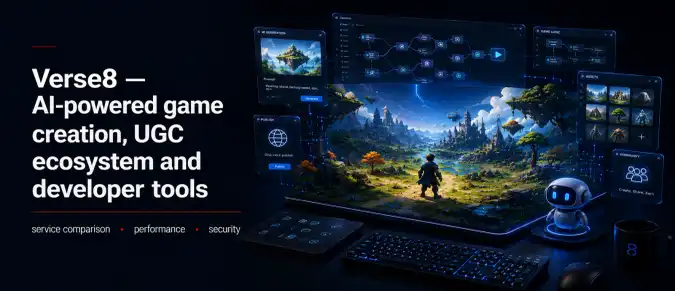

Verse8 is an AI-native platform for creating, publishing, and distributing user-generated games that combines generative artificial intelligence, UGC, and selected Web3 mechanics. Instead of relying on a traditional game editor, users can describe an idea in natural language, while the system helps generate the game world, logic, and other project components. The platform launched publicly in July 2025, and by 2026 Verse8 had evolved beyond a development tool into a publishing ecosystem for user-created games. Its blockchain strategy is primarily focused on intellectual property management, programmable licensing, and experiments with on-chain content monetization.
Contents
- What Is Verse8 and How Does the AI Game Creation Platform Work?
- Creating UGC Games: Prompts, Multiplayer, and Publishing
- Verse8 Monetization: VX, VXShop, and the Creator Economy
- Story, Web3, and Intellectual Property Management
- Verse8 Development and the Future of AI-Native UGC Gaming

1. What Is Verse8 and How Does the AI Game Creation Platform Work?
Verse8 emerged from the ecosystem of Planetarium Labs, a company known for developing blockchain games and infrastructure for Web3 gaming. The platform was designed to lower the technical barriers to creating interactive content. Users do not necessarily need to write code, install a traditional game engine, or assemble a separate team of artists and developers to build a basic prototype.
The core model follows a prompt-to-play approach. A creator describes a game in text, and the AI system interprets the request and generates the required project elements. Verse8 is not limited to simple 2D mini-games: its architecture is designed to support three-dimensional and multiplayer projects with different mechanics, visual styles, and rules.
Verse8 launched publicly on July 15, 2025. The platform became accessible through a web browser without requiring users to install a separate game client or full development environment. This approach combines content creation and distribution: after preparing a project, a creator can publish it within the same ecosystem where other users can discover and play the game.
Verse8 therefore differs from both a standalone blockchain game and a conventional game engine. The platform simultaneously functions as an AI-powered creation tool, a catalog of user-generated games, and infrastructure for publishing them. In 2026, the company also expanded its publishing strategy, treating promising UGC projects as potential standalone gaming products.
2. Creating UGC Games: Prompts, Multiplayer, and Publishing
The main Verse8 workflow begins with an idea expressed in ordinary text. AI helps transform the description into a working prototype, including game logic, environments, and other required components. After the initial generation, creators can refine the project through additional instructions, gradually changing its rules, content, or visual elements.
This model differs from conventional no-code editors. In a traditional game builder, users manually position predefined components and connect them through a visual interface. Verse8 transfers a significant part of this process to a generative system: the creator primarily focuses on defining the concept, evaluating the generated result, and iterating through additional prompts.
The platform supports multiplayer content, which increases the complexity of the processes being automated. A multiplayer game requires more than generated graphics: it needs interaction rules, game-session state management, and server infrastructure. Verse8 uses a cloud-based model, allowing the platform to handle part of the technical deployment process.
Another component is the ability to modify existing user-generated projects. Early Verse8 terminology referred to moddable and forkable verses, allowing creators to take an existing game as a foundation and develop their own variation. This approach brings the ecosystem closer to a UGC model in which one successful format can become the basis for multiple derivative mechanics and game worlds.
3. Verse8 Monetization: VX, VXShop, and the Creator Economy
For a UGC platform, generating content is only part of the process; creators also need tools to support their projects after publication. Verse8 is developing an integrated monetization system called VXShop, which allows creators to add in-game purchases without independently integrating a separate payment gateway. User-generated games can therefore receive an economic layer directly within the platform's infrastructure.
Transactions use VX, Verse8's internal virtual currency. Users purchase VX through the platform and spend it on supported in-game items and features. According to the service terms, VX is not legal tender, does not generate interest, and does not represent an investment right. Under the standard model, 100 VX corresponds to a purchase price of $1, excluding applicable taxes and additional fees.
| Component | Purpose | Role in the Verse8 Ecosystem |
|---|---|---|
| AI Game Creation | Game generation | Creation of game projects using text prompts |
| UGC Platform | User-generated content | Publishing, discovery, and launching of user-created games |
| Multiplayer | Multiplayer mechanics | Support for cooperative and competitive gameplay scenarios |
| VX | Virtual currency | Purchasing supported in-game items and features |
| VXShop | Monetization | In-game purchasing infrastructure for creators |
| Story | Blockchain / IP | Infrastructure for licensing and programmable IP rights |
VXShop simplifies payment infrastructure for creators because payment processing and related operations are handled by the platform. This can be particularly relevant for small UGC teams, as independently developing a payment system, backend infrastructure, and in-game store can consume a significant portion of a project's resources.
VX should, however, be distinguished from a freely traded cryptocurrency token. Verse8's terms define it as a virtual currency used within the service rather than an investment asset. The VXShop economy is therefore more comparable to the internal currencies used by gaming platforms, while Verse8's blockchain component is being developed separately through intellectual property infrastructure and on-chain integrations.

4. Story, Web3, and Intellectual Property Management
One of Verse8's most notable Web3 integrations is its collaboration with Story. In September 2025, the companies announced the use of Story as blockchain infrastructure for IP licensing in user-generated games. The concept is designed to connect the creation of derivative content with programmable rules governing the use of intellectual property.
Moonbirds and Azuki were selected as early examples. Their IP was intended to be integrated into Verse8's tools so that creators could use supported characters and brand elements when developing interactive projects. Under this architecture, blockchain is not used to process every movement of a game character. Instead, it provides infrastructure for rights registration, licensing, and the distribution of economic flows associated with IP.
Key Features of the Verse8 Ecosystem:
- game creation using natural-language prompts and AI;
- support for user-generated 2D and 3D projects;
- tools for developing multiplayer games;
- cloud publishing without independently deploying game servers;
- a UGC model that allows existing game concepts to be modified and expanded;
- an integrated VXShop monetization system;
- VX as the platform's internal virtual currency;
- Story integration for managing licensed intellectual property;
- experiments with Web3 IP in user-generated games;
- publishing and distribution infrastructure for promising projects.
A programmable IP model can potentially address one of the more complex issues surrounding generative UGC. If a user creates a derivative game based on another party's character or brand, it is necessary to determine who authorized the use of the original material and how the resulting economic value should be distributed. Story can record these relationships through on-chain infrastructure and smart contracts when appropriate licensing terms are in place.
The technology itself does not eliminate the legal risks associated with generative content. Users must have the necessary rights to materials they upload or use when creating UGC. Verse8's terms also separately regulate rights to generated materials and the use of user content, meaning that the technical ability to create a game does not automatically provide commercial rights to every piece of IP used in the project.
5. Verse8 Development and the Future of AI-Native UGC Gaming
Following its public launch, Verse8 began rapidly expanding the volume of user-generated content on the platform. In March 2026, the company reported more than 3.5 million monthly users, over 5,000 active creators, and approximately 25,000 games created. These figures were reported by the company itself, but they provide an indication of the scale of the AI-assisted game development experiment during the platform's early growth period.
In March 2026, Verse8 also raised $5 million in a seed funding round. Participants included Story Foundation, NEXPACE, Neowiz, MARBLEX, Solarium Labs, and NEXUS. The funding was intended to support development of the core AI system, creator acquisition programs, and expansion of the platform's publishing and global distribution infrastructure.
Game hackathons have provided a practical test of the UGC model. During BuidlHack 2026, organized together with YGG Play, 120 teams submitted projects created with Verse8. The winner was Bank or Plank, a 3D multiplayer game developed by a single participant without professional programming experience. Some projects were considered for additional publishing support, illustrating a transition from basic prototype generation toward identifying commercially viable user-created content.
As of August 2026, Verse8 is more accurately described as an AI-native UGC and publishing ecosystem rather than a standalone blockchain game. Generative tools provide the content creation layer, cloud infrastructure supports game deployment and distribution, VXShop handles in-game monetization, and Story adds a separate blockchain layer for intellectual property. The platform's future development will depend on the quality of user-created games, player retention, the effectiveness of its AI tools, commercial rules for UGC, and Verse8's ability to turn rapidly generated prototypes into games capable of sustaining long-term audiences.











