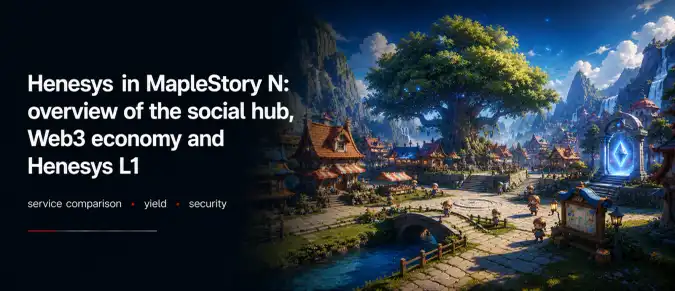

Henesys is one of the most recognizable locations in the MapleStory universe and continues to serve as an important gameplay and social hub in MapleStory N. Players interact with NPCs, access limited-time events, participate in mini-games, and engage with selected economic activities. At the same time, the Henesys name is used for Henesys L1, the dedicated blockchain network of MapleStory Universe that supports NXPC, NESO, NFTs, and ecosystem smart contracts. Therefore, Henesys in MapleStory N can be viewed on two levels: as a social location within the MMORPG and as part of the Web3 infrastructure developed by NEXPACE.
Contents
- What Is Henesys in MapleStory N and Why Is It a Social Hub?
- Henesys Social Features: Events, Parties, and Player Activities
- NESO, NXPC, NFTs, and the MapleStory N Economy
- Henesys L1, Avalanche, and MapleStory Universe Web3 Infrastructure
- Henesys Development and the Future of MapleStory N's Social Ecosystem
1. What Is Henesys in MapleStory N and Why Is It a Social Hub?
Henesys existed long before MapleStory N. In the original MapleStory, it is a town on Victoria Island associated with archers and early character progression. Thanks to its NPCs, accessibility for new players, and high concentration of users, Henesys historically became one of the most recognizable meeting points for the MapleStory community.
MapleStory N partially preserves this role. Henesys is used as a location for NPCs connected to limited-time events, shops, quests, and mini-games. For example, during 2026 updates, players could access Tangyoon Restaurant, One Card, and other temporary activities through NPCs located in Henesys.
For this reason, the term “social hub” should be understood functionally. Henesys is not a separate Web3 social platform or an independent MapleStory Universe application. It remains a town within the game world that serves as a community interaction point through its concentration of NPCs, events, and players.
Henesys L1 adds another meaning to the name. It refers to the main blockchain network of MapleStory Universe. Although named after the familiar in-game location, it serves a completely different purpose by providing on-chain infrastructure for NXPC, NESO, NFTs, and related ecosystem applications.
2. Henesys Social Features: Events, Parties, and Player Activities
The social layer of MapleStory N extends beyond characters simply sharing the same map. The game supports friends, parties, guilds, and other forms of player interaction. Through the party system, users can invite characters, search for available groups on the current map, and view information about other members. A party can include up to six players.
Guilds provide a more persistent community structure. Players can join existing organizations, participate in shared activities, and accumulate guild-related activity metrics. Henesys therefore functions not as the only social center, but as one physical location within a broader system of player interaction.
| Component | Type | Role in MapleStory N |
|---|---|---|
| Henesys | In-Game Town | Provides access to NPCs, events, and selected multiplayer activities |
| Party | Social System | Allows up to six players to form a group for shared content |
| Guild | Community System | Connects persistent groups of users and supports cooperative activity |
| Chat | Communication System | Allows players to communicate within the game world |
| Event NPCs | Event Infrastructure | Provide access to temporary quests, shops, and mini-games |
| MSU Marketplace | Web3 Marketplace | Supports trading of eligible NFTs and other digital assets |
Henesys is regularly used as an entry point for multiplayer events. In Tangyoon Restaurant, for example, players could interact with the NPC Kemdi and wait for a team to be formed or enter with an existing party. One Card similarly used the town as an access point for matchmaking. This turns a familiar location into a practical hub for organizing temporary social content.
Economic events are also conducted through NPCs in Henesys. During selected campaigns, users could exchange NESO for special items or gain access to seasonal rewards. The exact functionality changes with each update, meaning that the role of the town evolves together with MapleStory N's live-ops system.
3. NESO, NXPC, NFTs, and the MapleStory N Economy
The MapleStory N economy uses several interconnected types of assets. During regular gameplay, users can earn NESOLET, a character-bound currency obtained through various in-game activities. Through the minting process, NESOLET can be converted into NESO at a 1:1 ratio, bringing it into the on-chain economy of MapleStory Universe.
NESO is used to purchase NFT items, characters, and consumable assets through the MSU Marketplace, as well as for certain gameplay operations, including NFT item enhancement. NXPC has a broader role as the native token of MapleStory Universe, supporting asset creation and value exchange across the ecosystem.
Key Elements of the MapleStory N Economy:
- NESOLET as a currency earned directly through gameplay;
- conversion of NESOLET into NESO at a 1:1 ratio;
- NESO as an on-chain currency within MapleStory Universe;
- NXPC as the native token of the ecosystem and Henesys L1;
- a fixed swap ratio of 100,000 NESO to 1 NXPC;
- NFT items and characters with verifiable ownership history;
- MSU Marketplace for trading supported digital assets;
- Swap & Warp functionality for NXPC and NESO operations;
- MSU Explorer for viewing blockchain data;
- an on-chain economy separated from most high-frequency gameplay actions.
An important feature of this model is the separation between regular gameplay and blockchain transactions. Character movement, combat, communication, party participation, and most other actions do not require separate on-chain transactions. Blockchain infrastructure is primarily used when ownership, minting, transfer, or trading of a digital asset needs to be recorded.
As a result, Henesys retains the familiar structure of a traditional MMORPG town. Players interact with NPCs and other characters through conventional game mechanics, while the Web3 layer is activated for specific economic operations. This architecture combines social gameplay with verifiable digital ownership without moving the entire game loop on-chain.
4. Henesys L1, Avalanche, and MapleStory Universe Web3 Infrastructure
Henesys L1 is the dedicated blockchain network of MapleStory Universe and serves as the mainnet for the ecosystem's on-chain assets. The network is connected to Avalanche technology infrastructure, while users can interact with it through compatible Web3 wallets and MapleStory Universe services.
MapleStory N uses a hybrid architecture. High-frequency gameplay continues to operate through traditional server infrastructure, while digital ownership and selected economic operations can be recorded on Henesys L1. This approach avoids turning every character action into a blockchain transaction and helps preserve the responsiveness expected from an MMORPG.
NXPC is the native token of the network. NESO also plays an important role in MapleStory N as its on-chain game currency. A Swap mechanism connects the two assets at a fixed ratio of 1 NXPC to 100,000 NESO. A separate Warp function enables supported assets to move between Henesys and external blockchain infrastructure.
MSU Explorer provides access to blockchain data. Users can view Henesys L1 transactions, blocks, deployed smart contracts, tokens, and NFTs. This makes part of the MapleStory N economy publicly verifiable, while ordinary gameplay actions remain within the conventional client-server infrastructure.
5. Henesys Development and the Future of MapleStory N's Social Ecosystem
Following the launch of MapleStory N in 2025, Henesys retained its role as an important location for temporary content. Throughout 2025 and 2026, the town hosted NPCs for mini-games, shops, resource exchanges, and quests, including Tangyoon Restaurant, One Card, and Lucid Minion Hunt. This approach gives players recurring reasons to return to a familiar location, where individual progression intersects with group activities, the game economy, and community interaction.
At the same time, Henesys L1 is becoming increasingly important as infrastructure. MapleStory Universe uses blockchain not only for MapleStory N but also as a foundation for additional applications and services. Open on-chain data can support analytics, NFT tools, and other products built around the shared ecosystem economy.
The main risks include player retention, digital asset liquidity, the complexity of Web3 mechanics, and demand for third-party applications. NFTs and blockchain do not create a social environment on their own: events, guilds, trading, and cooperative content remain necessary for sustained player interaction.
Henesys should therefore be viewed in two contexts: as the social and event hub of MapleStory N and as the name of the blockchain network supporting NXPC, NESO, NFTs, and MapleStory Universe smart contracts. The future of this model will depend on NEXPACE's ability to combine traditional MMORPG social interaction with digital ownership without making Web3 infrastructure an obstacle to the core gameplay experience.











