

In the rapidly evolving world of digital assets, efficient trade execution becomes critical for success. Institutional traders face fragmented liquidity, disparate trading venues, and the need to minimize the market impact of their operations.
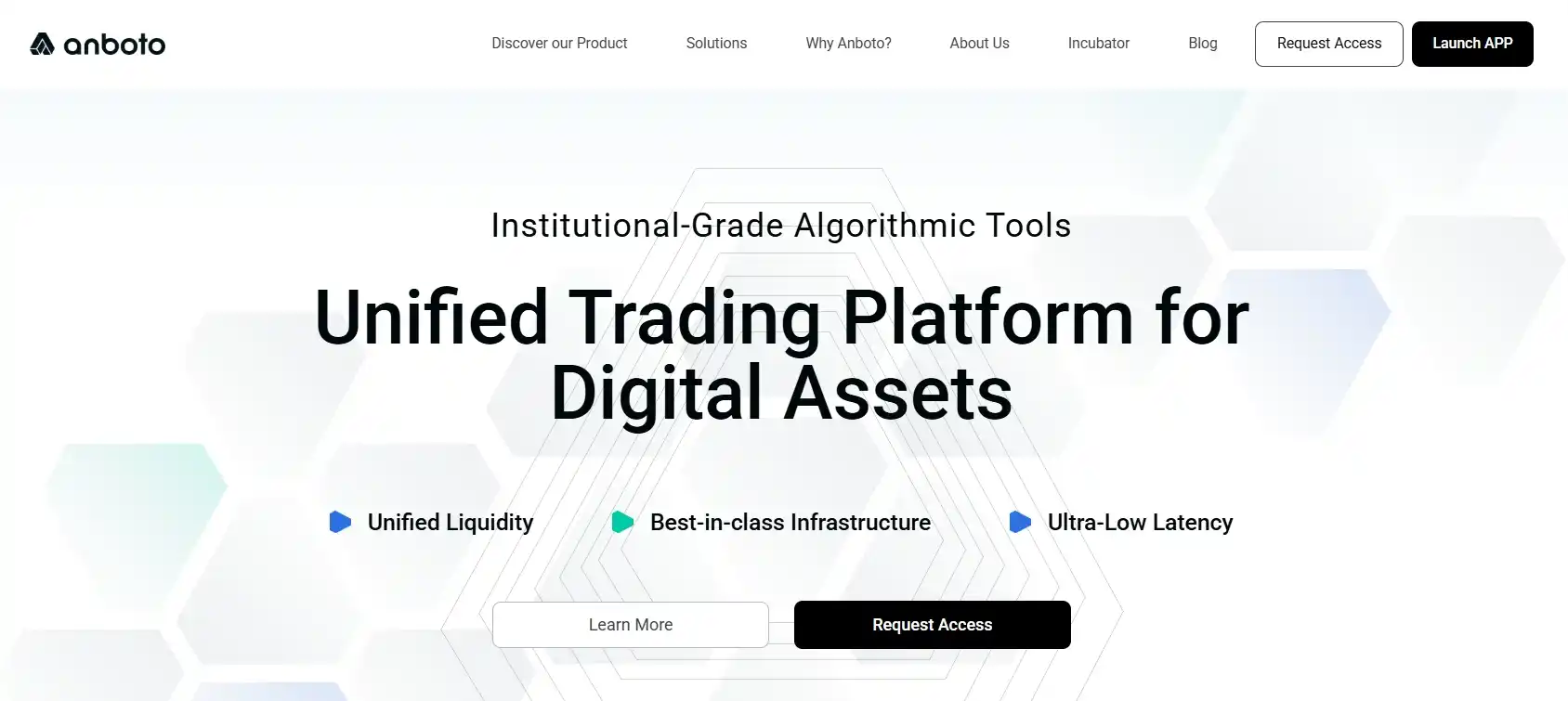
The Anboto platform offers a comprehensive solution to these problems, presenting itself as a universal trading gateway. It unifies access to centralized and decentralized exchanges, providing professional tools for analysis and execution. This approach allows market participants to act more confidently and achieve better results from their trading activities.
Contents:
- Universal Access to Digital Asset Liquidity
- Technological Foundation of Anboto for Professional Trading
- Algorithmic Order Execution Strategies of the Project
- Analytics at All Stages of a Trading Operation
- Integration with the Blockchain Ecosystem and the Future of Anboto
- Conclusion
Universal Access to Digital Asset Liquidity
The main obstacle for major players in the crypto market remains fragmentation. Liquidity is distributed across numerous centralized exchanges (CeFi) and decentralized protocols (DeFi). Anboto solves this problem by acting as a single aggregator. The platform is integrated with all major trading venues, providing secure access to their combined liquidity pools.
Such single-point access simplifies management and allows finding optimal prices for transactions of any volume. Traders no longer need to maintain separate accounts on dozens of platforms or manually track arbitrage opportunities. Anboto consolidates market data and execution capabilities, transforming a complex landscape into a comprehensible and controllable environment. This fundamentally changes the approach to trading digital assets, making it more systematic and efficient.
Technological Foundation of Anboto for Professional Trading
For implementing trading strategies, especially high-frequency ones, infrastructure is critically important. Anboto is built as an ultra-low latency platform. Engineering solutions ensure high-speed real-time operation, which directly affects the quality of order execution and final profitability.
To achieve maximum speed, dedicated servers located in close proximity to the servers of the largest exchanges are used. This minimizes signal transmission time. The resilient and reliable architecture withstands high loads characteristic of the volatile crypto market. Thus, the platform's technological superiority becomes a tangible advantage for its users, allowing them to act faster than the market.
Algorithmic Order Execution Strategies
The primary tool for optimizing trading for Anboto is a suite of advanced algorithms. These solutions automate the execution process, allowing for work with large volumes while minimizing market impact. The platform provides a unified set of strategies for use on both centralized (CeFi) and decentralized (DeFi) venues.
- TWAP (Time-Weighted Average Price): Splits a large order into equal parts and executes them at equal time intervals, averaging the price.
- VWAP (Volume-Weighted Average Price): Executes an order proportionally to the market trading volume, aiming to achieve an average price weighted by volume.
- Iceberg: Allows hiding the majority of an order's volume, showing the market only a small visible portion.
- IS (Implementation Shortfall): Actively seeks counterparty liquidity, balancing between the urgency of execution and transaction cost.
- POV (Percentage of Volume): Controls the trading pace by executing an order as a specified percentage of the total market volume.
The use of these algorithms allows institutional clients to execute orders at better prices compared to manual methods. This approach is especially important when dealing with large volumes, where direct market impact can be significant. Automation also ensures discipline and removes the emotional factor from decision-making.
Analytics at All Stages of a Trading Operation
The Anboto platform provides traders with comprehensive analytical tools covering the full trade cycle — from planning to result evaluation. This approach creates a closed loop for decision-making, where data from each stage is used to optimize subsequent operations. The system not only helps execute orders effectively but also enables continuous learning from results, increasing the overall efficiency of capital use.
| Analytical Stage | Main Goal | Key Result for the Trader |
|---|---|---|
| Pre-Trade Analysis | Assessing the potential market impact of an order | Minimizing slippage (price decline) and commission costs even before the trade starts |
| Execution Analysis | Monitoring the application of algorithms in real-time | Controlling the order fill quality considering available liquidity and market conditions |
| Post-Trade Analysis | Comparing achieved results with market benchmarks | Accurate calculation of savings, transparent reporting, and verification of strategy effectiveness |
Such comprehensive analysis transforms raw trade data into valuable information for informed decision-making. This ensures a high degree of operational transparency and creates a foundation for continuous improvement of trading methodologies. The integration of analytics at all stages is a key advantage for institutional clients who require detailed reporting and quantitative performance evaluation.
Integration with the Blockchain Ecosystem and the Future of Anboto
Anboto does not exist in isolation but is part of a broader crypto-economic infrastructure. Its ability to interact with Decentralized Finance (DeFi) protocols is a direct consequence of the development of smart contracts and cross-chain technologies. The platform utilizes the public and immutable nature of blockchain for transaction verification and access to decentralized pool liquidity.
This integration paves the way for complex strategies that combine CeFi and DeFi capabilities, such as arbitrage or the use of collateralized liquidity. In the future, deeper automation can be expected, where Anboto's algorithms will interact directly with smart contracts for instant execution of complex logical conditions. Thus, the project acts as a bridge connecting traditional institutional practices with the innovative and rapidly growing world of decentralized finance.
Conclusion
The Anboto platform offers institutional market participants a holistic solution for systematizing trading activities in a fragmented crypto market. It successfully removes key operational barriers: it aggregates liquidity, provides high-speed infrastructure, and implements a suite of algorithmic tools. This allows traders to act more efficiently and with greater discipline.
Integration with decentralized protocols and comprehensive analytics underscores the project's future-oriented approach. Anboto does not just automate processes but creates a foundation for complex strategies, connecting traditional financial practices with the innovative possibilities of blockchain. For professional investors, such solutions are becoming a necessary standard for maintaining competitiveness.











