

With the development of decentralized finance (DeFi) and blockchain technologies, associated risks are also growing: smart contract vulnerabilities, oracle manipulations, sudden drops in stablecoin prices. The OpenCover project offers an innovative solution for protecting digital assets, making insurance in this sphere simple, accessible, and reliable. The platform acts as an intermediary between crypto portfolio owners and professional insurers, ensuring transparency and rapid loss settlement. This allows investors to focus on growth strategy, minimizing potential financial losses.
Contents:
- Mission and Goal of OpenCover
- Key Products and Insured Risks
- Advantages and Service Accessibility
- Technological Foundation and Proof of Coverage
- Investment Support and Partners of OpenCover
- Conclusion
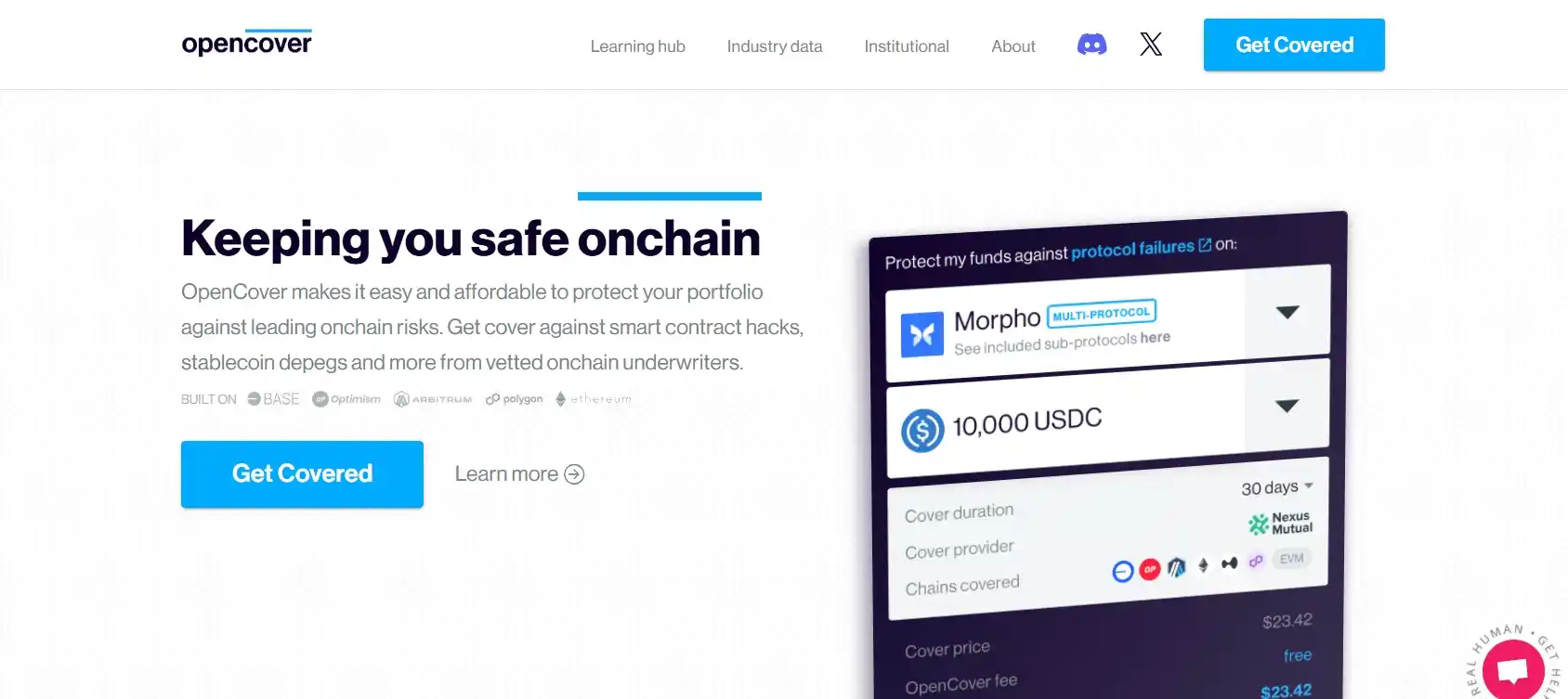
Mission and Goal of OpenCover
The main goal of the OpenCover platform is to ensure universal accessibility of protection against key risks in the blockchain space, such as smart contract vulnerabilities, stablecoin failures, and attacks on protocol governance. Its mission is to create a safer and more trustworthy environment for decentralized finance, where investors can focus on growth opportunities without exposing their capital to uncontrolled threats.
To accomplish this task, the project serves as a link between users and vetted insurers, democratizing access to complex financial instruments. OpenCover transforms digital asset insurance into a simple, economical, and transparent process, lowering entry barriers and promoting the maturity and mass adoption of the Web3 ecosystem.
Key Products and Insured Risks
OpenCover offers specialized insurance products focused on the most significant threats in the DeFi environment. The platform allows users to protect assets in over 100 leading protocols and their combinations, providing comprehensive protection in a multi-chain space.
The main insured risks are:
- Smart Contract Hacks: Compensation for damage from exploiting vulnerabilities in decentralized protocol code.
- Stablecoin Depegs: Insurance against a digital currency losing its peg to the underlying asset (e.g., the US dollar).
- Oracle Manipulations: Coverage for losses caused by failures or targeted attacks on external data sources critical for protocol operation.
- Governance Attacks: Protection from the financial consequences of malicious actors seizing control over a project's governance mechanisms.
This range of products allows investors to create a customized security profile that precisely matches the structure of their digital portfolio. The platform provides targeted coverage, offering confidence when interacting with the rapidly developing, yet not risk-free, Web3 ecosystem.
Advantages and Service Accessibility
OpenCover stands out in the market by offering a unique combination of ease of use, cost-effectiveness, and reliability. The platform eliminates technological and operational complexities, making the process of insuring digital assets intuitive and accessible even for beginners. Premiums start from just $2 per week for $5,000 of coverage, making protection affordable for most users.
The following table clearly illustrates the key differences between using the ready-made OpenCover solution and independently organizing insurance protection:
| Criterion | OpenCover Solution | Do It Yourself Approach |
|---|---|---|
| Value Proposition | Access to vetted insurers and standardized products. | Need for independent counterparty search and terms negotiation. |
| Process Complexity | Low, the interface automates policy selection and purchase. | High, requires deep knowledge in risk management and technical expertise. |
| Operational Costs | Transparent and predictable fees, included in the premium. | Hidden costs of time and resources for due diligence and administration. |
| Interaction Interface | A single convenient application for managing coverage. | Disparate tools: wallets, forums, chats for negotiations. |
Thus, OpenCover does not merely offer an insurance product but provides a comprehensive service that saves users what is most valuable — time and intellectual resources. This allows investors to confidently diversify risks and focus on the growth strategy of their portfolio, rather than on the technical details of its protection.
Technological Foundation and Proof of Coverage
OpenCover is organically integrated into the Web3 infrastructure, leveraging the key advantages of distributed ledger technology to ensure transparency and veracity. A fundamental element of this system is the issuance of an ERC-721 standard token as digital proof of an insurance contract. Each such non-fungible token (NFT) is unique and contains all essential information about the insurance policy.
This approach implements the "Proof of Cover" concept, where the token serves as irrefutable and easily verifiable evidence of active protection. It can be freely viewed in a blockchain explorer, transferred, or integrated with other decentralized applications. Thus, blockchain technology provides a reliable and immutable foundation for insurance relationships, minimizing the possibility of disputes and simplifying audit and verification processes.
Investment Support and Partners of OpenCover
The development of OpenCover is reinforced by the trust and financial investments of leading institutional and private investors specializing in high-tech and blockchain projects. The participation of these key players serves as a marker of high evaluation of the platform's potential and its long-term strategy.
Among the project's partners are influential funds and communities, such as:
- Village Global — a venture fund supported by the world's largest entrepreneurs.
- NFX — a prestigious venture firm founded by experienced startup founders.
- Alliance DAO — a leading Web3 accelerator that has nurtured many successful projects in DeFi.
- Base Ecosystem Fund — a fund investing in promising initiatives built on the Base network.
Such solid support not only provides the project with the necessary resources for growth but also strengthens its reputation in the market. This allows OpenCover to attract more vetted insurers with significant capital, which ultimately increases the reliability and scale of the protection offered to end users.
Conclusion
The OpenCover project addresses one of the most acute problems in the space of decentralized finance, offering a structured response to growing risks. The platform effectively fills an existing gap, transforming digital asset insurance from a complex, niche task into an accessible and convenient tool for every market participant.
The integration of Web3 principles through NFT proof of coverage, support from leading venture funds, and partnership with vetted insurers form a solid foundation for sustainable development. Thus, OpenCover makes a significant contribution not only to the protection of individual capital but also to the creation of a more reliable, mature, and attractive blockchain ecosystem for institutional players.











