
AI tools helped gather research and write the first draft of this article. I edited it and checked every quote against the source page listed at the end. The cover illustration is AI-generated. Details at the end.
An AI assistant is asked: "Has this lending protocol been audited?" A minute later it answers "Yes", with a link. The link exists. It opens. Its title says "Security audit". The answer looks sourced.
Now ask what the assistant actually did. It may have read the audit report. It may have read a line of preview text under a search result. It may have been unable to open the page at all and answered from what it remembered. All three end the same way: a confident sentence with a URL beside it.
Finding a page and reading it are two different steps, and a claim belongs to the second one. This article separates them. It is the first part of Evidence Work, a series about how a research answer earns its confidence. Later parts look at what happens to a page's text after it is fetched, at dates and versions, and at how to compare tools. This one stays earlier in the chain: what you can honestly say after a page has been found, and what you can only say after it has been read.
What a search result is
A search result is a pointer to a page. It normally shows an address, a title and a short description. The description is a snippet, and Google's documentation explains where it comes from: "Snippets are automatically created from page content." [1] It adds that Google sometimes uses the meta description of the page instead, when that gives users a more accurate description [1]. Either way, the text under the link is a summary produced by the search engine or supplied by the page's owner. It is not the page.
So a snippet can only support a modest statement: "A page with this title exists and, according to its preview, is about this." Whether the page says what the claim needs, in the part of the page that matters, is not in the snippet.
A pointer can also exist when nothing was read at all. Google's robots.txt documentation says that file "is not a mechanism for keeping a web page out of Google", and that Google "might still find and index a disallowed URL if it is linked from other places on the web" [2]. In that case the URL can appear in search results, but "the search result won't have a description" [2]. In other words, a search engine can list a page it has not looked inside. For an assistant that treats a search hit as evidence, that is a useful reminder: appearing in results is a fact about the address, not about the content.
Where a URL came from matters
A link in an answer can arrive by three routes: it came out of a search result, the user supplied it, or the model produced it from memory. Only the first two prove the address was seen by a tool or a person. The third proves nothing.
How unreliable can memory be? One 2023 study in Scientific Reports asked GPT-3.5 and GPT-4 to write short literature reviews on 42 multidisciplinary topics and checked the 636 citations found in the 84 resulting papers [3]. Of the citations from GPT-3.5, 55% were fabricated, against 18% for GPT-4 [3]. Among the citations that did correspond to real works, 43% of the GPT-3.5 ones and 24% of the GPT-4 ones contained substantive errors [3]. Two limits apply. The study measured bibliographic citations, not web links, and it tested two models that are now old. It says nothing about how today's tools behave. What it does show is the failure mode: a plausible, well-formed reference that points to nothing.
Some tool makers have built a guard against it. Anthropic's documentation for its web fetch tool says Claude "cannot fetch URLs that appear only in its own output" and can only fetch URLs that have already appeared in the conversation: in user messages, in client-side tool results, or in earlier web search and web fetch results [4]. The stated reason is security, to limit data exfiltration, but it has a useful side effect for research: a URL the model only wrote in its own reply cannot be fetched. The guard is not a full proof of origin, because the same page notes that client-side tool results count as a source even when they echo text Claude produced [4]. The documentation also lists url_not_in_prior_context as the error when that rule is broken [4].
The practical check is simple: for every link in an answer, ask how it got there. A link a tool actually returned, or that you gave the tool, can be traced. A link that appeared only in the answer text needs to be opened by a person before anyone relies on it.
Reading can fail, and the failure has to be reported
Suppose the address is real. The next step is to fetch it, and fetching can end in several ways that are not "the page text arrived".
Anthropic's documentation lists the error codes of its fetch tool. Among them: url_not_allowed, used for URLs blocked by domain rules or by Anthropic-side restrictions, including private addresses and robots.txt; url_not_accessible, "Failed to fetch content (HTTP error)"; unsupported_content_type, "only text, HTML, and PDF"; and content_too_large, for a PDF that would exceed the request's size limits [4]. The same page says that when the tool hits an error, the API still returns a successful response with the error inside it, and the model receives that error and continues the turn [4].
That last detail is the quiet danger. A tool failure is not an exception that stops the work; it is one more piece of text the model reads before it writes an answer. Whether the answer then says "I could not open this page" or quietly leans on the snippet and its own memory is a property of the workflow, not of the tool. A well-run research step records the outcome of every fetch and does not let a failed one stand in for a read.
This is also where specific tools differ. Anthropic's page, for example, notes that its web fetch tool "currently does not support websites dynamically rendered with JavaScript" and points to a browser tool for those [4]. What exactly different tools return from a page that did load, and what they drop, is a separate question for the next part of this series. Here the point is narrower: "fetch attempted" is not "page read".
Sources consulted are not claims supported
One more gap sits between reading and answering. OpenAI's documentation for its web search tool says the model's response by default includes inline citations for URLs found in the search results, and that the citation object holds "the URL, title and location of the cited source" [5]. A separate sources field gives "the complete list of URLs the model consulted when forming its response", and the page notes that "the number of sources is often greater than the number of citations" [5].
Read that as a reader would. A list of sources tells you which pages were retrieved. A citation tells you which pages the answer points to. Neither tells you that the sentence in the answer appears in the cited page. That last link is checked by comparing the claim with the passage, and a person or a second pass has to do it.
Four checks before a claim goes in
These checks turn the argument above into a routine. Apply them to each factual claim, not to the answer as a whole.
- Found. Where did the address come from: a search result, the user, or only the model's text? Memory-only addresses are unverified until opened.
- Fetched. Did the tool return the page, and with what outcome: success, blocked, HTTP error, wrong content type, too large? Anything but success means the page is unread.
- Read. Is the passage that carries the claim in the text that came back, and can it be quoted? If only a snippet or a title was seen, the claim cannot go beyond "a page with this title exists".
- Matched. Does the passage say what the answer says, in the same scope: same product, same version, same period? A page that mentions the topic does not necessarily support the sentence.
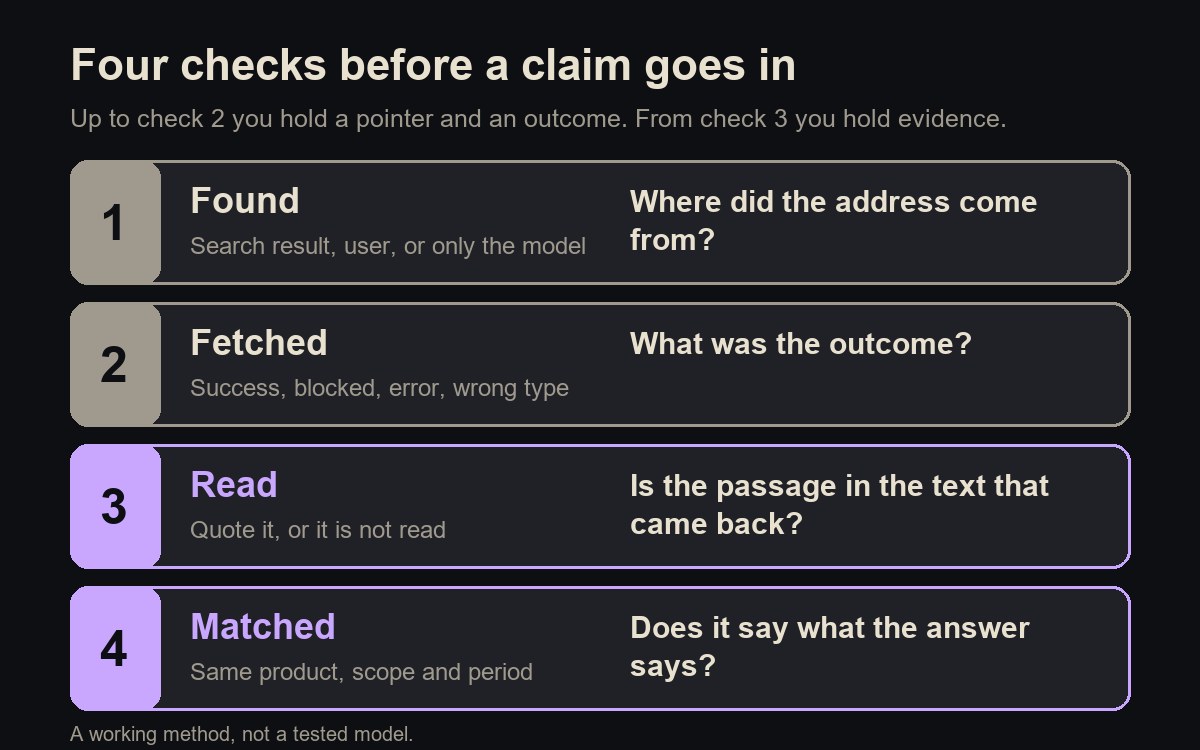
The line that matters falls between checks two and three. Up to there you hold a pointer and an outcome. From there you hold evidence.
An evidence log keeps this honest. For each claim, a single row is enough:
| Claim | Address and how it arrived | Fetch outcome | Passage | Status |
|---|---|---|---|---|
| The sentence you want to write | Search result, user link or memory only | Success, blocked, error, wrong type | A quoted sentence, or "none" | Stated, narrowed or unverified |
The status column forces the decision. "Stated" means a passage was read and matches. "Narrowed" means the claim was reduced to what the passage supports. "Unverified" means it stays out of the finished text, or goes in marked as unconfirmed.
A worked example (fictional)
The protocol, the pages and the report in this section are invented to show the method.
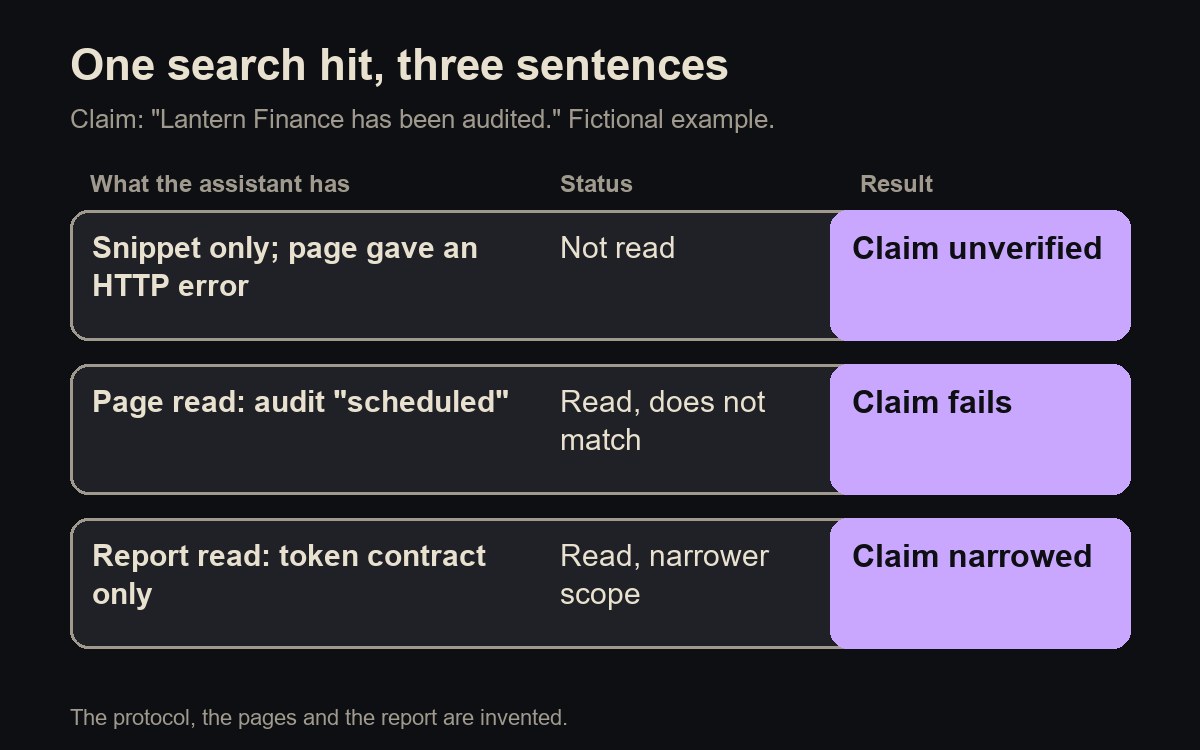
A research assistant is asked to check the claim: "Lantern Finance, a lending protocol, has been audited." Three cases show how the same search hit leads to three different sentences.
Case 1: only the snippet. The search result is titled "Lantern Finance security audit" and its preview begins "Lantern Finance has completed a security audit". The assistant tries to open the page and gets an HTTP error. Check 2 failed. The honest line is: "A page titled 'Lantern Finance security audit' appears in search; its content was not read." The claim is unverified.
Case 2: the page was read, and it says less. The page opens. It is a news post from the protocol team that says an audit is "scheduled for next quarter". Checks 1 to 3 pass; check 4 fails. The page is on the topic, but it supports the opposite of the claim. The honest line: "The protocol's own post says an audit is scheduled; no completed audit was found there."
Case 3: the report was read, and the scope is narrow. The post links to a PDF. The PDF is fetched and read. It lists an audit of one contract, the token contract, and says the lending pool was out of scope. Checks 1 to 3 pass. Check 4 fails for the claim as first written, which is too broad, and passes only for a narrower one. The honest line: "An audit of the token contract is published; the lending pool is stated to be outside its scope." The claim is narrowed.
All three started from the same search hit. Only the fetch outcome and the passage separated them.
Finance and blockchain are common places for this gap, because claims there tend to be binary ("audited", "regulated", "insured") while the documents behind them have scope, dates and conditions. The same split applies to an AI-model claim ("supports this feature") and to a game ("works on this platform"): the headline is a pointer, the document is the evidence.
What this article cannot tell you
It cannot tell you how often AI research tools answer from a snippet, or from memory, instead of the page. The sources describe how particular tools are documented to behave; they do not measure how often an assistant skips the read. The fabrication figures come from a 2023 study of citations by two older models and are not a rate for current ones. Tool behaviour changes, so the error codes and parameters quoted here describe documentation fetched on 18 November 2026. The four checks are a working method for a researcher, not a tested model. The worked example is invented.
How this article was made
| Task | What the AI did | What a person did | How it was checked |
|---|---|---|---|
| Research | Collected documentation pages and one study into notes | Chose the question and the sources to rely on | Quotes checked against the pages themselves [1]–[5] |
| Draft | Wrote the first draft from the notes | Edited the text, the four checks and the worked example | A separate review compared quotes and claims with the sources |
| Images | Generated the cover illustration (from the Dapp.Expert cover library) | Chose it; specified and checked the explanatory diagrams (built in code) | Labelled as AI-generated in the disclosure line and alt text |
| Not done by AI | — | The decision to publish and responsibility for the text | — |
Conflicts of interest: none. The author has no commercial relationship with Google, Anthropic, OpenAI or the study's authors; the protocol and report in the example are fictional.
Responsible for this article: Dmitriy Lastovka, author. Corrections: contact form.
Where this leads
Once a page has been fetched, its text still has to be turned into something a model can read, and that conversion changes what arrives. The next part looks at what AI page readers leave behind.
Sources
Labels: official (the organisation's own documentation), study (peer-reviewed paper).
- Google Search Central, "Control your snippets in search results". https://developers.google.com/search/docs/appearance/snippet Official.
- Google Search Central, "Introduction to robots.txt". https://developers.google.com/search/docs/crawling-indexing/robots/intro Official.
- Walters, W. H. and Wilder, E. I., "Fabrication and errors in the bibliographic citations generated by ChatGPT", Scientific Reports 13, 14045 (2023). https://pmc.ncbi.nlm.nih.gov/articles/PMC10484980/ Study.
- Anthropic, "Web fetch tool", Claude API documentation. https://platform.claude.com/docs/en/agents-and-tools/tool-use/web-fetch-tool Official.
- OpenAI, "Web search", API documentation. https://developers.openai.com/api/docs/guides/tools-web-search Official.