
AI tools helped gather research and write the first draft of this article. I edited it and checked every quote against the source page listed at the end. The cover illustration is AI-generated. Details at the end.
You read a page today and write down what it says. In three months someone asks where the number came from. You open the same address and the number is different, or the page is gone. Which of the two was right, and when?
A web page has no fixed text the way a printed book does. Keeping a source honest means recording three separate things: the date the page claims for itself, the version you actually read, and the copy you kept. This article treats each in turn, shows what the labels on a page can and cannot prove, and ends with a six-field note you can attach to any web source. It is about the record you keep, not about how pages are found or parsed; those are other questions.
Why a bare link is not a record
Pages disappear. Pew Research Center took a random sample of just under one million pages from Common Crawl, about 90,000 per year for 2013 through 2023, and checked whether each still existed. It reports that "25% of all the pages we collected from 2013 through 2023 were no longer accessible as of October 2023", and that 38% of pages from 2013 were gone, against 8% of pages from 2023 [1]. The same study found that 11% of the reference links in a sample of English Wikipedia pages pointed to inaccessible pages [1].
Those numbers describe pages that vanished entirely. Changed pages are harder to see, because the address still works and shows something. A link alone therefore proves only that an address existed. It does not say what the address showed on the day you read it.
Five dates, and only some belong to the page
When a source says "2024" or "last week", the date may mean different things. Keep them apart:
- Event date. When the thing described happened: a vote, a hack, a patch, a price move.
- Published date. When the page first appeared.
- Modified date. When the page was last changed.
- Retrieved date. When you read it. Only you can supply this one.
- Archived date. When a saved copy of the page was made, by you or by an archive.
Google's documentation on publication dates draws the first line. Dates in structured data "must describe the publication or update date of the page, not the stories or events described therein" [2]. A page about a 2021 exploit can carry a 2026 modified date. Quoting the 2026 date as the date of the exploit would be a mistake in the record, not in the page.
The same documentation shows how loose the page's own date can be. Google says its systems "look at several factors to determine our best estimate of when a page was published or significantly updated" [2]. It advises publishers to show a visible date, labelled for example as published or last updated, to add datePublished or dateModified in structured data, and to make the two values match [2]. In other words, even a search engine estimates a page's date from several signals. For a researcher, a visible date is a claim by the publisher, recorded as such.
What a "last updated" label can and cannot prove
A label can be wrong in either direction. Google's guidance for creating helpful content asks publishers: "Are you changing the date of pages to make them seem fresh when the content has not substantially changed?" [3] The question exists because the practice exists. A fresh date does not show fresh content.
The opposite error is just as ordinary: a page is edited and nobody touches the label. Neither error can be seen from the date alone. What helps is a second signal that does not depend on the author's habits.
The web itself provides some. An HTTP response can carry a Last-Modified header, which MDN describes as "a date and time when the origin server believes the resource was last modified" [4]. The wording matters: it is the server's belief. MDN also says it "is less accurate than an ETag for determining file contents" and can serve as a fallback when ETags are unavailable [4]. An ETag is "an identifier for a specific version of a resource", and if the resource at a URL changes, "a new ETag value must be generated" [5]. The page adds that the method of generating the value is not specified. A weak validator, marked W/, is a looser match: two representations with the same weak ETag may be semantically equivalent without being byte-for-byte identical [5].
Two cautions. First, headers describe what a server sent in one response; many pages are assembled on request, and a server may send no such header at all. Second, a response from a cache can be older than it looks. RFC 9111 defines the Age header as "the sender's estimate of the time since the response was generated or successfully validated at the origin server" [6]. If you copy a header into your notes, copy the response's own date and age with it.
A practical reading: treat the visible date, the structured date and the headers as three witnesses. When they agree, the claim is stronger. When they differ, write down the difference instead of choosing one.
A version is something you can name again
Dates say when. A version says which. In some fields versions have names, and the lesson there carries over to ordinary pages.
AI models. Anthropic's documentation on model IDs says that each model ID "identifies a pinned version of the model" and that the underlying model "remains constant for the lifetime of that ID" [7]. For some earlier models, the Claude API also accepts shorter aliases that "point to the most recent dated snapshot for that minor version" [7]. So a note saying "the model answered X" is ambiguous if it records an alias, because the alias can resolve to a different snapshot later. The same page adds that the serving infrastructure around a fixed model can change, which may produce small differences in behaviour under an unchanged ID [7]. Record the identifier the system itself reports, not the nickname.
Blockchains. Ethereum's JSON-RPC documentation says that when a request queries the state of Ethereum, "the provided block parameter determines the height of the block" [8]. The options include a specific block number as well as tags such as latest, safe and finalized [8]. A balance read at latest is a moving target. A balance read at a stated block number is a statement someone else can reproduce. A researcher who writes "the contract held X" without the block has left out the one detail that dates the claim.
Web pages. Ordinary pages rarely expose a version number. The nearest equivalents are an ETag if the server sends one, a visible revision note, a page history if the site keeps one, and a snapshot you or an archive made. When none exists, your own retrieval time and your saved copy are the version.
The lesson from all three: "latest" and "current" are instructions to a system, not facts about a source. A research note should replace each of them with a fixed identifier or a fixed time.
The copy is your evidence
If the page changes or vanishes, the only proof of what it said is a copy. There are two kinds, and they answer different questions.
A public archive snapshot. RFC 7089 defines the Memento framework, which "bridges the present and past Web" by giving a way to obtain "representations of prior states of a given resource" [9]. It defines a Memento as "a resource that encapsulates a prior state of the Original Resource", a TimeGate that can negotiate by datetime, and a Memento-Datetime header that says which moment a response reflects [9]. The practical point is simple: a good snapshot carries its own capture time, and that time is different from the page's date and from your retrieval time. Not every page has a snapshot, and a snapshot of a page you read may have been taken on a different day than your read; I did not verify any particular archive's coverage.
Wikipedia's citation rules show the same split in a form editors use daily. Their access-date is "the full date when the content pointed to by url was last verified to support the text in the article", and it is "not required for linked documents that do not change", but should be used for news articles on commercial sites [10]. For archived copies, archive-date "must be added to show the date the page was archived, not the date the link was added" [10].
Your own copy. A snapshot you did not make may not match what you saw. For anything a conclusion depends on, save the text you relied on, the address, the time you retrieved it and, if you can, a checksum of the saved file. A checksum is a short fingerprint: if a single character in the file changes, the fingerprint changes. That practice is mine, not a rule from the sources above, and it applies to short passages or files you are entitled to keep. Mind copyright and the site's terms: a private reference copy for a note is one thing, republishing it is another.
A six-field source note
Fields that follow from the above:
| Field | What goes in | Why |
|---|---|---|
| Address | The URL as opened, plus the final URL after redirects | A redirect can change what a link means |
| Page label | The date and wording the page shows ("Last updated 28 Oct") | A claim by the publisher, kept as a claim |
| Version signal | ETag, revision note, model ID, block number, or "none seen" | The most specific identifier available |
| Retrieved | Date and time with time zone, UTC if you can | Only you can record it |
| Copy | Where the saved copy or archive snapshot is, and its capture time | The evidence if the page changes |
| Used for | The exact claim the page supports | So a later reader can check that claim only |
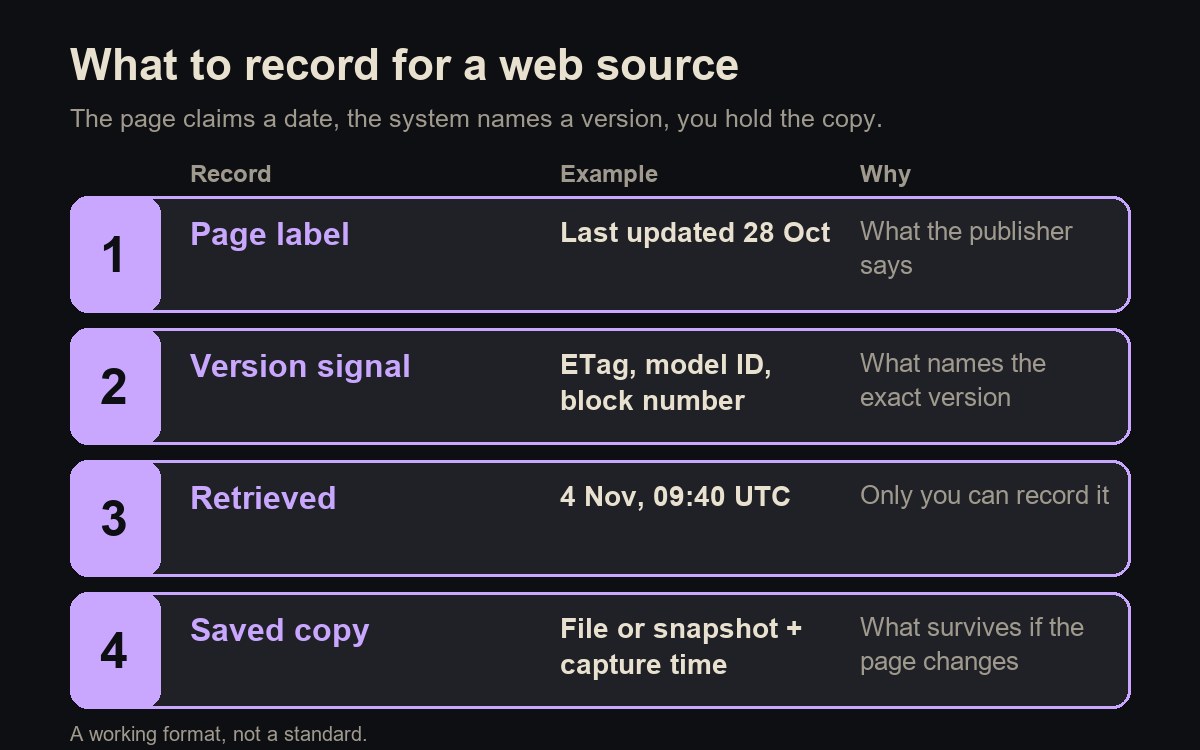
The note is small on purpose. For many sources a few lines are enough.
A worked example (fictional)
The exchange, the fee and the dates in this section are invented to show the method.
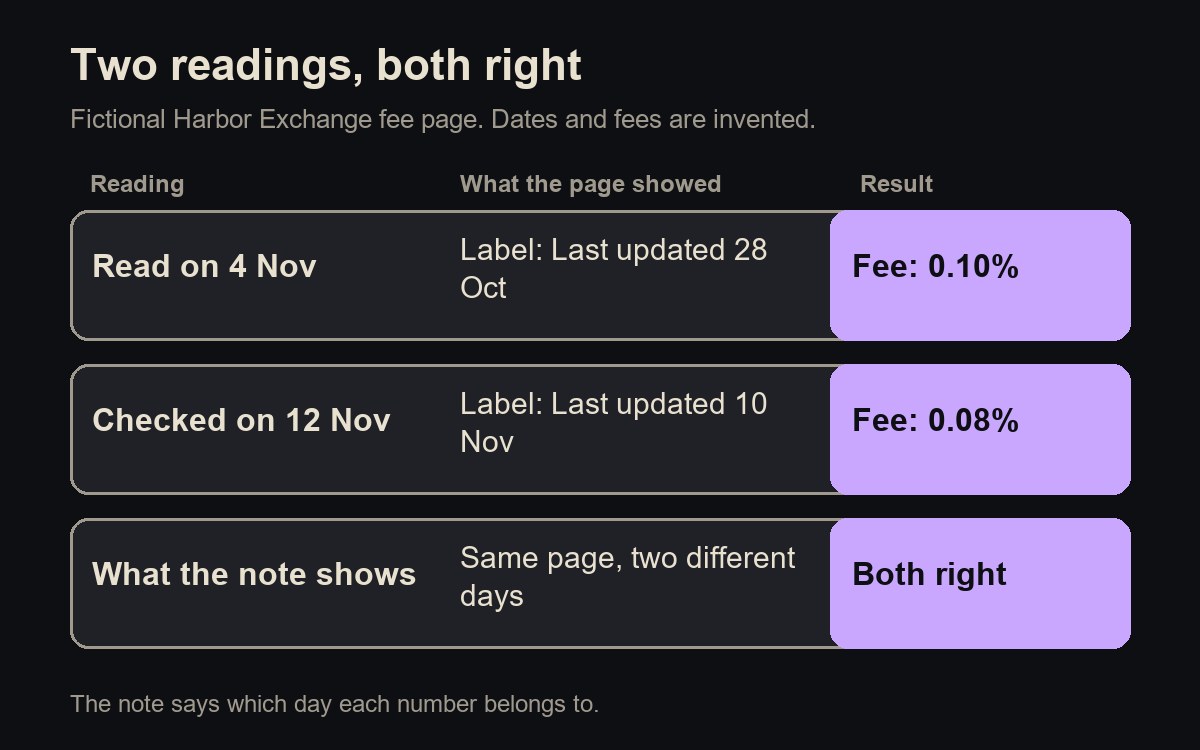
An analyst writes a comparison of trading costs and notes that the fictional "Harbor Exchange" charges a maker fee of 0.10%. Her note reads:
- Address: the fee-schedule page, no redirect.
- Page label: "Last updated 28 October".
- Version signal: none seen; the response had no ETag.
- Retrieved: 4 November, 09:40 UTC.
- Copy: saved page text in the project folder, checksum recorded.
- Used for: the maker fee for the standard tier.
On 12 November a reader writes that the fee is now 0.08%. Without the note, the analyst can only say "I think it was 0.10". With the note she can answer exactly: the page said 0.10% on 4 November, and its own label then said 28 October. She opens the page, sees "Last updated 10 November", and writes a correction that names both dates. The reader's number and hers are both right, for different days.
She also notices what the note cannot tell her: whether the fee changed on 10 November or earlier and the label was late. She says so, and does not guess.
When you can relax
Not every source needs the full record. Wikipedia's rule above gives the logic: a retrieval date is "not required for linked documents that do not change" [10], such as a published paper reached by its permanent identifier. A reasonable test is whether a reader could be misled if the page changed tomorrow. A news article, a price list, an exchange's terms, a model's documentation and a smart contract's balance fail the test. A finished, fixed document usually passes. The test is my suggestion, not a standard.
What this article cannot tell you
It cannot tell you how often sites send Last-Modified or ETag headers, or how often the visible date matches the real change; the sources do not say, and I did not measure it. It does not rank archives or say which ones will keep a page. The Pew figures describe a sample from Common Crawl and say nothing about any single site. The model-ID and blockchain examples show a habit, not a method that suits every page. The worked example is invented, and the six-field note is a working format, not a standard.
How this article was made
| Task | What the AI did | What a person did | How it was checked |
|---|---|---|---|
| Research | Collected the documentation pages into notes | Chose the question and the sources to rely on | Quotes checked against the pages from Google Search Central, Pew, RFC 7089, RFC 9111, MDN, Wikipedia, ethereum.org and Anthropic [1]–[10] |
| Draft | Wrote the first draft from the notes | Edited the text, the six-field note and the worked example | A separate review compared quotes and claims with the sources |
| Images | Generated the cover illustration (from the Dapp.Expert cover library); explanatory diagrams were built in code | Chose the illustration; specified and checked the diagrams | Labelled as AI-generated in the disclosure line and alt text |
| Not done by AI | — | The decision to publish and responsibility for the text | — |
Conflicts of interest: none. The author has no commercial relationship with the organisations cited; the exchange in the example is fictional. One cited page is a vendor describing its own models [7].
Responsible for this article: Dmitriy Lastovka, author. Corrections: contact form.
Where this leads
The record above makes one source checkable. The next part asks how to compare the tools that fetch sources in the first place, so that a difference between two results comes from the tools and not from the way the comparison was run.
Sources
Labels: official (the organisation's own documentation), research (a published study), standard (an internet standard), reference (community-maintained documentation).
- Pew Research Center, "When Online Content Disappears" (17 May 2024). https://www.pewresearch.org/data-labs/2024/05/17/when-online-content-disappears/ Research.
- Google Search Central, "Influence your byline dates in Google Search". https://developers.google.com/search/docs/appearance/publication-dates Official.
- Google Search Central, "Creating helpful, reliable, people-first content". https://developers.google.com/search/docs/fundamentals/creating-helpful-content Official.
- MDN Web Docs, "Last-Modified". https://developer.mozilla.org/en-US/docs/Web/HTTP/Reference/Headers/Last-Modified Reference.
- MDN Web Docs, "ETag". https://developer.mozilla.org/en-US/docs/Web/HTTP/Reference/Headers/ETag Reference.
- RFC 9111, "HTTP Caching", section 5.1 (Age). https://www.rfc-editor.org/rfc/rfc9111 Standard.
- Anthropic, "Model IDs and versioning". https://platform.claude.com/docs/en/about-claude/models/model-ids-and-versions Official (vendor documentation of its own product).
- ethereum.org, "JSON-RPC API", conventions: the block parameter. https://ethereum.org/en/developers/docs/apis/json-rpc/ Official.
- RFC 7089, "HTTP Framework for Time-Based Access to Resource States — Memento". https://www.rfc-editor.org/rfc/rfc7089 Standard.
- Wikipedia, "Help:Citation Style 1" (parameters access-date, archive-url, archive-date). https://en.wikipedia.org/wiki/Help:Citation_Style_1 Reference.