
AI tools helped gather research and write the first draft of this article. I edited it and checked every quote against the source page listed at the end. The cover illustration is AI-generated. Details at the end.
Anyone who has watched a game community for a week has a list. Someone asks whether a quest can still be finished after a patch. Someone else wants to know if a purchase is worth it. A parent asks whether a game is safe for a nine-year-old. A returning player asks what changed since they left. The list grows fast, and it is tempting to answer the loudest questions one by one.
That produces a pile of articles, not a publication. A map is what turns a list of questions into a plan: it says who is asking, what they are trying to get done, and which piece of writing answers them. Without it, the same question gets answered three times under three titles, and an obvious gap stays open because nobody asked about it in the place where you were looking.
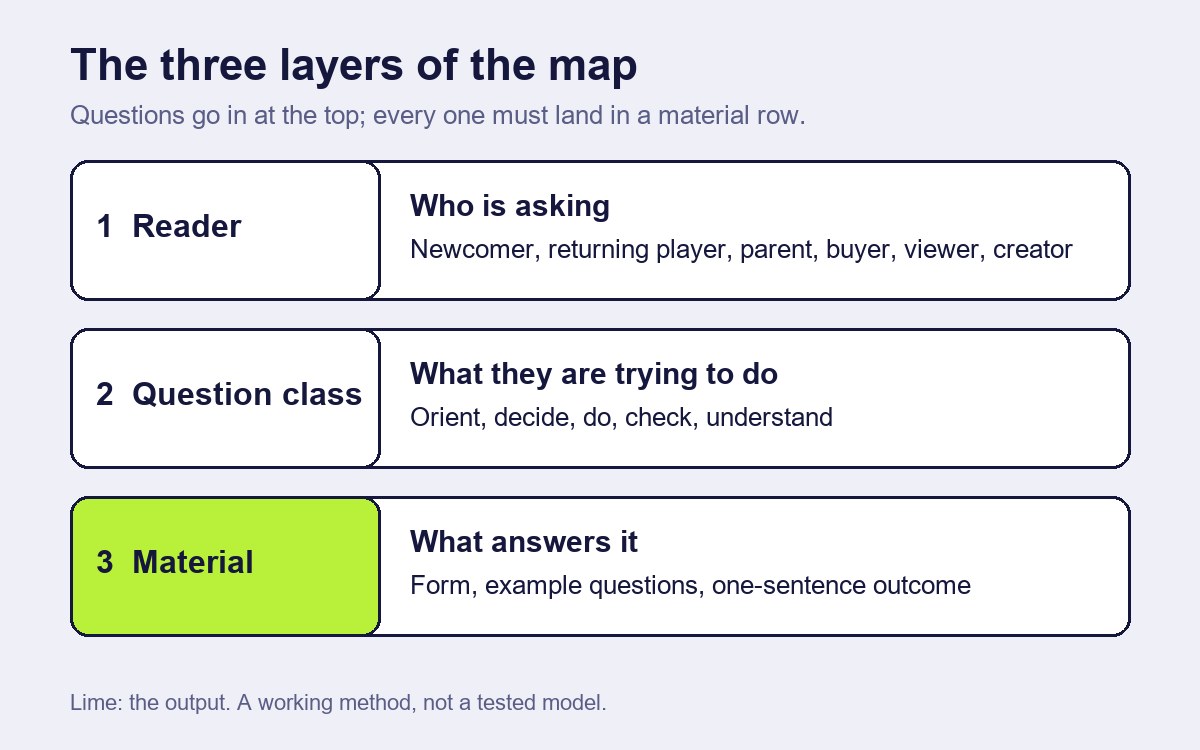
This article describes one way to build such a map for a game-focused information site, using three layers: the reader, the class of question, and the material. It is a working method, not a proven one. The last sections say what it cannot tell you.
Why a list of questions is not enough
A question is a surface. "Is it worth buying?" can come from someone who has never touched the genre, from a fan deciding on an expansion, or from a parent choosing a gift. The words are the same; the answer that helps each of them is different.
The opposite also happens. "How do I get started?", "what should a beginner know?" and "is it too late to join?" are three questions with one underlying task. Answered separately they become three thin articles that repeat each other and compete for the same reader.
So the first job is not writing. It is deciding what counts as the same question and what counts as a different one, and writing that decision down so the next person on the team makes it the same way. Google's guidance for site owners points at the same goal from the other side. Among its self-assessment questions it asks whether, after reading the content, a person will leave "feeling they've learned enough about a topic to help achieve their goal" [1]. A goal is a property of the reader's situation, not of the wording of the question.
Layer one: the reader
Start with a short list of reader types, defined by situation and not by demographics. For a game-focused site the working set might be:
- A newcomer who does not know the vocabulary and is deciding where to begin.
- A returning player who knew the game once and needs to know what changed.
- A busy parent who is not playing and needs a quick, safe answer.
- A buyer who is comparing a game, a platform or a purchase.
- A viewer who watches streams or videos and wants to understand what they see.
- A creator who writes, streams or makes guides and needs reference material.
The list is deliberately short. Six types are enough to keep a reader in mind while writing; twenty become a spreadsheet nobody consults. The test for a type is practical: does knowing it change the opening of the article, the vocabulary, or the length of the answer? If not, merge it with a neighbour.
A reader type is a hypothesis about who tends to ask, not a fact about any individual. Treat it as a label on a question that helps you choose a tone and a starting point, and drop or change the label when the evidence disagrees.
Layer two: the class of question
The second layer is what the reader is trying to do. Question classes are tasks, such as:
- Orient: what is this, and is it for me?
- Decide: should I buy, play or switch?
- Do: how do I complete this step, fix this problem, set this up?
- Check: is this safe, current, allowed, true?
- Understand: why does this work this way, what changed, what does this term mean?
Classes are far fewer than questions. A few hundred raw questions usually collapse into a handful of classes once you stop reading the wording and start reading the task.
How do you build the classes without inventing them? The user-experience research field has a standard method for this kind of grouping: card sorting. Nielsen Norman Group defines it as "a research method in which study participants place individually labeled cards into groups" [2]. In an open sort, "users create their own groups with no predefined categories"; in a closed sort, "users are given predefined categories and asked to organize the individual cards into those categories" [2]. The same source suggests "at least 15 participants" for a qualitative study and "at least 30–50 participants" for a quantitative one [2].
Those numbers belong to research on how people group information, and an editorial team sorting questions is not running that study. But the logic transfers. Do an open sort first, so the classes come from the questions and not from your assumptions. Then use a closed sort with the finished classes to check that a second person puts the same question in the same place. If two people disagree on where a question belongs, the class definitions are not clear enough yet.
Layer three: the material
The third layer is the piece of writing that answers a class of question for a type of reader. The useful move is to name the form before the topic. A "Check" question from a parent wants a short, direct answer with the verdict first. An "Understand" question from a returning player wants a changelog-style summary. A "Do" question wants steps.
A material entry in the map needs only five things:
- the reader type or types it serves,
- the question class,
- two or three example questions in the readers' own words,
- the form (short answer, guide, comparison, reference, explainer),
- the one thing the reader should be able to do or decide after reading.
The fifth item is the most useful. It is close to the test in Google's guidance: whether the reader leaves having "learned enough about a topic to help achieve their goal" [1]. If you cannot state it in one sentence, the entry is a topic, not a piece of writing.
The map is a table, not a diagram
A map of this kind is best kept as a plain table with one row per material and columns for reader, class, example questions, form and outcome. A second table lists each raw question with the row it belongs to. The two tables support four checks:
- Every question has a home. A question with no row is either out of scope, which should be written down as a decision, or a sign that a row is missing.
- Every row has questions. A row with no real questions under it is a guess dressed up as a plan.
- No two rows answer the same question for the same reader. If they do, merge them or make the difference explicit.
- Every question records where it came from. One column for the source is enough, and the last section before the pitfalls explains why.
Nothing here needs special software. The value is in making the decisions visible, so that two editors, or an editor and an AI drafting assistant, produce rows that match.
A worked example (invented)
The following example is fictional. The game, the questions and the decisions are made up to show the method.
Imagine a small farming game called Hollow Orchard. A week of reading community threads produces a list of questions. Six of them:
- "Is Hollow Orchard worth it if I only have an hour a day?"
- "Can my 9-year-old play online with strangers?"
- "I stopped at the summer update, what did I miss?"
- "How do I unlock the greenhouse?"
- "Does the greenhouse still need the old key after the patch?"
- "What is the difference between the base game and the expansion?"
A first pass by reader and class gives:
| Question (shortened) | Reader | Class |
|---|---|---|
| Worth it with an hour a day? | Buyer | Decide |
| 9-year-old playing online? | Parent | Check |
| What did I miss since summer? | Returning player | Understand |
| How do I unlock the greenhouse? | Newcomer | Do |
| Greenhouse key after the patch? | Returning player | Check |
| Base game or expansion? | Buyer | Decide |
Reading the table, an editor sees that the first and last rows are the same task for the same reader and combines them into one material: a short buying guide covering time commitment and the base game versus the expansion. The parent question becomes its own short answer, because its reader and its form are different from anything else on the list. The two greenhouse questions look alike but differ in class. One is a "Do" question that wants steps; the other is a "Check" question about whether something is still true. The second is a candidate for a note inside the first, and the editor writes that decision down so it is not reopened every week.
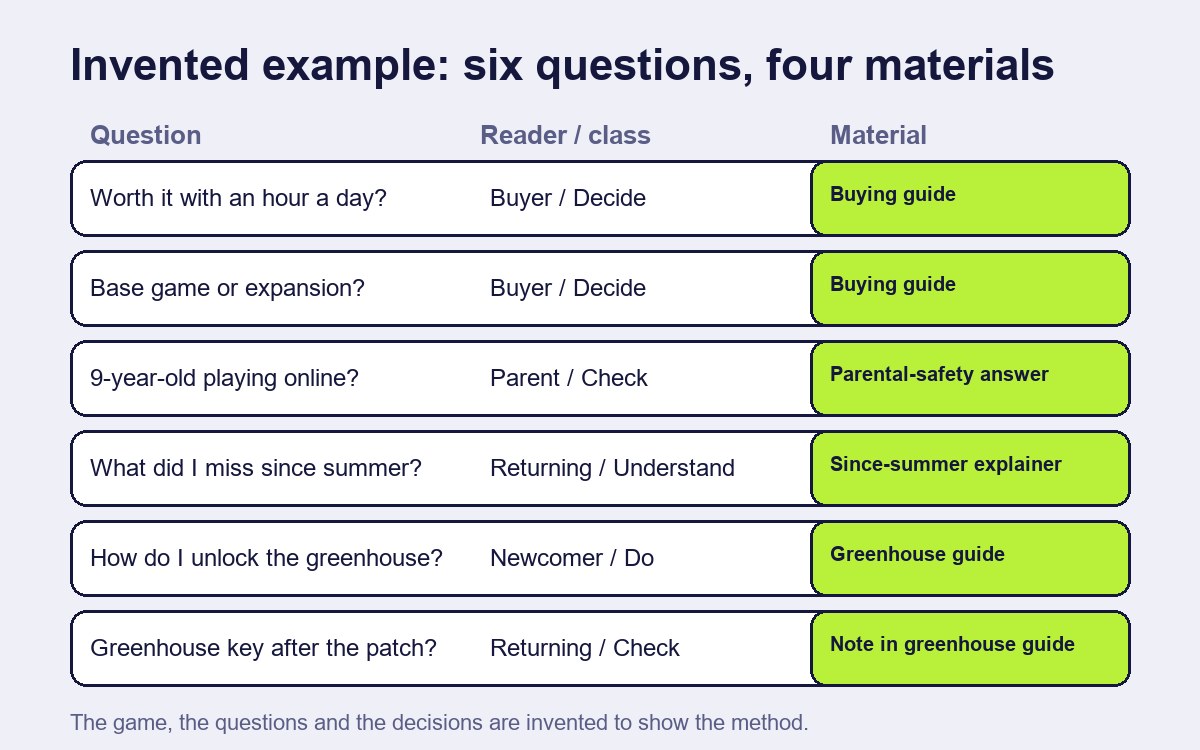
The result is four materials instead of six articles: a buying guide, a parental-safety answer, a "what changed since summer" explainer, and a greenhouse guide with a patch note. Each has a reader, a class, example questions, a form and a one-sentence outcome. A question that arrives with no obvious home goes on a "parked" list with the reason, instead of being forced into a row.
Where the questions come from, and what that does to the map
The map is only as good as the places the questions were read in. Discussion threads show what people ask each other. Search data shows what people type into a search engine. They are different samples.
Google Search Console can show the queries that led people to your own site. Its Performance report defines clicks as "the number of times a user clicked your site from Google Search results", impressions as "how many times your site appeared in Search results", and a queries dimension that "groups your data by the search query users typed" [3]. Two limits matter for an editorial map. The data only covers searches in which your site already appeared, so it cannot reveal a gap you do not yet cover. And the report leaves some queries out: Google's help page says that "tables in the performance reports omit rare queries to protect user privacy" [4]. The rarest and most specific questions are often the ones a small site most needs to see, and they are the ones this tool hides.
That is a reason to name the origin of every question in an extra column of the table. A map built entirely from one community will mirror that community's habits. A map that records where each question came from shows which parts rest on one source only.
Common ways this goes wrong
- Classes that are topics. "Quests", "Economy" and "Updates" are shelves, not tasks. Two readers with opposite needs end up on the same shelf. Rewrite each class as something the reader is trying to do.
- Too many reader types. If each type has one question, the types are doing the work of the questions. Merge until each type has several.
- Merging by wording. Two questions with the same words from different readers are two entries. Two questions with different words and the same task are one.
- Treating the map as finished. It is a hypothesis about the questions seen so far. New questions that do not fit are the signal to revise it.
What this article cannot tell you
It cannot tell you how many people ask any of these questions. The map says what the questions are and how they relate, not how large each group is. It also cannot tell you that these six reader types are the right six for your game; they are a starting set to be changed by evidence. The card sorting figures come from research on grouping information and are cited as a method reference, not as a rule for editorial teams [2]. I found no published study that tests this exact three-layer map on a game site. The worked example is invented, and the method has not been tested experimentally.
How this article was made
| Task | What the AI did | What a person did | How it was checked |
|---|---|---|---|
| Research | Collected the working method from an internal research document and looked up supporting method sources | Chose the question and the sources to rely on | Quotes checked against the pages listed below [1]–[4] |
| Draft | Wrote the first draft from the notes | Edited the text, the structure and the worked example | A separate review compared quotes and claims with the sources |
| Images | Generated the cover illustration; wrote the scripts that draw the cards and the diagrams from the article text | Looked at every image and approved it | Labelled as AI-generated in the disclosure line and alt text |
| Not done by AI | n/a | The decision to publish and responsibility for the text | n/a |
The three-layer scheme (reader, class of question, material) comes from an internal Dapp.Expert working document and is described here as a method, not as a measured result. That document is not public.
Conflicts of interest: none. The author has no commercial relationship with Google, Nielsen Norman Group or the sites named; the game in the example is fictional.
Responsible for this article: Dmitriy Lastovka, author. Corrections: contact form.
Sources
Labels: official (the organisation's own page).
- Google Search Central, "Creating helpful, reliable, people-first content". https://developers.google.com/search/docs/fundamentals/creating-helpful-content Official.
- Nielsen Norman Group, "Card Sorting: Uncover Users' Mental Models for Better Information Architecture". https://www.nngroup.com/articles/card-sorting-definition/ Official.
- Google Search Console Help, Performance report (Search), answer 7576553. https://support.google.com/webmasters/answer/7576553 Official.
- Google Search Console Help, "About Search Console data" (answer 96568). https://support.google.com/webmasters/answer/96568 Official.