
AI tools helped gather research and write the first draft of this article. I edited it and checked every quote and figure against the source page listed at the end, read on 18 November 2026. The cover illustration is AI-generated. Details at the end.
A byline answers one question for a reader: who is responsible for this? A conflicts line answers another: what could bend it? Give both on every story, in plain words, next to the text: a real name, a role, a way to contact the person, and any interest that a reasonable reader would want to know about. This takes a few lines and costs a small publication nothing but the habit.
This article explains what the byline and the disclosure each do, shows what published policies and search guidance say about them, walks a fictional example, and gives a template. It is about accountability and disclosure in editorial work. It is not legal advice and it does not tell any publication where to set a threshold.
What a byline is for
A byline is a statement of responsibility. If a claim is wrong, the reader knows whom to write to, and the publication knows who answers. Without a name, accountability falls to "the site", which in practice means nobody.
Google's documentation on creating helpful content asks self-assessment questions about this. They include whether pages carry a byline "where one might be expected", and whether bylines lead to "further information about the author or authors involved, giving background about them" [1]. The same page says "We strongly encourage adding accurate authorship information, such as bylines to content where readers might expect it" [1]. The page also warns against fabricating creator profiles, with the examples of AI-generated headshots, made-up names or false credentials [1]. So a byline should name someone who exists, and the background given should be true.
The Trust Project lists "Journalist Expertise" among its Trust Indicators, alongside "Best Practices", "References" and "Actionable Feedback" [2]. It is framed as something an outlet shows readers, which suggests the author's background belongs next to the work and not buried.
What a conflicts-of-interest line is for
A conflict of interest is a connection that could reasonably affect how a story is reported or how it will be read: a holding in the asset covered, a commercial relationship with a subject, an employer or sponsor with a stake. Having one is not a scandal. Hiding one is the problem. The line lets the reader weigh the story with the connection in view.
Published policies show different approaches:
- CoinDesk's ethics page, last updated December 2024, says its reporters "must disclose in their profile pages any cryptocurrency holdings of $1,000 or more", and must "update these disclosures upon any material changes" [3].
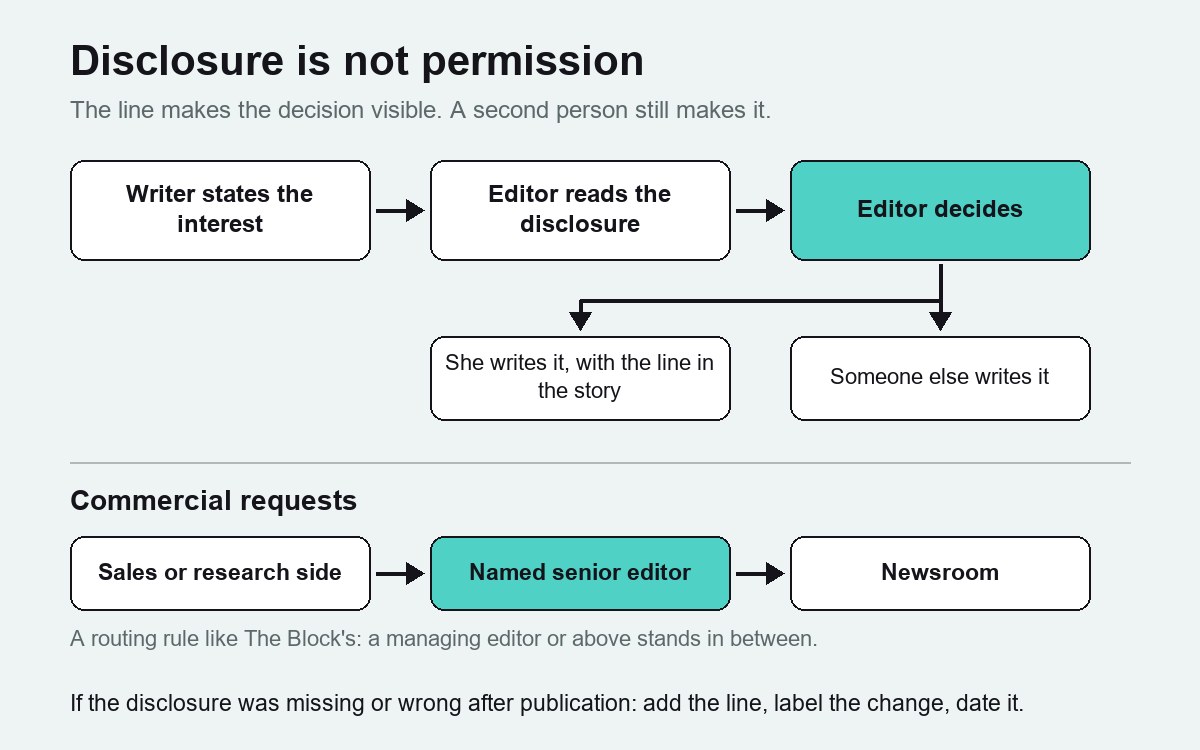
- The Block's conflicts-of-interest policy says requests between its sales or research side and editorial "shall go through a newsroom managing editor or above", and complaints about coverage that reach the sales or research side should go to the appropriate editorial managing editor or above [4]. This is a routing rule: a named senior person stands between the commercial side and the newsroom.
These are two organisations' own rules. The $1,000 figure is CoinDesk's choice, not a standard, and the pages cited do not claim that it is right for anyone else. A small publication should choose its own threshold, or none, and publish the rule it actually follows.
Poynter's guidelines add two related commitments: "We credit the authors and creators of the various forms of journalism we publish", and "We do our best to avoid conflicts of interest and to remain free of influences". They also require staff who discuss organisations where they have done consulting work to disclose that relationship [5]. No single policy here covers everything, but together the three point to the same habits: name the author, state the interest, and decide who looks at it.
Who the line is for, and what it should not do
The reader is the audience, so write the disclosure for someone who has never seen your policy page. Name the interest in concrete terms (the asset, the client, the sponsor), not in a category. "The writer holds a small amount of the token" tells a reader more than "the writer may have interests in the sector". Keep it short, keep it in the story and keep it neutral: a disclosure is a fact, not an apology or a defence.
It should also not do two things. It should not be used to pad the story with legal-sounding text that nobody reads. And it should not drift into advice: a story about an asset does not become a recommendation to buy it because the writer disclosed a holding. If a piece reads as advice, that is an editorial problem the disclosure cannot fix.
Bylines and AI
CoinDesk's page says it "may occasionally use artificial intelligence (AI) tools to help generate content (text, images, etc.)", and commits to transparency with readers through "a dedicated byline that identifies the AI as a creator/contributor of the content" [3]. This is one outlet's policy. The principle behind it is simple: if a tool produced material the reader will rely on, say so, and keep a person's name on the responsibility. A tool cannot answer a reader's complaint. A person can.
A fictional example
The following example is invented. Example Review is a made-up publication; the writer, the story and the disclosure are fictional and show the format.
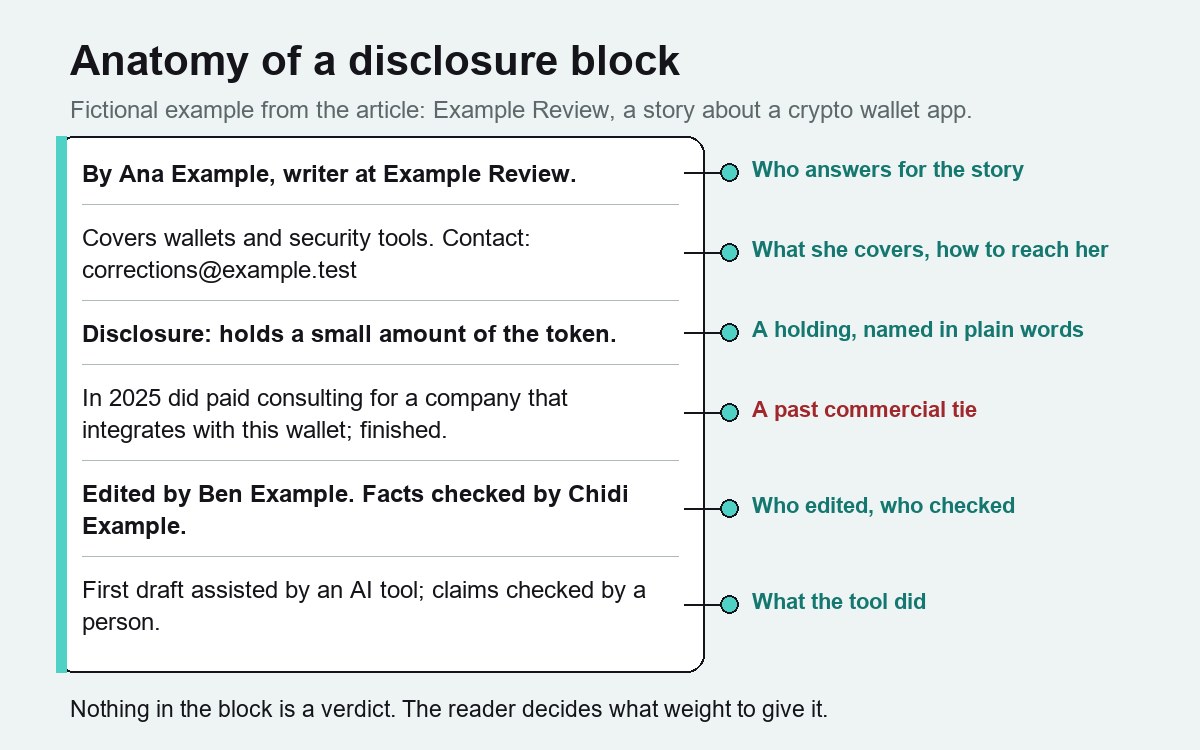
A story reviews a new crypto wallet app. The writer, Ana, holds a small amount of the wallet's token and once did a paid consulting day for a company that integrates with the wallet. The block at the top or bottom of the story reads:
By Ana Example, writer at Example Review. Covers wallets and security tools. Contact: corrections@example.test.
Disclosure: The writer holds a small amount of the token mentioned in this article. In 2025 the writer did paid consulting for a company that integrates with this wallet; that work is finished. The publication has no commercial relationship with the wallet's maker.
Edited by Ben Example. Facts checked by Chidi Example. First draft assisted by an AI tool; all claims were checked by a person against the sources listed.
What this does: the reader knows who wrote it, what she covers, how to reach her, what she owns, a past commercial tie, who edited and who checked, and what the tool did. Nothing in it is a verdict. The reader decides what weight to give it.
The second half of the story is the editor's decision. Ben reads the disclosure and decides whether Ana should write about this wallet at all, or whether someone else should. A disclosure does not automatically make a conflict acceptable. It makes the decision visible.
Four mistakes and fixes
1. A byline with no person behind it. "Staff" or "Editorial team" on a story with claims. Fix: name the person who answers for it, even in a team of one.
2. A name with no background. A byline that leads nowhere, or an author page with invented credentials [1]. Fix: a short, true author page: what this person covers and how to reach them.
3. Disclosure only in a policy page. A conflicts policy exists, but the story with the conflict does not carry the line. Fix: put the disclosure in the story, where the reader is reading.
4. Disclosure as the end of the question. "I disclosed it" is treated as permission. Fix: a second person decides whether the conflict is acceptable, and routes any commercial request through a named senior person, as The Block describes for its sales and research requests [4].
Keeping the block current
A disclosure is a statement about a date. Holdings change, paid work ends and new work starts. CoinDesk's policy asks reporters to update their disclosures upon material changes [3], and the same logic applies to a small publication. Set a simple rule: review each writer's disclosures when they take a new type of assignment, and at a fixed interval of your choosing. When a story is already published and the disclosure was missing or wrong, treat it as a correction: add the line, label the change and date it.
A template to copy
For each story, at the top or bottom:
By name, role, what the person covers. Contact: address.
Disclosure: holdings, paid work, relationships or employer interests that a reasonable reader would want to know, or "none".
Edited by / checked by: names, if applicable.
Tools: what an AI tool did, if anything, and what a person checked.
And once, in a public policy: what you disclose, when, and who reviews it. Decide a threshold you will actually apply, and state it as your own rule.
What this article does not settle
It does not give a correct threshold for holdings; the one figure in the sources is a single outlet's rule. It does not say how disclosures should be verified or enforced, or what a publication should do when a writer will not disclose. It does not discuss personal investment advice, which is a separate matter with legal rules that vary by place. The example is invented. The block layout is a proposal. The sources describe policies and search guidance, not outcomes: none shows that bylines or disclosures raise trust by any measured amount.
How this article was made
| Task | What the AI did | What a person did | How it was checked |
|---|---|---|---|
| Research | Gathered candidate sources and drafted notes | Chose the question and which pages to rely on | Every quote checked against the page named in the sources, read on 18 November 2026 |
| Draft | Wrote the first draft from the notes | Edited the text, the disclosure block and the example | An independent review compares claims with the sources before publication |
| Images | Generated the cover illustration | Chose and checked it | Labelled as AI-generated in the disclosure line and alt text |
| Not done by AI | — | The decision to publish and responsibility for the text | — |
Conflicts of interest: none. The author has no commercial relationship with the organisations named here.
Responsible for this article: Dmitriy Lastovka, author. Corrections: contact form.
Sources
Labels: guidance (a platform's documentation), standard (a published industry framework), policy (a published organisational policy). Quotes are as on the pages read on 18 November 2026.
- Google Search Central, guidance page on creating helpful content (the "Who, How, Why" section). https://developers.google.com/search/docs/fundamentals/creating-helpful-content Guidance.
- The Trust Project, page listing the Trust Indicators. https://thetrustproject.org/trust-indicators/ Standard.
- CoinDesk, ethics page ("Last updated December 2024"). https://www.coindesk.com/ethics/ Policy.
- The Block, conflicts of interest policy. https://www.theblock.co/conflicts-of-interest Policy; no revision date on the page.
- Poynter, ethics guidelines page. https://www.poynter.org/guidelines-2/ Policy.