
AI tools helped gather research and write the first draft of this article. I edited it and checked every quote and figure against the source page listed at the end, read on 18 November 2026. The cover illustration is AI-generated. Details at the end.
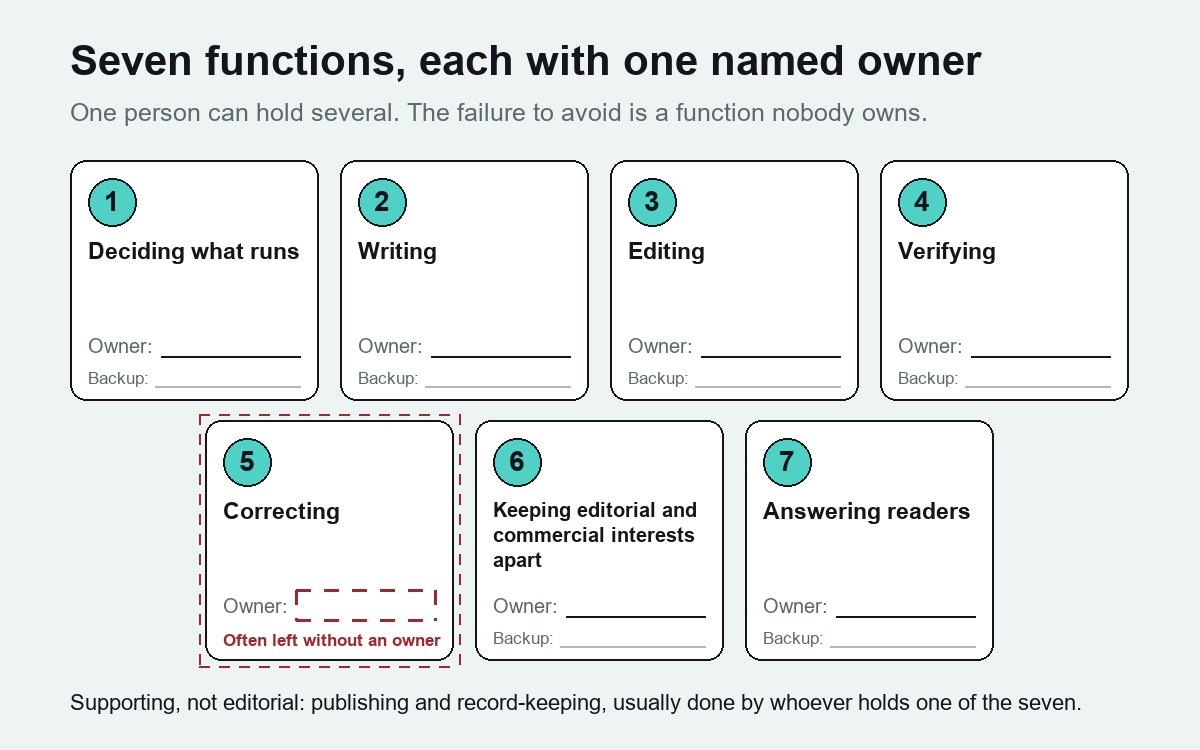
A small publication does not need a masthead full of titles. It needs a set of functions to be performed by someone, and it needs to know who that someone is. Seven are worth naming: deciding what runs, writing, editing, verifying, correcting, disclosing conflicts of interest, and answering readers. One person can hold several, and in a team of one a person holds all of them. The failure to avoid is not "too few people". It is a function that nobody owns.
This article lists the seven, shows where public policies and markup vocabulary point to each, maps a fictional three-person team onto them, and gives a checklist. It is a practical guide to function, not to hiring. It does not describe how any particular newsroom is organised, since the policies cited here say little about that.
Why start from functions, not titles
A title tells you what someone is called. A function tells you what has to happen before a story reaches a reader. Two newsrooms with different titles can cover the same functions, and two with the same titles can leave a function empty.
Public vocabulary and industry standards point the same way. Schema.org's vocabulary for a news organisation (NewsMediaOrganization) does not list job titles. It lists statements a publication can make about what it does: a masthead, an ethicsPolicy, a correctionsPolicy, a verificationFactCheckingPolicy, an unnamedSourcesPolicy and an actionableFeedbackPolicy, among others [1]. Each of these corresponds to a function that somebody has to carry out: if you publish a corrections policy, a person has to operate it. The Trust Project's eight Trust Indicators (Best Practices, Journalist Expertise, Labels, References, Methods, Locally Sourced, Diverse Voices and Actionable Feedback) are likewise phrased as things an outlet does, not as who does them [2].
The seven functions
1. Deciding what runs. Someone chooses which stories are published, what is held, and what the publication will not cover. Poynter's guidelines state a related value in the context of funding: it "retains full editorial control and discloses every instance of foundation funding" [3]. A small publication should be able to say who has the final decision, even if the answer is "me". It should also know what happens when the decision-maker is the person with the conflict: someone else, even an outside reader, takes that call.
2. Writing. Producing the draft. This is the function most people think of first and the one that matters least for accountability.
3. Editing. Judging the draft for the reader: structure, clarity, the promise of the headline.
4. Verifying. Comparing each claim with its source. The Trust Project's "References" indicator asks whether a journalist "provide[s] sources for each claim" in in-depth or controversial stories [2]. Somebody checks that this is true.
5. Correcting. Receiving reports of errors, deciding, publishing a visible correction. A public corrections policy is a statement the vocabulary lets you make [1], and the Trust Project asks whether outlets "correct errors quickly, clearly and prominently" [2]. This function is often left without an owner. A later article in this series is titled "Who Owns a Published Correction?".
6. Keeping editorial and commercial interests apart. The Block's published conflicts-of-interest policy says independence "necessitates a boundary between the editorial and the sales/research teams", and says reporters may not "take part in commercial sales conversations" [4]. For a small publication with no sales team the function still exists: someone has to notice when an advertiser, a sponsor or an owner's other business touches a story, and say so.
7. Answering readers. Receiving questions, complaints, tips and error reports, and replying. The Trust Project calls this "Actionable Feedback" [2]; Schema.org has an actionableFeedbackPolicy property for "a statement about public engagement activities" [1]. Without an owner, reader messages go unanswered, and error reports never reach the correction function.
Two further functions are supporting rather than editorial: publishing, meaning the technical step of putting the story live and keeping dates and labels right, and record-keeping, meaning the hand-off sheet, the correction log and the disclosure page. In a small team they are usually done by whoever holds one of the seven.
What public policies tell you, and what they do not
The Block's "About" page describes "an editorial firewall" between its newsroom and "every commercial interest", and lists links to financial disclosures, conflicts of interest and team verification under Policies and disclosures [5]. The page names executives, including a publisher and a vice president of research, but no newsroom roles, and it does not mention fact-checking or corrections [5]. CoinDesk's ethics page, last updated December 2024, says its news team "operates independently with an editorial committee to ensure journalistic independence" and gives no detail on the committee [6]. Neither page lets an outsider reconstruct who does which job.
That is an honest limit. A public policy can promise that a function exists, not who performs it. For a small publication, an outsider-facing version is simple: say that the function exists, say how a reader reaches it, and keep the internal assignment in writing for the team.
A fictional team, mapped
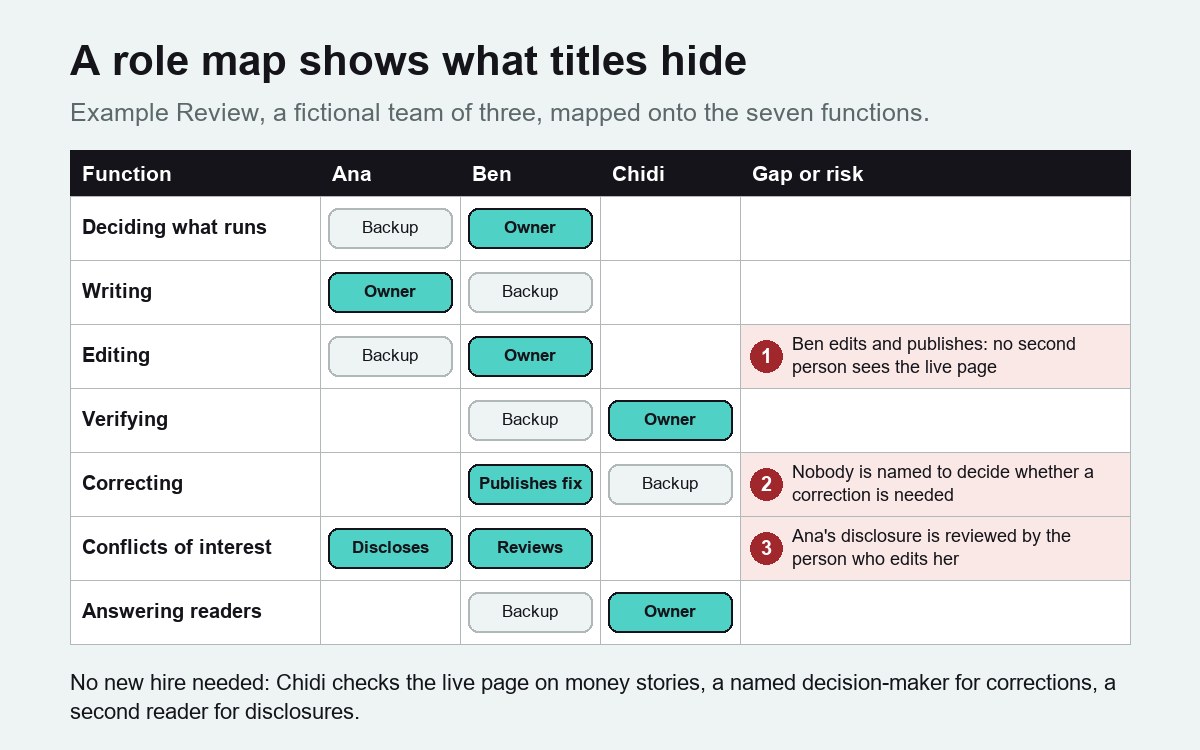
The following example is invented. Example Review is a made-up three-person publication on games and finance; its people and assignments are fictional and show the method.
The team: Ana writes most stories. Ben edits and publishes. Chidi is a part-time researcher who checks claims and handles reader mail.
| Function | Owner | Backup | Gap or risk |
|---|---|---|---|
| Deciding what runs | Ben | Ana | None for routine stories; for a story about a company Ben has a stake in, Ana decides |
| Writing | Ana | Ben | None |
| Editing | Ben | Ana, for Ben's own stories | Ben edits and publishes, so no second person sees the live page |
| Verifying | Chidi | Ben, on stories Chidi cannot reach | Chidi is part-time; urgent stories skip this step unless Ben holds them |
| Correcting | Ben (publishes the fix) | Chidi | Reader error reports arrive at Chidi, who forwards them; nobody is named to decide whether a correction is needed |
| Conflicts of interest | Ana (discloses), Ben (reviews) | none | Ana's disclosure is reviewed by the person who edits her |
| Answering readers | Chidi | Ben | Single point of failure |
The table is the useful part. It shows three risks that titles would hide: Ben both edits and publishes, so a story can go live with no one looking at the live page; the correction decision has no named owner; and conflict disclosures are reviewed by someone who works with the person disclosing. None needs a new hire. The fixes are small: a rule that Chidi checks the live page for stories on money, a named decision-maker for corrections and a second reader for disclosures.
When one person holds all seven
In a team of one, the table has a single name in every row, so the useful question changes: which functions will you perform as separate passes, and which will you ask an outside person to cover? A practical split is to do deciding, writing and answering readers yourself, and to find a second reader for verification and for conflicts on any story that carries a serious claim or touches money. The second reader need not be an employee. What matters is that the article says who did what, in the "How this article was made" block, and that the second reader is a different person from the author. If no one is available, say so in the story rather than implying a check that did not happen.
Four mistakes and fixes
1. A function with two owners. "Ben and Chidi handle errors" usually means neither does. Fix: one owner, one backup, written down.
2. A function with no owner because it is rare. Corrections and conflicts of interest are infrequent, so nobody holds them until the day they are needed. Fix: assign them now. The cost is a line in a table.
3. The writer owns verification of their own story. The writer knows what the story is meant to say, which makes it easy to read past an error. Fix: even in a team of one, use a separate pass with a claim list, and say in the article who checked what.
4. A policy page with no one behind it. Publishing a corrections or ethics policy creates a promise. Fix: for each public statement, name the person who answers when someone relies on it.
A checklist to copy
For each of the seven functions, write four words on a single page: owner, backup, how a reader reaches it, where it is written down.
- Deciding what runs
- Writing
- Editing
- Verifying
- Correcting
- Conflicts of interest and commercial separation
- Answering readers
Then check three things: no function has two owners, no owner is also the only reviewer of their own work on a high-risk story, and every public policy has a named person behind it.
What this article does not settle
It does not claim that seven is the right number, or that any real newsroom follows this list; it is a working list assembled from the function-like items in public policies and vocabulary. The Block and CoinDesk pages cited say little about internal roles. The example team is invented. The article does not cover how to staff, pay or train anyone, and it does not discuss large newsrooms or legal duties, which vary by jurisdiction. Later articles in this series are titled "Separating Writing, Editing, and Verification", "Who Owns a Published Correction?" and "Bylines, Accountability, and Conflicts of Interest".
How this article was made
| Task | What the AI did | What a person did | How it was checked |
|---|---|---|---|
| Research | Gathered candidate sources and drafted notes | Chose the question and which pages to rely on | Every quote checked against the page named in the sources, read on 18 November 2026 |
| Draft | Wrote the first draft from the notes | Edited the text, the function list and the example | An independent review compares claims with the sources before publication |
| Images | Generated the cover illustration | Chose and checked it | Labelled as AI-generated in the disclosure line and alt text |
| Not done by AI | — | The decision to publish and responsibility for the text | — |
Conflicts of interest: none. The author has no commercial relationship with the organisations named here.
Responsible for this article: Dmitriy Lastovka, author. Corrections: contact form.
Sources
Labels: schema (a public vocabulary definition), standard (a published industry framework), policy (a published organisational policy).
- Schema.org, "NewsMediaOrganization". https://schema.org/NewsMediaOrganization Schema.
- The Trust Project, page listing the Trust Indicators. https://thetrustproject.org/trust-indicators/ Standard.
- Poynter, ethics guidelines page. https://www.poynter.org/guidelines-2/ Policy.
- The Block, conflicts of interest policy. https://www.theblock.co/conflicts-of-interest Policy; no revision date on the page.
- The Block, "About". https://www.theblock.co/about Company statement.
- CoinDesk, ethics page ("Last updated December 2024"). https://www.coindesk.com/ethics/ Policy.