
AI tools helped gather research and write the first draft of this article. I edited it and checked every quote and figure against the source page listed at the end, read on 18 November 2026. The cover illustration is AI-generated. Details at the end.
A published correction is not one task but five: someone receives the report of an error, someone decides whether it is one, someone writes the note, someone puts it on the page, and someone follows up where the wrong version travelled. Ownership means naming one person for each step, so that a reader's error report cannot fall between two people who each assume the other has it. In a team of one, it means writing down that all five are yours, and doing them in order.
This article builds that model from published newsroom practice, traces a fictional reader report through it, and gives a template. It deals with ownership and workflow. The wording and labelling of notes in a developing story are a separate question, and this article does not decide what counts as a significant error.
What published practice says
The sources available for this topic are policies and guides. They describe commitments and one newsroom's workflow; none measures how well any model works.
Someone decides. A 2013 Journalism.co.uk guide describes the New York Times process as Greg Brock, who handled its corrections, told the publication. Brock and his assistant first assess whether a report has merit, then pass it to the relevant department where needed. Factual errors are corrected online first, with a note; the department editor writes the fuller print correction, and it goes to Brock before publication [1]. In the same piece, Craig Silverman says newsrooms need a defined workflow that sets out who handles error reports and who makes the call on a correction [1]. The guide is more than a decade old and describes one organisation, but it names the steps: intake, assessment, drafting by the department, approval before the print correction runs.
The commitment is public. CoinDesk's ethics page, last updated December 2024, states: "All factual errors in published articles will be corrected promptly upon discovery", and says corrections are generally noted at the bottom of the article, or at the top when the error affects the article's central idea [2]. Poynter's guidelines commit to "timely response, clear corrections, and prominent acknowledgement that a mistake was made and addressed" but do not specify who decides, labels or placement [3]. The Trust Project asks whether outlets "correct errors quickly, clearly and prominently" [4].
The format can be plain. ProPublica's corrections page lists entries newest first, each linked to its article, headed "Correction, [date]:" and often opening with a line such as "This story originally misidentified..." [5]. The page asks readers to send corrections by email and states no formal policy or decision process of its own [5].
Policies can be declared in markup. Schema.org lets an organisation state a correctionsPolicy, described as "a statement describing (in news media, the newsroom's) disclosure and correction policy for errors" [6]. For an individual article, the correction property "indicates a correction to a CreativeWork, either via a CorrectionComment, textually or in another document" [7].
Taken together, the published material says that corrections should be prompt, visible and consistent, and one guide says someone should own the workflow. It does not provide a standard allocation of roles, so the model below is a proposal.
Five steps, five owners
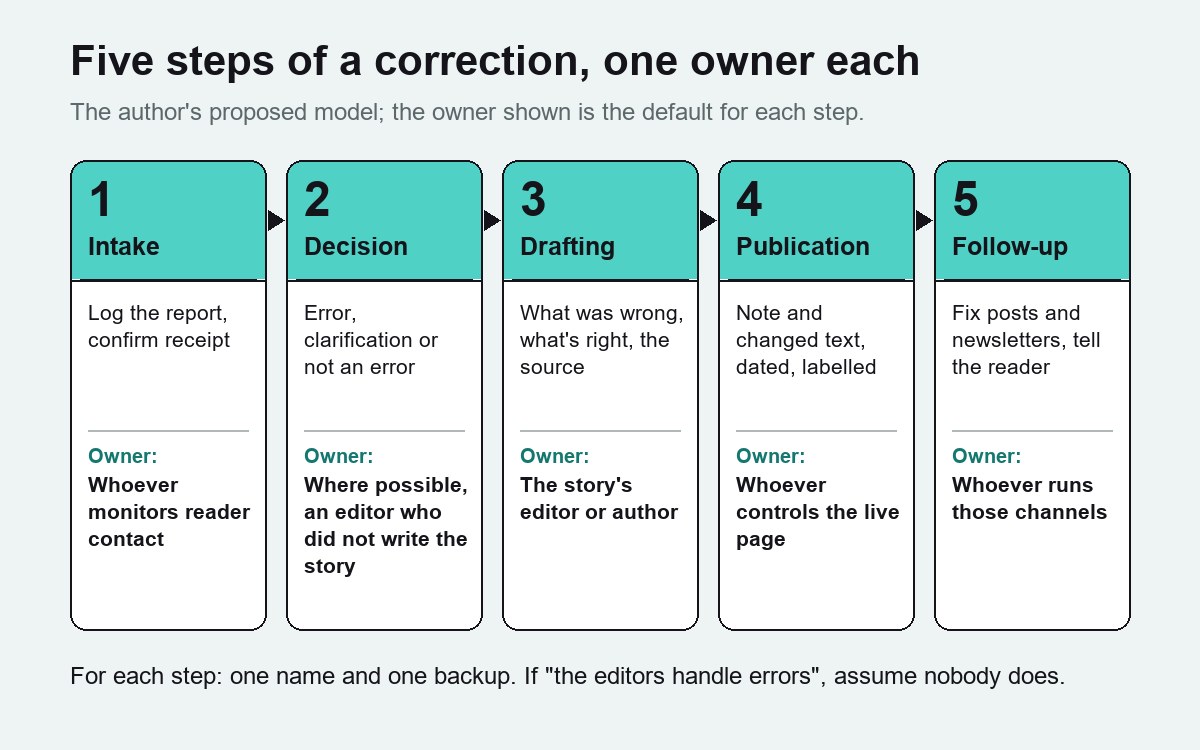
1. Intake. Receive the report, log it with date, source and the claim in question, and confirm receipt. Owner: the person who monitors reader contact, in a one-person publication, you. The aim is that no report is lost because it arrived in the wrong inbox. A contact form and an email address are both common routes, as ProPublica's page shows with its email [5]; whichever you use, someone reads it.
2. Decision. Decide whether the report identifies an error, a disagreement or something that needs clarification. Owner: an editor who did not write the story, where possible. Ask what the source says, what the story says, and whether the difference matters to a reader's understanding. Record the decision and the reasoning. The Brock process has an assessment step before the department takes over [1].
3. Drafting. Write the note: what was wrong, what is right and where that comes from, and whether the conclusion changes. Owner: the story's editor or author, because they know the sources. In the Brock process, the department editor writes the print correction [1]. Drafting is the step where the author's pride can interfere, which is why the decision should already have been made by someone else.
4. Publication. Put the note on the page and change the text, with date and label. Owner: whoever controls the live page. Another person, or the same person after a pause, confirms the page shows what was intended. In the Brock process, the print correction goes to Brock before publication [1], an approval step between drafting and publishing.
5. Follow-up. Correct or reply to social posts and newsletters that carried the wrong claim, and tell the person who reported it. Owner: whoever runs those channels. The same guide quotes Steve Buttry saying that while you can't "un-ring the bell", you can "identify who else has re-rung the bell" and ask those who shared the original to pass the correction along [1].
For each step, one name and one backup. If a function has two owners, as in "the editors handle errors", assume neither does.
Timing: a proposal, not a standard
The sources say "promptly" and "quickly" without a number [2][4]. A publication should still set its own limits, because "promptly" cannot be checked. A reasonable set for a small publication, offered as a proposal and not as industry practice:
- confirm receipt of a report within three days;
- decide within seven days;
- publish within one day of deciding.
Choose numbers you can meet. An unmet deadline in a public policy is worse than a longer one that is kept.
A fictional case, traced end to end
The following example is invented. Example Wire is a made-up news site; the reader, the story and the times are fictional.
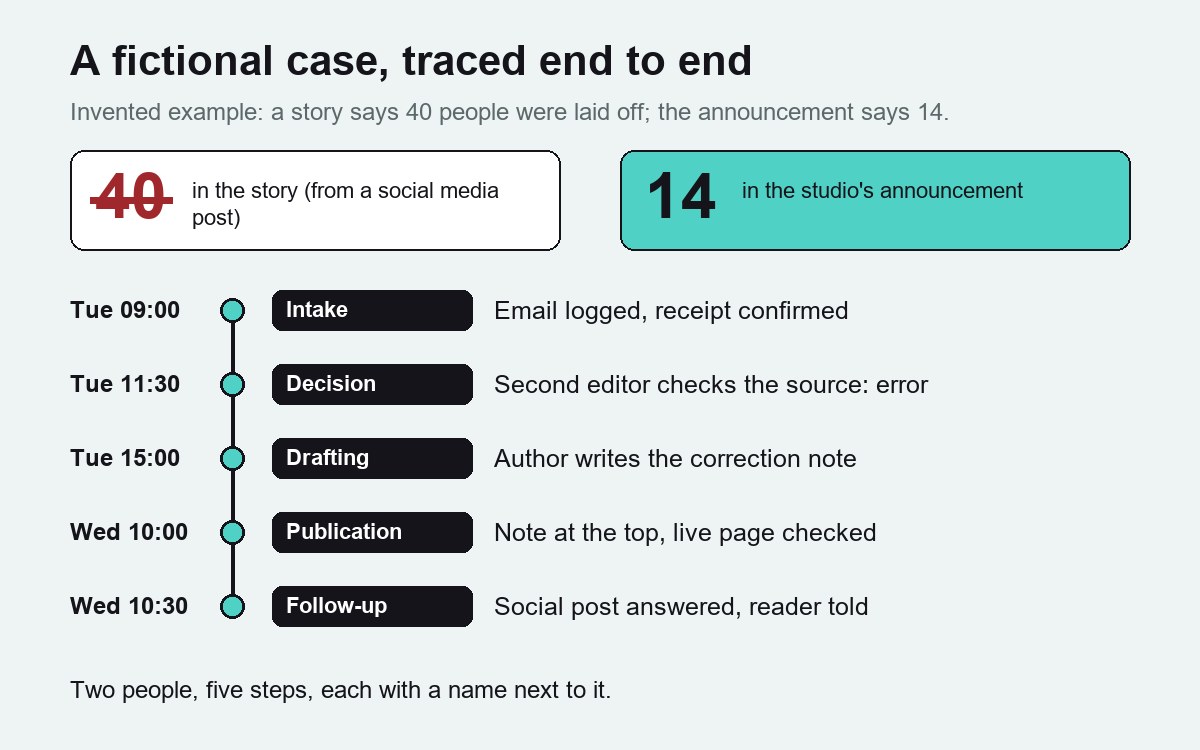
A reader emails Example Wire on a Tuesday: a story on a game studio's layoffs says 40 people were affected, but the studio's own announcement says 14.
- Tuesday, 09:00, intake. The editor-in-charge of reader mail logs the email with the story address, the claim ("40") and the reader's cited source, and replies that the message was received.
- Tuesday, 11:30, decision. A second editor, who did not write the story, opens the studio's announcement. It says 14. The story's figure comes from a social media post that the author treated as a quote from the studio. The decision: error. The conclusion of the story, that the studio made cuts, does not change, but the scale does.
- Tuesday, 15:00, drafting. The author writes the note: "Correction, 18 November: An earlier version said 40 people were affected. The studio's announcement says 14. The text has been changed. The earlier figure came from a social media post that was not from the studio."
- Wednesday, 10:00, publication. The note appears at the top, because the figure is in the opening paragraph; the text is changed; the live page is checked by the decision-maker.
- Wednesday, 10:30, follow-up. The site's social post that carried "40" is answered with the correction and a link. The reader is told by email.
Nothing here required a large team: two people, with the second editor acting as decision-maker. What mattered was that each step had a name next to it.
Four mistakes and fixes
1. The report that goes nowhere. An email lands in an inbox nobody checks. Fix: one named owner for intake and a visible address.
2. The author decides. The person who wrote the error is asked whether it was one. Fix: someone else decides wherever possible. When you are the only person, use the decision step as a separate pass: open the source first, then the story.
3. A note without a live-page check. The correction is drafted and approved, but the page still shows the old text, or the note is under the wrong story. Fix: a named person verifies the live page.
4. Forgetting the copies. The story is fixed, but posts that carried the wrong claim stay up. Fix: follow-up has an owner and a list: social posts, newsletters, syndicated copies. The 2013 guide gives the social-media case: find who re-shared the error and ask them to share the correction [1].
A template to copy
For each report, a log line:
Received: date, channel, reporter, claim in question. Intake by: name.
Decision: error / clarification / not an error. Source checked. Reason. Decided by: name, date.
Note drafted by: name. Published: date, label, position on page. Live page checked by: name.
Copies and channels corrected: list. Reporter informed: date.
And one line in the public policy: who can be contacted, how, and what the publication commits to do.
What this article does not settle
It does not claim this model is the common one. The sources describe a single newsroom's process as reported in 2013, commitments by three organisations, a format and two vocabulary definitions. None says how long any outlet actually takes. The time limits are proposed. The case is invented. The article does not cover legal obligations, retractions of whole stories or disputes with the people named in a story, which depend on the jurisdiction and the case.
How this article was made
| Task | What the AI did | What a person did | How it was checked |
|---|---|---|---|
| Research | Gathered candidate sources and drafted notes | Chose the question and which pages to rely on | Every quote checked against the page named in the sources, read on 18 November 2026 |
| Draft | Wrote the first draft from the notes | Edited the text, the five-step model and the example | An independent review compares claims with the sources before publication |
| Images | Generated the cover illustration | Chose and checked it | Labelled as AI-generated in the disclosure line and alt text |
| Not done by AI | — | The decision to publish and responsibility for the text | — |
Conflicts of interest: none. The author has no commercial relationship with the organisations named here.
Responsible for this article: Dmitriy Lastovka, author. Corrections: contact form.
Sources
Labels: news report (a published guide), policy (a published organisational standard), standard (a published industry framework), schema (a public vocabulary definition).
- Rachel McAthy, "Made a mistake? Advice for journalists on online corrections", Journalism.co.uk, 21 January 2013. https://www.journalism.co.uk/how-to-handle-online-news-corrections/ News report; guidance article quoting practitioners.
- CoinDesk, ethics page ("Last updated December 2024"). https://www.coindesk.com/ethics/ Policy.
- Poynter, ethics guidelines page. https://www.poynter.org/guidelines-2/ Policy.
- The Trust Project, page listing the Trust Indicators. https://thetrustproject.org/trust-indicators/ Standard.
- ProPublica, corrections page. https://www.propublica.org/corrections Policy; a list of corrections, no formal policy stated on the page.
- Schema.org, "NewsMediaOrganization" (property correctionsPolicy). https://schema.org/NewsMediaOrganization Schema.
- Schema.org, "correction" property. https://schema.org/correction Schema.