

AI tools helped gather research and write the first draft of this article. I edited it and checked every quote against the source page listed at the end. The cover illustration is AI-generated. Details at the end.
You have an article about moving a save file between a console and a PC. A reader now asks a question about exactly that. What do you do?
One common reflex is to write something new: a new question is a new entry on the list. The opposite reflex is to fold everything into the old page and keep one "ultimate guide" growing forever. Both are sometimes right. Neither is a rule.
A useful rule asks what the reader needs and what has changed, not how many questions came in. This article gives four questions that sort a new reader question into three outcomes: update the existing page, write a new one, or point the reader to what already exists. It is the closing part of Interest Radar, a series on finding questions worth researching. Earlier parts dealt with spotting signals of interest. This one is about what to do once a question has been chosen.
Why the choice matters
Publishing a second page is cheap on the day and costly later. Two pages that answer the same question split your own readers, your links and your maintenance. Updating the old page is cheap on the day too, but it can hide the fact that a reader with a different need has been given an answer to the wrong problem.
Search documentation shows both risks. Google's guidance on creating helpful content lists self-check questions for a publisher. One asks whether the content provides "substantial value when compared to other pages in search results" [1]. Read as an editor, the comparison set can reasonably include your own pages: a new article that repeats the old one adds a page, not value. That reading is mine, not Google's.
The same page cautions in the other direction. Among the questions it asks is whether you are "changing the date of pages to make them seem fresh when the content has not substantially changed" [1]. It also asks whether you are adding or removing a lot of content "primarily because you believe it will help your search rankings overall by somehow making your site seem 'fresh?'" and answers in parentheses: "No, it won't" [1]. An update is justified by what happened to the answer, not by a wish to look current.
Question 1: is it the same need?
Two questions about the same topic can be different jobs. The Diátaxis framework, a widely used approach to technical documentation, starts from this idea: it "identifies four distinct needs, and four corresponding forms of documentation": tutorials, how-to guides, technical reference and explanation [2]. Its "compass" reduces the choice to two questions: does the content inform action or cognition, and does it serve the acquisition or the application of skill [3]?
Diátaxis was written for documentation, not for articles aimed at players. Treat it as a sorting tool, not as a law. Used that way it separates three situations:
- A reader wants to do the thing the page already explains. Same need. The page may need a correction or a clearer step, not a sibling.
- A reader wants to decide whether to do it at all ("is moving my save worth it?"). That is a question for understanding, not a procedure. A procedure page is the wrong place for it.
- A reader wants to look up a fact ("which save slots carry over?"). That is a lookup, and burying it inside a long walkthrough makes it hard to find.
If the need differs, lean toward a separate page, even when the topic and the keywords are shared. If the need is the same, the default is the existing page.
Question 2: did the facts change?
Some answers go stale on a schedule: a game patch moves a menu, a platform changes a policy, a price changes. When the facts in the old page are now wrong, a new article next to it leaves two contradicting answers online. The old one must be fixed whatever else you decide.
A fix needs to be visible and honest. Google's page on publication dates says its systems "look at several factors to determine our best estimate of when a page was published or significantly updated" [4]. It recommends a user-visible date labelled as published or last updated, and, in structured data, the datePublished and dateModified fields [4]. The dates must describe "the publication or update date of the page, not the stories or events described therein" [4], and the visible and structured values should match [4].
In practice this gives three habits for an update:
- Change the page, then the date. Move the "Last updated" line only after a substantial change, consistent with the warning quoted above [1].
- Say what changed. A short note at the top or bottom ("Updated 12 November: the sync button moved in patch 1.4") lets a returning reader see at once whether the update touches them. This is an editorial practice, not something the documentation requires.
- Keep what still holds. Delete only what is wrong. Readers who linked to or bookmarked the page expect it to still answer the question they came with.
The reverse also holds. If the facts did not change and the reader simply asked in different words, there is nothing to update. That is the third outcome, covered under question 3.
Question 3: would two pages compete?
If you publish a second page on the same need, you now have two pages for one search intention, and nothing tells a reader or a search engine which one is the answer. Google's documentation uses the phrase "duplicate or very similar pages" for a related case [5]. It describes several reasons to name a preferred page among them, including to "consolidate signals for similar or duplicate pages", so that links and other signals count towards one address, and to make metrics easier to follow [5]. It also notes that none of the methods is required, and that without a preference Google picks the version it considers best for users [5].
That is a useful limit on how far to read the documentation. It is written for URLs of the same content, such as a page reachable with and without tracking parameters. Two separately written articles on one question are a gentler version of the same situation, and the guidance on what to do about it is the editor's judgement, not a search rule.
When you find the overlap after both pages exist, the options are:
- Merge and redirect. Fold the weaker page into the stronger one and send the old address to it with a permanent redirect. Google describes permanent redirects as a signal that "the redirect target should be canonical", to be used when you are sure the redirect will not be reverted [6]. Its list of cases where redirects are useful includes removing a page and sending people to a new one [6].
- Keep both and separate them. If the two pages really serve different needs, say so in each, link them to each other, and make the titles state the difference.
- Name the preferred version. For true duplicates, link to the page you consider canonical consistently from your own pages, as the guidance recommends [5].
Before any of this, the cheapest step is a search of your own site and your own earlier posts for the question, in its old and new wording. Most overlap is found in that minute.
Question 4: is the old page doing too many jobs?
A good update can still go wrong when a page keeps growing. A how-to guide that began with seven steps gains a troubleshooting section, then a section on whether the whole thing is worthwhile, then a table of settings. Each addition came from a real reader question. Together they make a page that serves no one well.
This is the case in which a new question should split the old page. Move the section with a different need into its own article and leave a short pointer in the original. Use the compass again: by its two questions, a block that informs cognition (why, whether, how it works) is a different form from one that informs action, and the compass is meant for content that may need to be moved [3].
A rough signal that a split is due is when the section has its own question as its heading, would make sense if read alone, and is the thing readers ask for by name. That is a working rule from editorial practice, not a figure from the sources.
The four questions in one table
| Question | If yes | If no |
|---|---|---|
| 1. Is it the same need as the existing page? | Look at questions 2 and 3 | Lean toward a new page |
| 2. Did a fact in the old page change or turn out wrong? | Update the old page and its date, with a note | Nothing to correct |
| 3. Would a new page answer the same intention as an old one? | Update, merge, or point to the existing page | A new page can stand |
| 4. Is the old page already carrying a different job? | Split: new page, pointer in the old one | Keep it as one page |
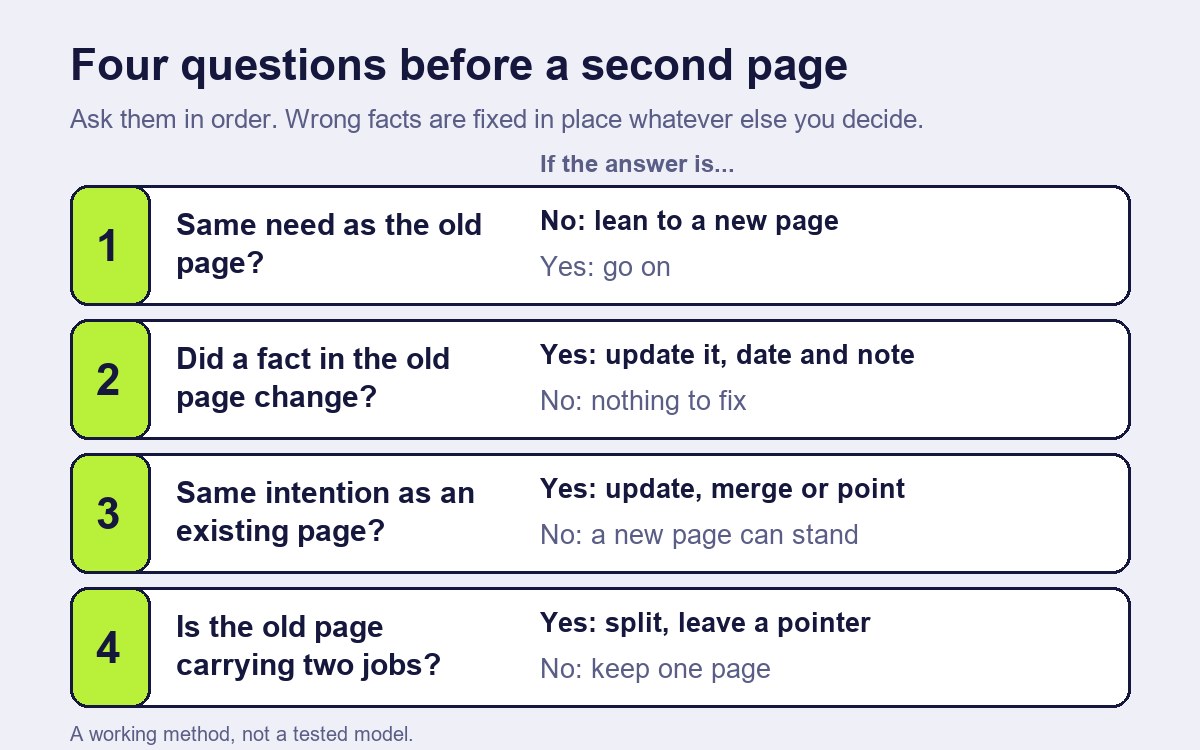
Read the table from the top. A "no" to question 1 is the main reason for a new page. A "yes" to question 2 sends you to the old page whatever the other answers are, because wrong facts must be fixed in place.
A worked example (fictional)
The game, the guide and the questions in this section are invented to show the method.
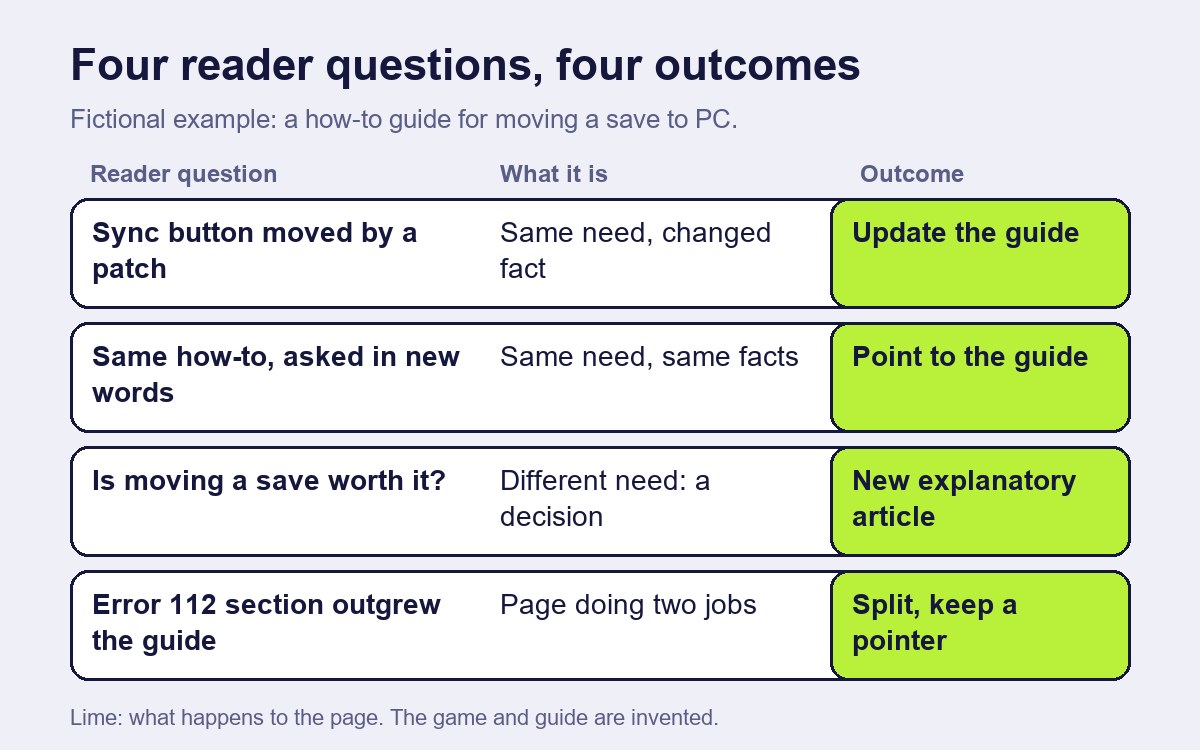
A small site publishes a how-to guide, "Move your Lantern Fields save from console to PC", in March. Over the next two months, four reader questions arrive.
"The sync button isn't where the guide says." A patch moved it. This is the same need and a changed fact: update the guide, correct step three, change the "Last updated" line, and add a one-sentence note saying what changed. No new article.
"How do I carry my save from my console to my computer?" The question is worded differently from the guide's title but has the same need. The editor searches the site, finds the guide, replies with the link and adds that wording to the guide's introduction so the next reader finds it. No update to the facts, and no new article.
"Is it worth moving a save or starting fresh on PC?" A different need, a decision rather than a procedure. The editor drafts a short explanatory article about what carries over, what does not and what a reader gives up, and links it from the guide. A new article, because the first page cannot answer it without turning into a different document.
"Why does the sync fail with error code 112?" Three readers have asked. The guide has grown a troubleshooting section that is now longer than the steps. The editor moves it into its own page ("When Lantern Fields sync fails"), leaves a two-line pointer in the guide and updates the guide's date, because the page itself changed. A split.
Four questions led to one update, one reply with a small edit, one new explanatory article and one split. None of them led to a second page that repeated the first.
What this article cannot tell you
It cannot tell you that updating a page raises its position in search results, or that a new page lowers it; the sources say nothing of the kind, and Google's own guidance cautions against changing content only to look fresh [1]. It gives no threshold for page length, no time since publication after which a page should be rewritten, and no count of reader questions that justifies a new article. The four questions are a working method for an editor, not a tested model. The framework in question 1 was written for software documentation and is applied here by analogy. The worked example is invented.
How this article was made
| Task | What the AI did | What a person did | How it was checked |
|---|---|---|---|
| Research | Collected the search-documentation pages and the documentation framework into notes | Chose the question and the sources to rely on | Quotes checked against the Google Search Central pages and the Diátaxis site [1]–[6] |
| Draft | Wrote the first draft from the notes | Edited the text, the four questions and the worked example | A separate review compared quotes and claims with the sources |
| Images | Generated the suprematist cover illustration (from the Dapp.Expert cover library) | Chose the illustration; specified and checked the explanatory diagrams (built in code) | Labelled as AI-generated in the disclosure line and alt text |
| Not done by AI | — | The decision to publish and responsibility for the text | — |
Conflicts of interest: none. The author has no commercial relationship with Google or the Diátaxis authors; the game and guide in the example are fictional.
Responsible for this article: Dmitriy Lastovka, author. Corrections: contact form.
Where this leads
Choosing the form of the answer is the end of the question-finding block. The next one starts with the material itself: how to look for sources on the open web, and why finding a page is not the same as reading what is on it.
Sources
Labels: official (the organisation's own documentation), framework (published method read on its own site).
- Google Search Central, "Creating helpful, reliable, people-first content". https://developers.google.com/search/docs/fundamentals/creating-helpful-content Official.
- Diátaxis, "A systematic approach to technical documentation authoring" (home page). https://diataxis.fr/ Framework.
- Diátaxis, "The compass". https://diataxis.fr/compass/ Framework.
- Google Search Central, "Influence your byline dates in Google Search". https://developers.google.com/search/docs/appearance/publication-dates Official.
- Google Search Central, "How to specify a canonical URL with rel=\"canonical\" and other methods". https://developers.google.com/search/docs/crawling-indexing/consolidate-duplicate-urls Official.
- Google Search Central, "Redirects and Google Search". https://developers.google.com/search/docs/crawling-indexing/301-redirects Official.