
Artificial intelligence is becoming one of the key development areas in the cryptocurrency industry. While early algorithms were mainly used for automated trading, modern AI agents can independently analyze the market, manage digital assets, interact with smart contracts, and perform complex sequences of actions without constant user involvement. Thanks to blockchain, these systems can securely store assets, execute transactions, and verify every action in a public ledger. Against this background, a new Web3 segment is emerging, combining autonomous agents, intelligent portfolio management, and on-chain security technologies.
Table of Contents
- What Is AI in the Cryptocurrency Industry?
- Autonomous AI Agents and Their Capabilities
- AI for Crypto Portfolio Management
- On-Chain Security and AI Agent Safety
- The Future of AI in Crypto and Web3
1. What Is AI in the Cryptocurrency Industry?
AI in the crypto sector refers to a set of artificial intelligence technologies used to analyze blockchain data, automate financial operations, assess risks, and interact with decentralized applications. Unlike traditional trading bots, modern systems can make decisions based on large amounts of data and adapt to changing market conditions.
Blockchain provides AI with an additional layer of trust. All transactions are recorded in a distributed ledger, while smart contracts allow predefined conditions to be executed automatically without intermediaries. This creates opportunities for fully autonomous financial services.
One of the most noticeable areas of development is the integration of AI with decentralized finance (DeFi). Artificial intelligence analyzes liquidity, yield across protocols, transaction fees, volatility changes, and other parameters to help optimize capital allocation.
Another important factor is the development of Account Abstraction infrastructure, secure delegation mechanisms, and temporary permissions for specific actions. As a result, AI can interact with blockchain networks without requiring constant access to the user’s main private keys.
2. Autonomous AI Agents and Their Capabilities
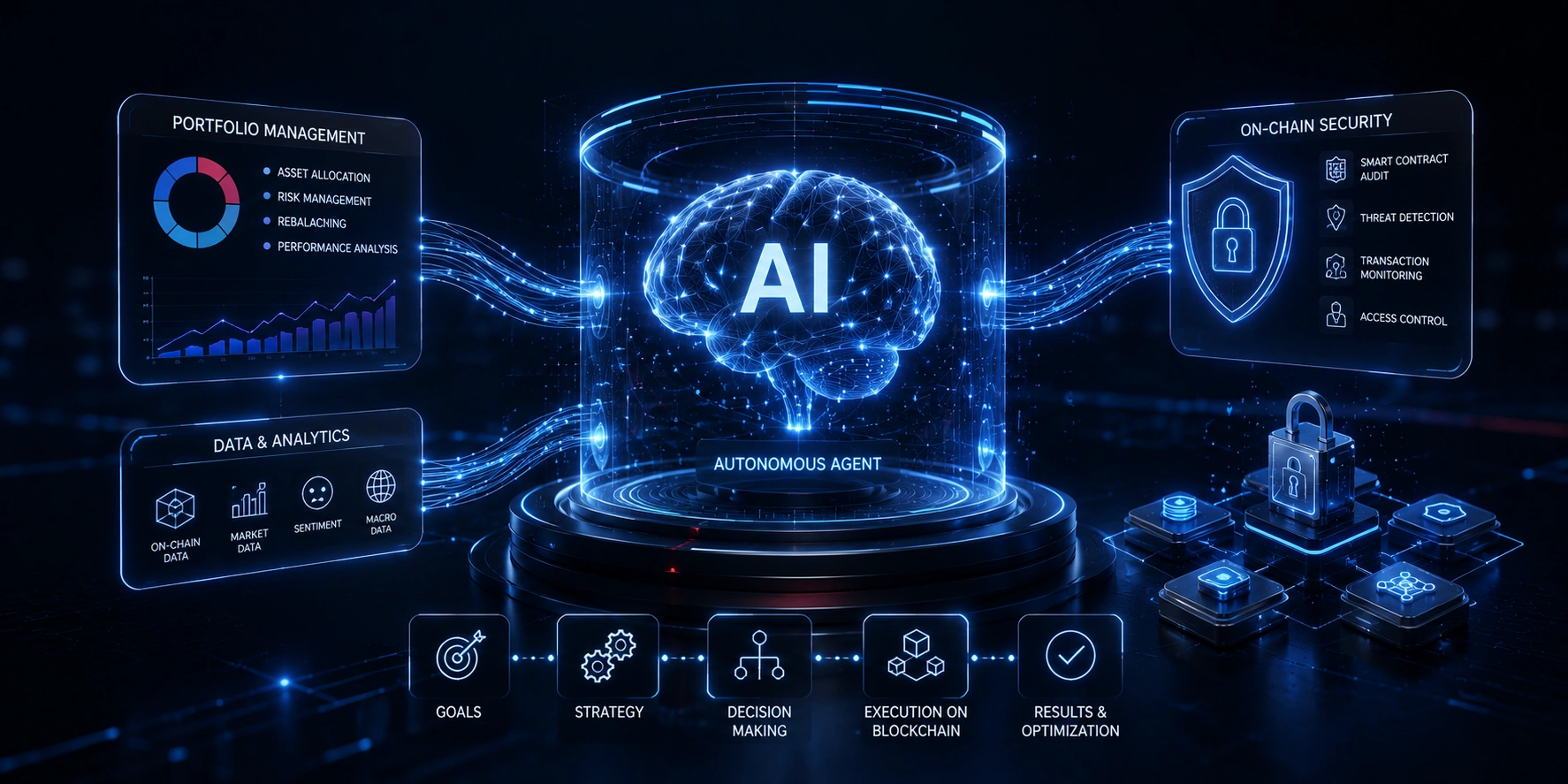
An autonomous AI agent is a software system that can independently plan actions, use external services, connect to blockchain protocols, and execute financial operations according to a defined objective. Unlike basic algorithms, such agents can make complex decisions by combining data from multiple sources.
In Web3, AI agents can have their own crypto wallets, interact with smart contracts, sign transactions through secure delegation mechanisms, and complete tasks without constant human involvement.
The most common use cases include:
- analyzing market conditions and finding investment opportunities;
- automatically allocating capital across DeFi protocols;
- managing liquidity and staking positions;
- monitoring smart contract risks;
- executing trading strategies automatically;
- optimizing transaction fees and routing;
- finding arbitrage opportunities across different blockchains.
As Web3 infrastructure develops, multi-agent systems are also emerging. In these systems, several intelligent agents interact with each other, distribute tasks, and make joint decisions. This architecture is viewed as one of the stages in the formation of an economy of autonomous digital participants.
3. AI for Crypto Portfolio Management
Managing a crypto portfolio becomes increasingly complex as the number of blockchains, tokens, and DeFi protocols grows. Artificial intelligence can continuously analyze thousands of parameters at the same time, allowing systems to react more quickly to market changes.
AI evaluates price dynamics, trading volumes, large wallet activity, liquidity indicators, protocol health, and network activity. Based on this data, algorithms can generate recommendations or automatically rebalance assets according to a predefined strategy.
| Function | Traditional Algorithm | Modern AI Agent |
|---|---|---|
| Market analysis | Based on predefined rules | Based on machine learning and complex data analysis |
| Portfolio rebalancing | According to a fixed schedule | Depending on current market conditions |
| DeFi interaction | Limited automation | Integration with smart contracts and multiple protocols |
| Risk management | Fixed parameters | Dynamic adaptation to volatility |
| Data processing | A limited number of sources | On-chain, off-chain, and market analytics at the same time |
Modern platforms are gradually moving from simple trading signals to intelligent capital management, where AI controls not only transactions but also risk allocation across different market segments.
Despite the high level of automation, most solutions still preserve manual control for asset owners. This makes it possible to limit the actions AI can perform and reduce the likelihood of unwanted operations.
4. On-Chain Security and AI Agent Safety
The expansion of autonomous agents’ capabilities makes security one of the most important areas of industry development. If AI can manage digital assets, it is necessary to prevent key compromise, algorithmic errors, and unauthorized transaction execution.
On-chain security combines a set of technologies that allow AI actions to be controlled directly on the blockchain. Smart contracts define the conditions for executing operations, while cryptographic mechanisms ensure that every transaction can be verified.
Modern architectures use limited permissions, temporary access keys, multisignature wallets, hardware wallets, user intent verification systems, and audit logs of agent activity. This approach helps reduce potential damage even when errors occur in the model’s logic.
Continuous monitoring of AI behavior also plays an important role. Specialized systems analyze deviations from normal activity, detect suspicious transactions, and can automatically pause operations before additional verification is completed. These mechanisms are becoming especially relevant as intelligent systems gain more autonomy.
5. The Future of AI in Crypto and Web3
The development of artificial intelligence is gradually changing how users interact with blockchain. Instead of manually managing assets, users are gaining access to intelligent assistants capable of performing complex financial tasks, analyzing market conditions, and independently interacting with decentralized services.
The next stage is considered to be the formation of an economy of autonomous agents, where software systems will be able to exchange digital assets, pay for computing resources, interact with each other, and participate in decentralized organization governance. To support this model, standards for secure transaction execution, digital identity, and programmable permissions continue to evolve.
At the same time, requirements for algorithm transparency, smart contract audits, and risk management are increasing. Regulators and developers are paying more attention to the control of autonomous systems, as AI errors may affect not only individual users but also the stability of financial protocols.
As a result, the combination of artificial intelligence and blockchain is becoming one of the most important directions in Web3 development. Autonomous agents can improve digital asset management, automate DeFi operations, and enhance the processing of large data sets. However, broader adoption will depend on security, infrastructure reliability, and control mechanisms that balance AI autonomy with user asset protection.











