
AI tools helped gather research and write the first draft of this article. I edited it and checked every quote and figure against the source page listed at the end, read on 27 November 2026. The cover illustration is AI-generated. Details at the end.
Named entity recognition, or NER, is the tool that reads a sentence and marks the people, companies and places in it. It works well on the kind of text it was built for. In crypto and AI news it goes wrong for three reasons that come from how the tool was built, not from bugs: its labels were designed for other text, one name often points at several different things, and its picture of the world stops at the date its training data ended. For an editor, the practical rule is to treat every automatic label as a suggestion and to measure it on your own sentences before relying on it.
This article explains what a general-purpose recognizer is trained to find, shows the three gaps with a fictional sentence, looks at what domain-specific work in this area reports, and ends with a five-step check you can run on a small sample. It is about reading tool output critically. It does not rank products and it does not claim that any tool is bad: a tool can be good at its job and still be the wrong tool for yours.
What a general-purpose recognizer is trained to find
An entity recognizer does not understand a story. It was shown a large set of sentences in which people had marked spans of text with a label, and it learned to imitate those marks. What it can say is therefore limited to the labels and the kind of text in that training set.
Two widely used examples show how narrow that can be.
The first is a model card on Hugging Face for a BERT-based recognizer. It says the model was "fine-tuned on the English version of the standard CoNLL-2003 Named Entity Recognition dataset", derived from Reuters news stories, and the card lists four classes: location, organization, person and miscellaneous [1]. Its limitations section is plain about the consequence: the model "is limited by its training dataset of entity-annotated news articles from a specific span of time", and "This may not generalize well for all use cases in different domains" [1].
The second is spaCy's small English pipeline, version 3.8.0. Its release page lists 18 entity labels, among them PERSON, ORG, GPE, PRODUCT, EVENT, MONEY and WORK_OF_ART, and names OntoNotes 5 among its sources [2]. The page also reports precision of 84.30, recall of 84.36 and an F-score of 84.33 for entities [2]. The page does not say here which test text those figures come from, so read them as the developers' own measure on their own benchmark, not as a promise for crypto headlines.
spaCy's documentation says the same thing in general terms: statistical models "strongly depend on the examples they were trained on", you may need "some tuning later, depending on your use case", and you can add your own classes and update the model with new examples [3]. So the tool's makers do not hide the limit. The risk is that a reader of its output forgets it.
None of this is a defect. A recognizer built on news-wire labels is meant to find people, organizations and places in news-wire text. The mismatch begins when it is pointed at a different subject.
Three gaps
1. The label gap: the right answer does not exist in the scheme
Think about what a crypto or AI editor wants marked: a token, a protocol, a wallet, a model, a benchmark, a validator, a smart contract, a ticker. Neither scheme above contains these as labels [1][2]. The tool can still mark the words, because it must put each span somewhere, and so it chooses the nearest label it has. A protocol becomes an organization. A model name becomes a product, or a person, or nothing.
The result looks like an answer and is a forced choice. An editor reading "ORG" next to a protocol name sees a confident label, not the fact that the scheme had no honest option.
2. The collision gap: one name, several things
News in these fields reuses names constantly. A project, its token, its company and its founder may share a name or a near-copy of it. A model family and a lab can share one. A ticker can read like a common word. A recognizer that works span by span sees the characters, not the thing, and its label can only be right if the context of the sentence settles it, which it often does not. Settling which thing a name refers to is a separate task from finding the name, and the next article in this series, "Resolving Ambiguous Names in News", takes it up. Here the point is only that finding a name and understanding it are two steps, and the first tool does just the first.
3. The time gap: the vocabulary stops moving
The Hugging Face card above names the problem directly: training data from "a specific span of time" [1]. In fast-moving fields this matters more than it does for countries and ministers. New protocols, new tokens and new model releases appear every month, and a model trained before they existed has never seen them. It does not say "unknown". It guesses from spelling and from nearby words, and some guesses will look right.
A fictional sentence, three ways
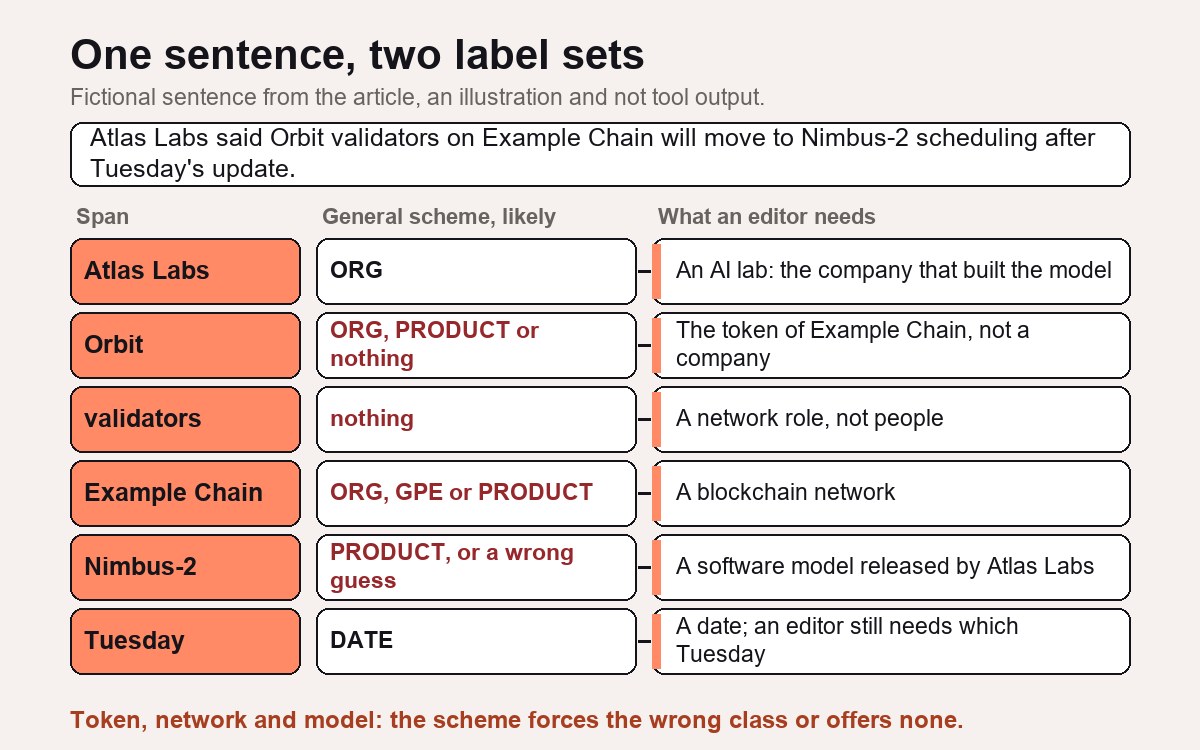
The following example is invented. Example Chain is a made-up blockchain network, Orbit its made-up token, Atlas Labs a made-up AI lab and Nimbus-2 its made-up model. The labels in the table are an illustration of what a general scheme can and cannot express. I did not run any tool to produce them, and I do not claim that a particular product would output them.
The sentence:
Atlas Labs said Orbit validators on Example Chain will move to Nimbus-2 scheduling after Tuesday's update.
| Span | A general scheme would likely offer | What an editor needs |
|---|---|---|
| Atlas Labs | ORG | An AI lab: the company that built the model |
| Orbit | ORG, PRODUCT or nothing | The token of Example Chain, not a company |
| validators | nothing | A network role, not a person or group of people |
| Example Chain | ORG, GPE or PRODUCT | A blockchain network |
| Nimbus-2 | PRODUCT, or a wrong guess | A software model released by Atlas Labs |
| Tuesday | DATE | A date; an editor still needs which Tuesday |
Two things are worth noticing. First, even where the tool agrees with the editor, the label is thin: ORG for Atlas Labs is not wrong, and it also does not say that this is the lab behind the model. Second, in the three rows that matter most to a crypto and AI story (the token, the network and the model) the scheme either forces the wrong class or offers none.
What domain-specific work reports
Researchers working on this area have built domain data. Three pages are worth reading for what they say, and for what they do not say.
A model card for a crypto-focused recognizer, cryptoNER, targets a "cryptocurrency TICKER SYMBOL, NAME, and blockscanner ADDRESS within text" [4]. Its card says it was trained on "artificially generated tweets and ERC20 token metadata", and that performance "may be subpar when the model encounters entities outside its training data" [4]. This is a useful reminder that a domain label set is an improvement on a general one in some respects, and that it has its own boundary: here, tickers, names and addresses, not stories about validator changes, and not news as such.
The DLT-Corpus paper, posted in February 2026 and revised in May 2026, reports about 2.98 billion tokens of text from the distributed-ledger field and a model called LedgerBERT [5]. On a named-entity task drawn from scientific literature, with entities such as consensus mechanisms (Proof of Stake), platforms (Ethereum) and technical concepts (private key), the paper's Table 2 gives F1 scores of 0.243 for BERT-base and 0.299 for LedgerBERT, scored with strict entity-level matching [5]. Two cautions apply. The test text is scientific literature, not news, so the numbers do not transfer to headlines. And the absolute scores are low for every model in the table, which suggests that domain entities are a hard problem even for domain-trained systems, not just for general ones. The paper credits LedgerBERT's gain to domain-specific pre-training; that is the authors' explanation, which I report but did not test.
Another direction is a model that takes the entity types as input instead of fixing them. The GLiNER paper presents a compact model that can identify any entity type, not only a fixed set, and reports that it outperforms ChatGPT and fine-tuned LLMs in zero-shot evaluations on several NER benchmarks [6]. That is the paper's claim on its own benchmarks. I have not tested it on crypto or AI news and the page does not say how it does there.
The common thread is that each approach changes one of the three gaps: new labels, domain data, or labels supplied at run time. None removes the need to look at the output.
A five-step check for an editor
You do not need a research team to see how a tool does on your material. A small sample is enough to learn what to trust.
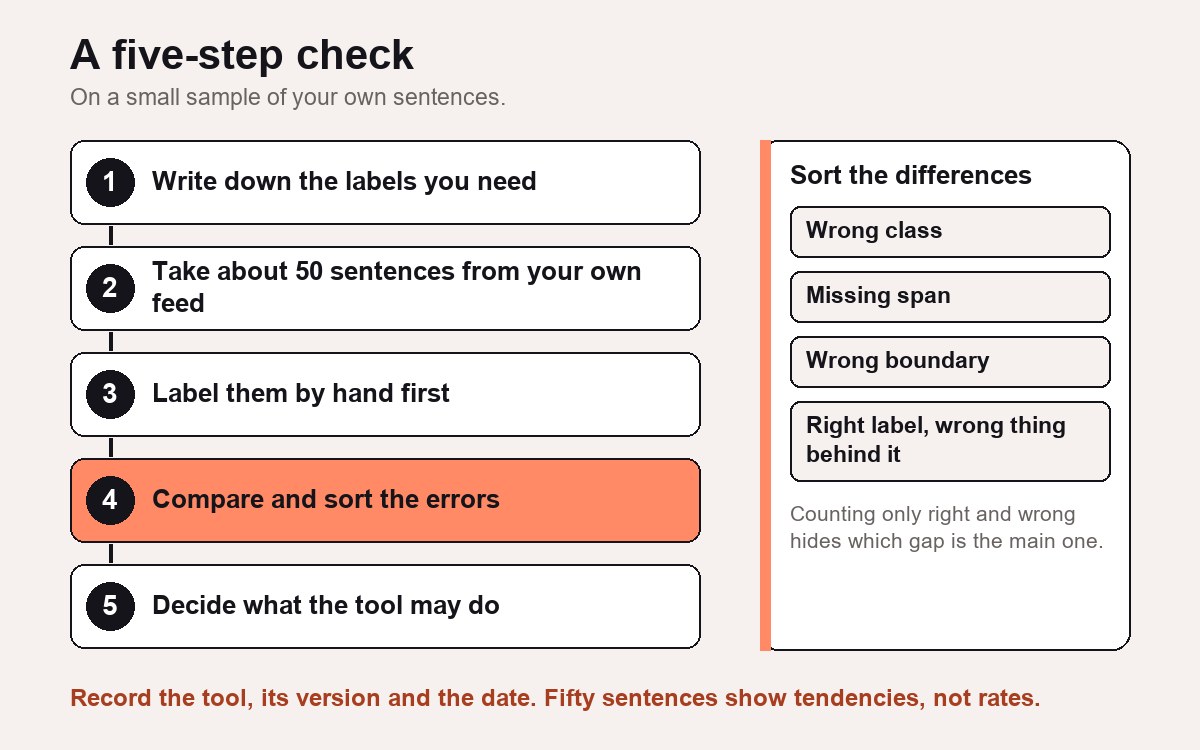
- Write down the labels you need. Five to ten, in your own words: token, protocol, company, person, model, event. If the tool's scheme cannot express them, you know the gap before you test anything.
- Take a sample from your own feed. Fifty sentences from recent stories, including ones with new names, tickers and model releases. Include the awkward ones on purpose.
- Label them by hand first. Do it before you look at the tool's output, so its answers do not steer yours. Note where you were unsure; that is information too.
- Compare and sort the errors. For each difference, record the type: wrong class, missing span, wrong boundary, or right label with the wrong thing behind it. Counting only "right" and "wrong" hides which gap is the main one.
- Decide what the tool is allowed to do. For example: it may suggest tags, but an editor accepts them; it may not create a link between two names unprompted. Record the tool, its version and the date, because the answer will change when either does.
This does not produce a score you can publish. It produces a list of what this tool does with your text, which is what you need in order to decide how much to lean on it.
Four mistakes and fixes
1. Trusting a label because it is confident. A tool gives a class to every span it marks. Fix: a label is a suggestion until a person or a source confirms it.
2. Reading a benchmark score as a promise. An F-score tells you how a model did on someone's test text [2]. Fix: test on a sample of your own stories.
3. Treating a domain model as a general answer. A crypto model may do better on token names and, as its own card warns, be subpar on entities outside its training data [4]. Fix: check what it was trained on, and what it was not.
4. Forgetting the date. A model that has not seen last month's release cannot know it. Fix: write the tool version and test date next to every result, and re-run the sample when either changes.
What this article cannot tell you
It does not say how often any named tool makes a given error in crypto or AI news, because I ran none of them. The example sentence and the labels in the table are invented illustrations. It does not compare products or recommend one. The benchmark figures quoted come from model pages and one paper and measure different tasks on different text; they cannot be compared with each other. The DLT-Corpus numbers concern scientific literature, not news. The five-step check is my proposal, not a standard, and a sample of fifty sentences shows tendencies, not rates. A Russian-language background analysis prepared for this series was not used.
How this article was made
| Task | What the AI did | What a person did | How it was checked |
|---|---|---|---|
| Research | Gathered candidate sources and drafted notes | Chose the question and which pages to rely on | Every quote and figure checked against the page named in the sources, read on 27 November 2026 |
| Draft | Wrote the first draft from the notes | Edited the text, the fictional example and the five-step check | An independent review compares claims with the sources before publication |
| Images | Generated the cover illustration | Chose and checked it | Labelled as AI-generated in the disclosure line and alt text |
| Not done by AI | — | The decision to publish and responsibility for the text | — |
Conflicts of interest: none. The author has no commercial relationship with the organisations or products named here.
Responsible for this article: Dmitriy Lastovka, author. Corrections: contact form.
Sources
Labels: model card (a developer's own description of a model), documentation, release page, paper (an arXiv preprint). All pages were read on 27 November 2026.
- Hugging Face, model card for dslim/bert-base-NER (training data, classes, limitations). https://huggingface.co/dslim/bert-base-NER Model card.
- Explosion, release page for spaCy model en_core_web_sm 3.8.0 (label scheme, sources, entity scores). https://github.com/explosion/spacy-models/releases/tag/en_core_web_sm-3.8.0 Release page.
- spaCy documentation, "Linguistic features", Named Entities section. https://spacy.io/usage/linguistic-features Documentation.
- Hugging Face, model card for covalenthq/cryptoNER. https://huggingface.co/covalenthq/cryptoNER Model card.
- Hernandez Cruz, Devine, Vadgama, Tasca and Xu, "DLT-Corpus: A Large-Scale Text Collection for the Distributed Ledger Technology Domain", arXiv 2602.22045 (v1 25 Feb 2026, revised 27 May 2026); NER results from section 5.1 and Table 2 of the HTML version. https://arxiv.org/abs/2602.22045 Paper.
- Zaratiana, Tomeh, Holat and Charnois, "GLiNER: Generalist Model for Named Entity Recognition using Bidirectional Transformer", arXiv 2311.08526 (14 Nov 2023). https://arxiv.org/abs/2311.08526 Paper.