

AI tools helped gather research and write the first draft of this article. I edited it and checked every quote and figure against the source listed at the end, read on 27 November 2026. The cover illustration is AI-generated. Details at the end.
On a busy day an editor can face dozens of articles that all seem to be about the same thing: a token falling off its peg, a model release, a game studio's layoffs. Reading each one to find out which belong together is slow, and so is missing that a "new" story is the third rewrite of one from the morning. Clustering by event means grouping articles that report the same specific happening, and the hard part is not the algorithm but the definition: you have to decide what "the same event" means before any tool can group anything.
This article explains that definition, what a typical embedding pipeline does, where it breaks, and how an editor can check the groups.
Event, story, topic: three different groupings
News tools use these words loosely, and the grouping depends on which one you mean.
The early Topic Detection and Tracking (TDT) pilot study, a DARPA-sponsored initiative with Carnegie Mellon, Dragon Systems and UMass Amherst among its primary participants, narrowed the idea on purpose. Its final pilot report says the notion of a topic "was modified and sharpened to be an 'event', meaning some unique thing that happens at some point in time" [1]. Its example: the eruption of Mount Pinatubo on a given date is an event, while "volcanic eruption in general" is a class of events [1]. So an event is located in time and place and is specific. A topic such as "stablecoin risks" is broader.
That gives three levels worth keeping apart in an editorial tool:
- Event: one specific happening, such as the depeg of a particular stablecoin on a particular day.
- Story: the running coverage of that event and its aftermath, which can last weeks.
- Topic: a broad subject that many events belong to.
A cluster that silently merges into a topic is useless to an editor, because "stablecoins" is a site section, not a signal. One that splits every follow-up into its own group is also useless. The first design decision is therefore a sentence: which of these three does this tool group?
Why "same event" is not a similarity score
It is tempting to treat this as "find articles whose text is similar". A shared task shows why that is not enough. SemEval-2022 Task 8 released nearly 10,000 news article pairs in 18 language combinations and asked annotators to rate each pair on seven dimensions [2]. Its overview states the difficulty plainly: "two articles may have substantial textual overlap but describe similar events that happened years apart" [2].
The seven dimensions were geographic focus, named entities, time, narrative schemas, overall story, writing style and tone [2]. The "overall" question asked whether the two articles cover "the same substantive news story", excluding style, framing and tone [2]. Annotators used a four-point scale from very dissimilar to very similar [2]. Two things follow for anyone building an event grouper.
First, "same event" combines several signals (who, where, when, what happened), and one text-similarity number can be high while another differs. Second, even trained annotators do not agree perfectly: the overview reports a Krippendorff's alpha of 0.77 on the overall dimension, which the authors call very high [2], so the target a machine learns from is not crisp. The top systems reached "up to 0.818 correlation with gold standard labels", and human annotators can reach higher correlations [2].
TDT met the same limit. Its report assumes each story discusses at most one event, then admits this is not always true: in its corpus ten stories carried a YES or BRIEF tag for more than one event, and the assumption was kept because it fits most stories and simplifies evaluation [1]. A grouping tool inherits that simplification: an article covering two events lands in one cluster or the other.
What a typical pipeline does
Most tools follow the same shape.
- Normalise and deduplicate. Strip boilerplate, then collapse exact and near-copies such as syndicated wire text, so one agency story republished fifteen times is not counted as fifteen independent reports.
- Turn each article into a vector. Sentence embedding models place similar meanings close together. Sentence-BERT was introduced partly for cost: the authors report that finding the most similar pair among 10,000 sentences takes about 65 hours with BERT, against about 5 seconds with SBERT embeddings [3].
- Group the vectors. Here you choose a clustering method. The choice matters more than it looks, as the next section shows.
- Add the signals similarity misses. Dates, named entities and locations, extracted from the text, are used to split or merge groups. This is where the earlier parts of this series connect: if entity recognition or name resolution is wrong, the grouping inherits the error.
- Show the result with its evidence. The editor should see why two articles were grouped, not only that they were.
The choices that decide the result
The scikit-learn documentation is a plain source for what each family of method assumes [4].
k-means "requires the number of clusters to be specified" [4]. For news that is a poor fit, because the number of events in a day is exactly what you do not know. The same page says its inertia criterion assumes clusters "are convex and isotropic, which is not always the case" [4].
Agglomerative (hierarchical) clustering starts with each item alone and merges the closest. The linkage rule changes behaviour: single linkage merges on the closest pair, complete linkage on the farthest, average linkage on the mean distance, and cosine distance is supported [4]. The Sentence-Transformers documentation notes that it "can be useful if the number of clusters is unknown", lets you set a distance threshold, and is slow on large sets: "only applicable for maybe a few thousand sentences" [5].
Density-based clustering (DBSCAN) has a parameter, eps, that the scikit-learn page says is "crucial to choose appropriately" for the data and distance and usually cannot stay at its default [4]. Points that belong to no dense region are labelled noise (-1) [4]. Noise is a feature for news: a one-off article about something nobody else covered should stay alone, not be forced into a group.
Threshold-based "fast clustering" in Sentence-Transformers lets you set a cosine-similarity threshold and a minimal community size, and is "tuned for large datasets" [5]. The threshold is your definition of "same event", written as a number.
Online (streaming) clustering fits how news arrives. Miranda and colleagues describe an online method that clusters an incoming stream of multilingual documents into monolingual and crosslingual story clusters, discovering "an ever growing number of cluster labels" online, and report state-of-the-art results on German, English and Spanish datasets [6]. The abstract gives no figures, and results on those datasets do not transfer by default to crypto, finance or games coverage. Streaming fits the TDT setting, where each story is processed in sequence and the first story about a new event is flagged [1].
None of these methods knows what an event is. Each draws a line in a vector space, and where it falls depends on your threshold, distance and data.
A fictional worked case
The following example is invented. Lumen USD is a made-up stablecoin; the outlets, times and headlines are fictional and only show how a pipeline could behave.
On a Tuesday, a tool receives eight articles:
| # | Outlet | Headline (fictional) | Published |
|---|---|---|---|
| A | Example Wire | Lumen USD slips to $0.94 on large redemptions | 09:10 |
| B | Example Chain Daily | Lumen USD loses peg as redemptions surge | 09:40 |
| C | Example Wire | Lumen USD slips to $0.94 on large redemptions (republished) | 09:55 |
| D | Sample Markets | What a depeg means for stablecoin holders | 10:30 |
| E | Example Chain Daily | Lumen USD issuer pauses redemptions | 14:20 |
| F | Sample Games | Studio pays staff in Lumen USD, now worth less | 15:05 |
| G | Example Review | Lumen USD's reserve report, annotated | 16:00 |
| H | Example Wire | Lumen USD regains $0.99 after issuer statement | next day, 08:30 |
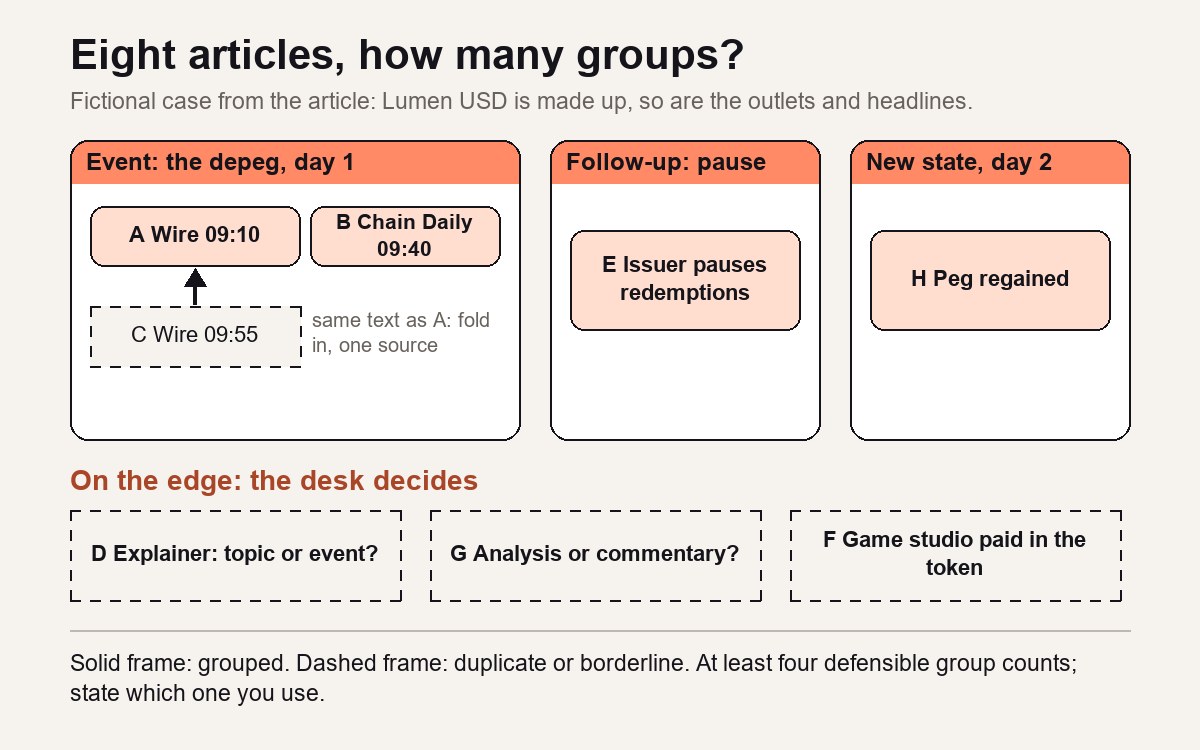
A reasonable pipeline might behave like this.
- A and C are the same wire text. A deduplication step should fold C into A and record that the story had one source, republished.
- A and B report the same event with different words. They should group.
- D is a broader explainer. It mentions the event, but it is closer to the topic "stablecoin depegs". A similarity threshold set low enough to group A and B may pull D in; a higher one leaves it out. The editor must be able to see which was chosen. TDT's BRIEF tag, for stories that mention an event only briefly, is the same problem in older words [1].
- E is a new development: the issuer pauses redemptions. Is it the same event or a new one? The vectors will probably be close, since the vocabulary is nearly the same, so a tool needs time and the verb ("pauses" versus "slips") to mark it as a follow-up inside one story.
- F is about a game studio. Its subject differs, but it is a consequence of the same event. Whether it belongs depends on the desk.
- G is analysis from the same day with the same entities. It may be grouped with A and B, or kept apart as commentary.
- H, the next day, shares entities and vocabulary but reports a new state. A fixed time window would split it from the first day; a story-level link would keep it.
Eight articles, and at least four defensible group counts. The aim is to pick the answer that fits the editor's question, state it, and let the tool show its work.
Four mistakes and fixes
1. Treating similarity as identity. A high score between two articles says the texts are alike, not that they report the same happening; the SemEval example of overlapping text about events years apart is the warning [2]. Fix: combine the similarity score with a date window and shared entities, and show those next to it.
2. One global threshold, set once. A threshold that suits wire reports may be wrong for long analysis or another language. Fix: tune on a labelled sample from your own coverage and review it periodically. The scikit-learn page notes that measures such as the Rand index and mutual information "require the knowledge of the ground truth classes", which is "almost never available in practice", so someone has to label a sample by hand [4].
3. Reporting cluster size as importance. Fifteen articles may be one wire story republished fifteen times. Fix: count independent sources after near-duplicate removal.
4. No way back. If an editor sees a group and cannot see why, or cannot split a wrong group, the tool becomes a source of unchecked claims. Fix: show the closest pair, shared entities and dates, and let the editor split or merge groups. The planned Part 06 is titled "Making NLP Assistance Inspectable for Editors".
How to check the clusters
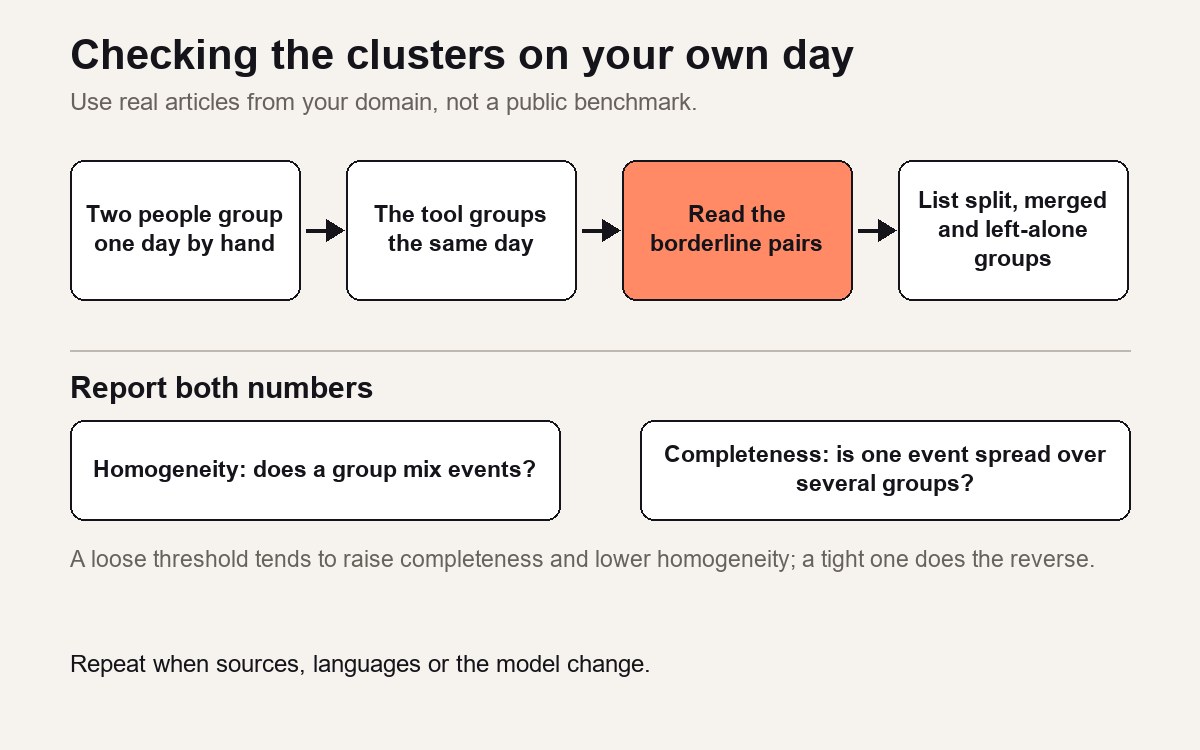
The scikit-learn page names the vocabulary you need. For a labelled sample, homogeneity means each cluster "contains only members of a single class" and completeness means "all members of a given class are assigned to the same cluster" [4]. In news terms: does a group mix events, and is one event spread over several groups? They pull in opposite directions: a loose threshold tends to raise completeness and lower homogeneity, and the reverse for a tight one. Report both.
A small routine:
- Take one day of real articles from your own domain, not a public benchmark.
- Have two people group them by hand, and write down where they disagree. The disagreement shows how crisp the target is in your own coverage, as the SemEval annotators' agreement did for theirs [2].
- Run the tool and compare. List the groups it split, merged and left alone.
- Read the borderline pairs, not only a score.
- Repeat when sources, languages or the model change.
Label-free scores have their own limit. The scikit-learn page notes that the silhouette coefficient is "generally higher for convex clusters" than for density-based clusters such as those from DBSCAN [4]. It checks geometry, not whether two articles describe the same happening.
What this article cannot tell you
It does not say which model, method or threshold to use; none was tested for this article, and the fictional case shows behaviour that is plausible, not measured. It gives no accuracy for any tool. The SemEval figures describe one dataset of paired articles, and the abstract of Miranda and colleagues reports results on German, English and Spanish datasets without figures; neither shows how a method behaves on crypto, finance or games coverage. It does not cover paywalled articles, ranking of clusters or user-generated posts. The three-level split into event, story and topic is a working proposal for editorial tools, not a standard; only the event definition is quoted from TDT. Where the text says a tool "can" or "might" do something, that is design reasoning, not a test; so is the deduplication step, which cites no source.
How this article was made
| Task | What the AI did | What a person did | How it was checked |
|---|---|---|---|
| Research | Gathered candidate sources and drafted notes | Chose the question and which pages to rely on | Every quote and figure checked on the primary page or paper named in the sources, read on 27 November 2026 |
| Draft | Wrote the first draft from the notes | Edited the text, the fictional case and the checklist | An independent review compares claims with the sources before publication |
| Images | Generated the cover and inline illustrations | Chose and checked them | Labelled as AI-generated in the disclosure line and alt text |
| Not done by AI | — | The decision to publish and responsibility for the text | — |
Conflicts of interest: none. The author has no commercial relationship with the organisations or tools named here.
Responsible for this article: Dmitriy Lastovka, author. Corrections: contact form.
Sources
Labels: report (a programme's own report), paper (a peer-reviewed or preprint paper), documentation (a software project's docs). Quotes are as on the pages read on 27 November 2026.
- Allan, Carbonell, Doddington, Yamron, Yang, "Topic Detection and Tracking Pilot Study: Final Report", DARPA Broadcast News Transcription and Understanding Workshop, 1998 (full PDF text read). https://www.cs.cmu.edu/~jgc/publication/Topic_Detection_Tracking_Pilot_DARPA_1998.pdf Report.
- Chen et al., "SemEval-2022 Task 8: Multilingual news article similarity", Proceedings of SemEval-2022, ACL, pp. 1094-1106 (full PDF text read). https://aclanthology.org/2022.semeval-1.155/ Paper.
- Reimers and Gurevych, "Sentence-BERT: Sentence Embeddings using Siamese BERT-Networks", arXiv:1908.10084, abstract. https://arxiv.org/abs/1908.10084 Paper.
- scikit-learn 1.9.1 documentation, section 2.3 "Clustering". https://scikit-learn.org/stable/modules/clustering.html Documentation.
- Sentence-Transformers documentation, "Clustering" application page. https://www.sbert.net/examples/sentence_transformer/applications/clustering/README.html Documentation.
- Miranda, Znotins, Cohen, Barzdins, "Multilingual Clustering of Streaming News", EMNLP 2018, arXiv:1809.00540, abstract only. https://arxiv.org/abs/1809.00540 Paper.