
AI tools helped gather research and write the first draft of this article. I edited it and checked every quote and figure against the source page listed at the end, read on 27 November 2026. The cover illustration is AI-generated. Details at the end.
A news text says "Meridian". Is that a person, a company, a product or a token? Do not decide by the name. Decide by evidence: list the candidates, give each one an identifier, check what the surrounding text says about each, and allow the answer "unresolved". A tool can propose a candidate, but the proposal is a suggestion that needs a visible reason, not a fact.
This article is about the step after a name has been found in a text: working out which real-world thing it points to. It shows how published tools frame the task, walks a fictional example from blockchain news, lists four mistakes and gives a checklist. It is not a benchmark and it does not recommend a product.
One string, four things
Part 01 of this series asks why general-purpose entity recognition misses domain meaning. Here a tool has already marked "Meridian" as a name; the question is which one. Everything below is invented.
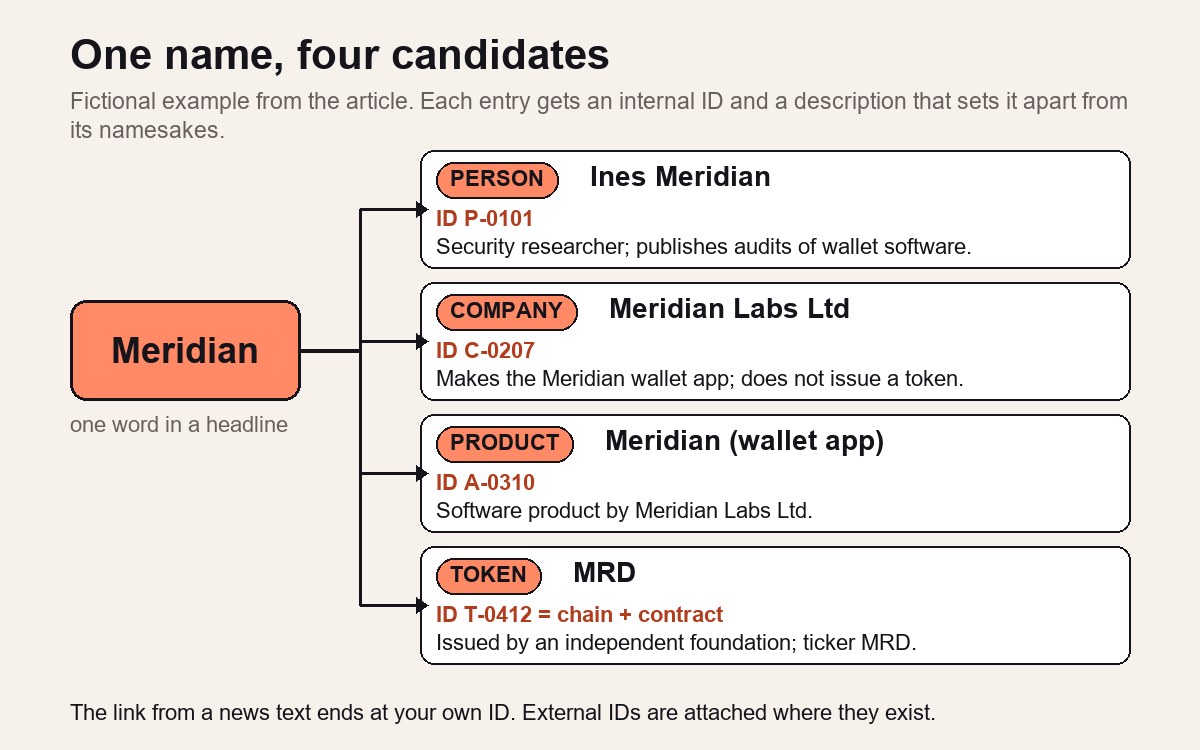
- Ines Meridian is a security researcher (a person).
- Meridian Labs Ltd is a company that builds wallet software.
- Meridian is that company's wallet app (a product).
- MRD is a token issued by a separate foundation and traded under the ticker MRD (a token). The wallet app can hold it, but it is not the company's token.
Now read four invented headlines:
- "Meridian patches signing bug before launch."
- "Meridian says it has no plans to list a token."
- "Meridian surges 40% after exchange listing."
- "Meridian warns users about phishing sites."
A reader resolves most of them in a second; a program has less to go on. Headline 1 could be the product or the company. Headline 2 is a company statement about a token that is not its own. Headline 3 is probably the token. Headline 4 could be the company, the product, or the researcher. The words are identical; the referent changes.
What the task is called, and what tools do
Linking a name in text to one entry in a knowledge base is usually called entity linking or entity disambiguation. Published tools break it into similar pieces.
spaCy's documentation says its EntityLinker "disambiguates textual mentions (tagged as named entities) to unique identifiers", and that the component "requires a KnowledgeBase, as well as a function to generate plausible candidates" [1]. So there are three parts: a list of known things with identifiers, a way to propose candidates for a mention, and a model that chooses. In spaCy's default setup the candidate generator is described as "a function looking up exact, case-dependent aliases in the KB", and a machine-learning model picks "the right candidate, given the local context of the mention" [1]. The scoring is not described further.
Research systems follow the same shape. The BLINK paper describes "a two-stage zero-shot linking algorithm, where each entity is defined only by a short textual description": a first stage that "does retrieval in a dense space defined by a bi-encoder", and a second in which "each candidate is then re-ranked with a cross-encoder, that concatenates the mention and entity text" [2]. An earlier paper defines zero-shot linking as a setting where "entities are only identified by text descriptions" [3]. Both describe the benchmark settings of their papers. Neither tells you how a tool would do on crypto news.
The shared lesson for an editorial team: entities must exist in a list, they need descriptions, and the choice is made from the context around the mention.
Step 1: a candidate list with identifiers
Before any model runs, you need a list of the things your coverage actually talks about, each with a stable identifier. Names are not identifiers; two things can carry the same name.
Wikidata shows the principle. Its help page says "Each item has a unique identifier (starting with a Q prefix)", that "there may be multiple items with the same label", and that a description is "a short phrase designed to disambiguate the page in question" from pages with a similar label [4]. The label can collide; the identifier and the description keep the items apart.
Different kinds of thing have different identifier systems:
- A company. GLEIF describes the Legal Entity Identifier as "a unique 20-character alphanumeric code" that follows "four necessary principles of ISO 17442", and each LEI "can represent only one entity" [5]. It identifies a legal entity. It says nothing about a product that company makes.
- A token. The Chain Agnostic Improvement Proposal CAIP-19 defines an asset type as "a string designed to uniquely identify the types of assets", built from a chain ID, a namespace and a reference; its example for the DAI token is eip155:1/erc20:0x6b175474e89094c44da98b954eedeac495271d0f [6]. A token is identified by the chain and the contract address together, not by the word in a headline.
- A market-data provider's coin. CoinGecko's coins list returns three fields per coin, described as "Coin ID", "Coin symbol" and "Coin name", and its notes say to use the endpoint "to get coin IDs for other endpoints that require id or ids parameters" [7]. The page does not say whether symbols are unique. The safe reading is that the ID is what the other endpoints ask for, so store the ID and treat the symbol as a label.
- A person or a product. There is no single registry of the kind above for every person or product. Use an open knowledge base such as Wikidata where an entry exists, and an internal ID where it does not. "We have no external ID for this" is an honest state, better than a guess.
The rule that follows is your own list needs an internal ID for every entity, with external IDs attached where they exist. A link from a news text should end at your ID.
Step 2: write the description so a reader could choose
Both research systems cited above identify an entity by its description [2][3], and Wikidata uses descriptions for the same reason [4]. The editorial lesson is practical. Write for every entry in your list a short description that separates it from its namesakes, in plain words a human could use to decide:
- Ines Meridian: security researcher, publishes audits of wallet software.
- Meridian Labs Ltd: company, makes the Meridian wallet app; does not issue a token.
- Meridian (wallet app): software product by Meridian Labs Ltd.
- MRD: token issued by an independent foundation; traded under the ticker MRD.
Note the clause "does not issue a token". A description that says what an entity is not removes whole classes of wrong links. This is my design choice, not something the cited sources prescribe.
Step 3: read the context for type evidence
With candidates and descriptions, the text around the mention does the deciding. The signals differ by type. These are examples of what an editor would look for, not a tested feature list:
- Token: a ticker in capitals, a price or percentage move, an exchange listing, a contract address, words like "supply" or "holders".
- Company: a verb like "raised", "hired" or "said in a statement", an executive named with a title, a legal suffix.
- Product: a version, a release, a bug, "users", "update", "app".
- Person: a first name, a title or role, a quote attributed with "she said".
Apply them to the headlines. "Meridian surges 40% after exchange listing" carries a percentage move and a listing: token evidence. "Meridian patches signing bug before launch" carries a bug and a launch: product evidence, with the company a plausible second reading. The system should keep both, not choose silently.
Evidence across sentences matters too. If an early paragraph says "Meridian Labs Ltd" and a later one says only "Meridian", the later mention probably continues the earlier one, but a story can switch referents. This is a reading habit, not a rule from the cited sources.
Step 4: allow "unresolved"
The most useful answer is sometimes none. spaCy's documentation describes this directly: "If there are no predictions with scores above the threshold, the linked entity is NIL", and the method returns KB IDs "including NIL if there is no prediction" [1]. It also says the default threshold of None "implies that all predictions are accepted" [1]. That default matters for editorial use. A system that must always pick a candidate will pick wrongly some of the time, and its output will look identical to the right picks.
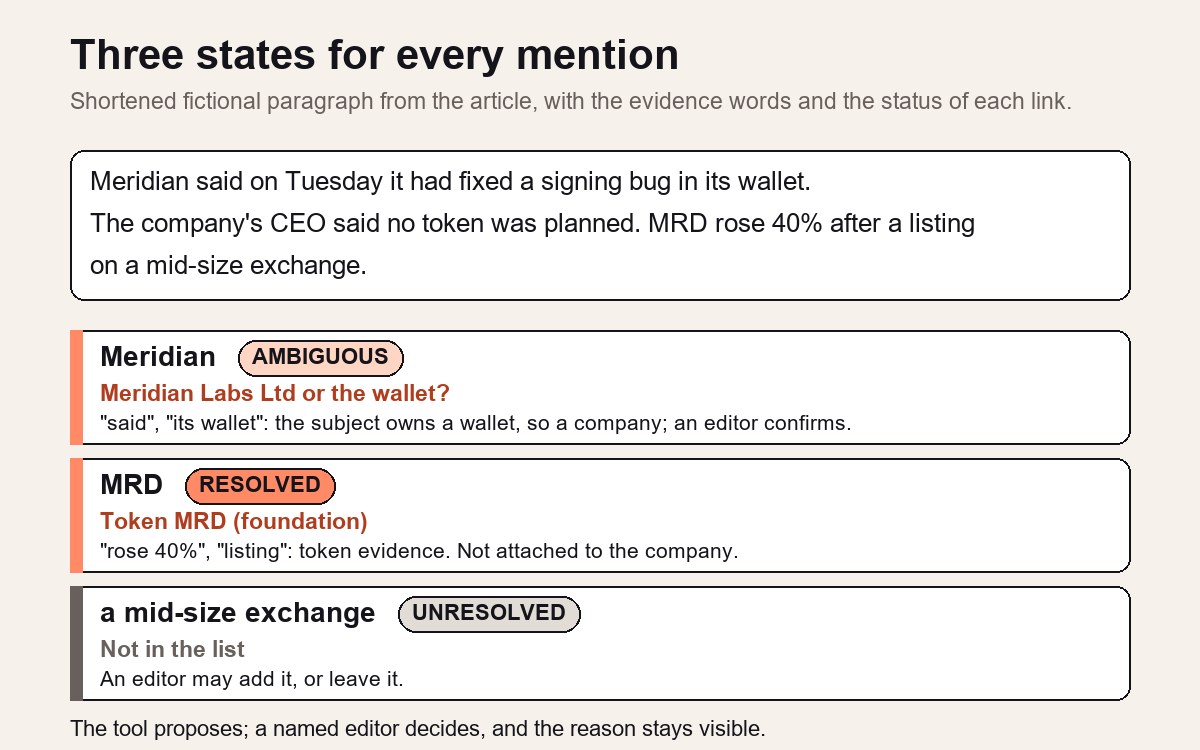
A newsroom design that follows from this has three states:
- Resolved: the evidence points to one candidate and the tool shows it.
- Ambiguous: two or more candidates remain; the editor sees them side by side.
- Unresolved (NIL): nothing in the list fits. It may be a new entity, which is a chance to add one to the list, or a name outside your coverage.
Where to set the line between them depends on your own data. No source cited here gives a number, and this article does not either.
A fictional worked example
The following example is invented. Dapp Daily is a made-up outlet; the text, the names and the numbers are fictional.
Meridian said on Tuesday it had fixed a signing bug in its wallet, a week before the planned release. The company's CEO said the team had no plans to launch a token. Separately, MRD rose 40% after a listing on a mid-size exchange, according to the exchange.
The system proposes links:
- "Meridian" (first sentence). Candidates: Meridian Labs Ltd and the Meridian wallet. Evidence: "said" points to a company; "its wallet" shows the subject owns a wallet, so the subject is not the wallet itself. Result: ambiguous at first, resolved to the company after an editor confirms.
- "The company's CEO". Linked by reference to Meridian Labs Ltd, the same entity as the subject of the first sentence.
- "MRD". Ticker, "rose 40%", "listing". The evidence points to the token. The list says the token is issued by an independent foundation, so the tool must not attach it to Meridian Labs.
- "A mid-size exchange". Not in the list: unresolved. An editor may add it, or leave it.
A reader would not confuse these. The danger is in how the output is used: a topic page or a related-links box. If link 3 had gone to the company, a 40% rise would sit on a page about a company that says it has no token.
Four mistakes and fixes
1. Matching by name. The lookup returns the first entity with the string. Fix: collect all candidates and decide from context, as in Step 3.
2. Storing the name or symbol as the identifier. A label can be shared by several items [4], and a provider's ID is what its other endpoints ask for [7]. Fix: store an internal ID, with chain and contract address for tokens [6] and a legal entity identifier for companies where one exists [5].
3. Forcing every mention to resolve. A forced pick looks like knowledge, and the default of accepting all predictions makes exactly that possible [1]. Fix: keep "ambiguous" and "unresolved" as results and show them to a person.
4. Showing the link without the reason. An editor who sees only "Meridian Labs Ltd" cannot judge it. Fix: show the mention, the candidates, the chosen ID, the words in the text that supported it and the status. The tool's suggestion is a claim to be checked, not an independent fact.
A checklist to copy
For each linked mention, record:
- the mention as written and its position in the text;
- the candidate list, each with its internal ID;
- the chosen ID, or "ambiguous", or "unresolved";
- the evidence words from the text;
- who decided: the tool, or a named editor;
- the date of the entity list, because entries change: a company renames a product, a token migrates to another chain.
And once, for the list itself: who may add an entity, how a description is written, and what is reviewed when.
What this article cannot tell you
It does not say how accurate any entity linker is on crypto, finance or games news: the sources are tool documentation and two research abstracts about general benchmarks, and I ran no linker on real data. It gives no threshold for "unresolved". The signals in Step 3 are an editor's heuristics and are untested. All names and snippets in the example are invented. The CoinGecko page was read for its field descriptions only and does not say how symbol collisions are handled. Tools change; this reflects pages read on 27 November 2026.
How this article was made
| Task | What the AI did | What a person did | How it was checked |
|---|---|---|---|
| Research | Gathered candidate sources and drafted notes | Chose the question and which pages to rely on | Every quote checked against the page named in the sources, read on 27 November 2026 |
| Draft | Wrote the first draft from the notes | Edited the text, the example and the checklist | An independent review compares claims with the sources before publication |
| Images | Generated the cover and inline illustrations | Chose and checked them | Labelled as AI-generated in the disclosure line and alt text |
| Not done by AI | — | The decision to publish and responsibility for the text | — |
Conflicts of interest: none. The author has no commercial relationship with the organisations or tools named here.
Responsible for this article: Dmitriy Lastovka, author. Corrections: contact form.
Sources
Labels: documentation (a tool or provider's own pages), paper (a research abstract on arXiv), standard (a published identifier or proposal). Quotes are as on the pages read on 27 November 2026.
- spaCy, EntityLinker API documentation. https://spacy.io/api/entitylinker Documentation.
- Wu, Petroni, Josifoski, Riedel, Zettlemoyer, "Scalable Zero-shot Entity Linking with Dense Entity Retrieval" (BLINK), arXiv:1911.03814, abstract page. https://arxiv.org/abs/1911.03814 Paper (abstract only).
- Logeswaran, Chang, Lee, Toutanova, Devlin, Lee, "Zero-Shot Entity Linking by Reading Entity Descriptions", arXiv:1906.07348, abstract page. https://arxiv.org/abs/1906.07348 Paper (abstract only).
- Wikidata, Help:Items. https://www.wikidata.org/wiki/Help:Items Documentation.
- GLEIF, Introducing the Legal Entity Identifier (LEI). https://www.gleif.org/en/about-lei/introducing-the-legal-entity-identifier-lei Standard description.
- Chain Agnostic Standards Alliance, CAIP-19 (asset type and asset ID specification). https://standards.chainagnostic.org/CAIPs/caip-19 Standard.
- CoinGecko API documentation, Coins List (ID Map). https://docs.coingecko.com/reference/coins-list Documentation.