

AI tools helped gather research and write the first draft of this article. I edited it and checked every quote and figure against the source page listed at the end, read on 27 November 2026. The cover illustration is AI-generated. Details at the end.
A news sentence rarely says "this is true". It says that someone said, expects, denies or suspects something, at some moment, about someone. A tool that pulls out the plain statement and drops the rest hands an editor something that looks like a fact and is not one yet. Extract a claim as a record: the statement, who stands behind it, how it is hedged, when it applies and exactly where in the text it comes from. Treat the relationships between claims as suggestions that a person confirms.
This article explains what "claim" and "relationship" can mean in a newsroom tool, what research shows about quotations and triples, walks a fictional example through a record design, and lists checks for a small sample. It is about the structure of the output, not about which model to use or whether any claim is true.
What "extraction" has to produce
Two different jobs hide behind the word.
The first is finding statements: which sentences or spans contain something that could be checked later. The second is linking them: which claims support, contradict, repeat or depend on another claim, and which people, companies or assets they are about.
Neither job is verification. Verification asks whether the claim matches the evidence. Extraction only prepares the ground.
Schema.org, the vocabulary behind fact-check markup, shows how modest a claim record can be. Its Claim type "represents a specific, factually-oriented claim that could be the itemReviewed in a ClaimReview", and it advises that "Ideally, a Claim description includes enough contextual information to minimize the risk of ambiguity or inclarity" [1]. It also separates appearance, "an occurrence of a Claim in some CreativeWork", from firstAppearance, "the first known occurrence" [1]. Two ideas follow: a claim is a thing with context, and the same claim can appear in several places.
Reported speech is half the job
News is full of other people's words. Pareti and colleagues note that "up to 90% of sentences" in some articles are reported speech, citing earlier work, and that reported speech is "a carrier of evidence and factuality" [2]. Their abstract adds that simply focusing on direct quotations "ignores around half of all reported speech", because the rest is indirect or mixed. In the corpora they use, direct quotations are around 30% in the Penn Attribution Relation Corpus, which covers Wall Street Journal articles, and 52% in the Sydney Morning Herald Corpus [2]. Those are particular newspapers, not a rate for crypto or games coverage, but they show the shape of the problem.
A quotation-mark rule is therefore not enough. "Police would only apply for the restrictions when 'we have a lot of evidence…', Superintendent Tony Cooke said" is a mixed quotation, partly in the writer's words and partly in the speaker's. "Mr Walsh said Rio was continuing to hold discussions with its customers" is indirect, with no quotation marks at all [2]. The paper tests methods for extracting all three types and for attributing them to a speaker, and reports that attribution methods built for direct quotations can be applied to the other two [2]. For an editor the lesson is practical: if the tool only looks at quotation marks, it will miss the sentences where a company or an official is characterised without a quote.
The distinction also decides who owns the claim. "The exchange will restore withdrawals on Friday" in the outlet's voice is the outlet's claim. "The exchange said it expects to restore withdrawals on Friday" is the exchange's claim, reported by the outlet.
Why triples lose what an editor needs
The classic relationship format is the triple: subject, relation, object. Open information extraction produces these without a fixed list of relation types. Angeli, Johnson Premkumar and Manning describe the older approach as extraction with "a large set of patterns" that is "brittle on out-of-domain text and long-range dependencies", and propose a classifier that "learns to extract self-contained clauses from longer sentences", followed by natural logic inference to find the "maximally specific arguments" of each triple [3]. Their examples show what shortening does: "Alice played baseball on Sunday" entails "Alice played on Sunday", but "Obama signed the bill on Sunday" should not entail "Obama signed on Sunday" [3]. A system has to know which parts it may drop without changing the meaning. That is a careful treatment of one problem, but a triple still has three slots. Take a fictional sentence:
Example Exchange said on Tuesday that it expects to restore withdrawals by Friday, provided the audit finishes.
A bare extraction gives (Example Exchange; restore; withdrawals). The speech verb is gone, "expects" is gone, the deadline and the condition are gone. Nothing in the triple's words is false, yet a reader of the triple would believe something stronger than the sentence says. The slots are the limit, not the model.
Newer models extract triples end to end. Huguet Cabot and Navigli present REBEL, a seq2seq model that "performs end-to-end relation extraction for more than 200 different relation types", and report state-of-the-art performance in most of the benchmarks they test [4]. Whether that carries over to relations a newsroom needs, such as "denied" or "paused withdrawals", is a question for your own sample, not for the abstract.
A claim record that keeps the context
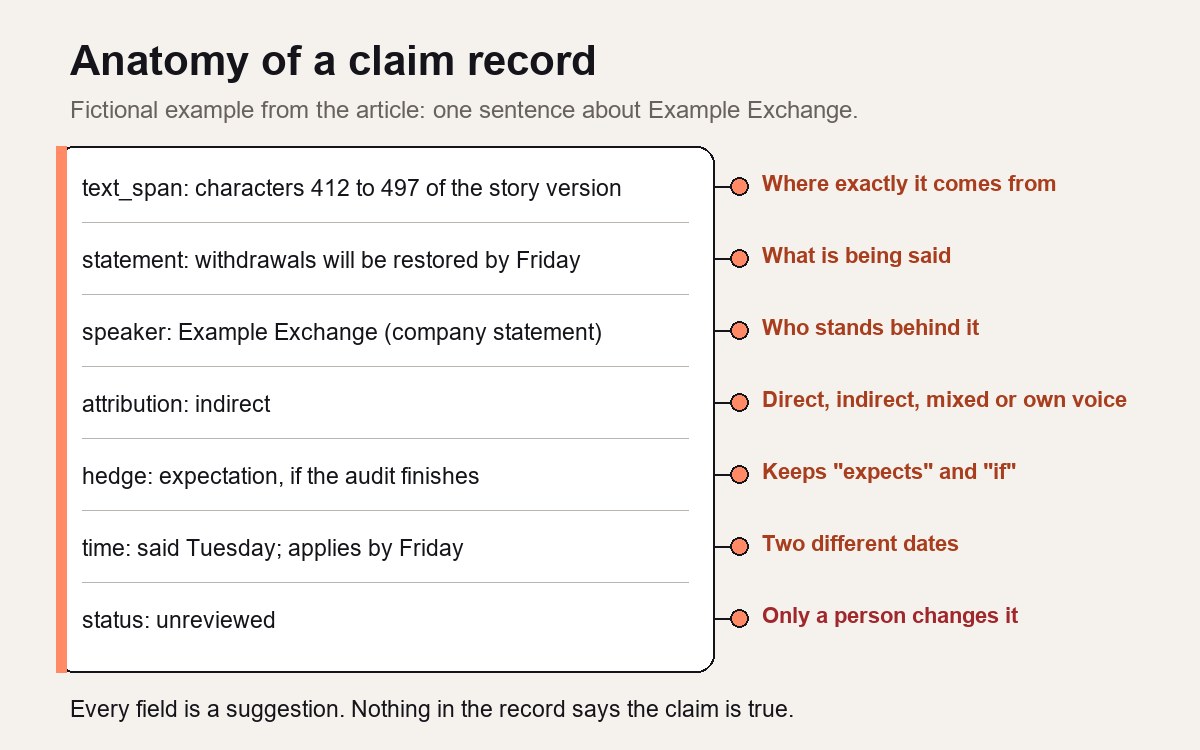
Instead of a triple, keep a record. This design is my proposal, not a standard; each field answers a question an editor would ask.
| Field | The editor's question | Example (fictional) |
|---|---|---|
| text_span | Where exactly does this come from? | Characters 412 to 497 of the story, saved with the story version |
| statement | What is being said, in plain words? | Withdrawals will be restored by Friday |
| speaker | Who stands behind it? | Example Exchange (company statement) |
| attribution | Direct, indirect, mixed, or the outlet's own voice? | Indirect |
| hedge | Is it a plan, an expectation, a condition, a denial? | Expectation, conditional on the audit |
| time | When is it said, and when does it apply? | Said Tuesday; applies by Friday |
| entities | Which people, firms and assets? | Example Exchange, linked to an entity ID |
| status | Has a person looked at it? | Unreviewed |
Every field the tool fills in is a suggestion. status starts as unreviewed and only a person changes it. Nothing in the record says the claim is true; it says what the text asserted and who is on the hook.
The text_span field makes every record auditable: the editor can go to the sentence, see what the tool saw and correct the record. A record without a span is an opinion about the story.
Which claims are worth a person's time
A story can contain dozens of statements, and most are background. A tool can help rank them, but a ranking is not a verdict. Gencheva and colleagues treat finding check-worthy claims in political debates as a ranking task. They built a dataset of debate statements that nine reputable sources had fact-checked, and modelled the context of each statement, including the interaction between opponents and the reaction by the moderator and the public. They report state-of-the-art results and say their experiments confirm the importance of that contextual information [5]. The data are political debates, not financial or technical news, so the lesson is a design lesson only: a sentence is easier to judge with its surroundings than alone.
The CheckThat! lab at CLEF runs a related task. Its 2025 Task 2 takes a noisy social media post and asks for "a concise form", a normalised claim, in 20 languages, with METEOR as the evaluation metric [6]. METEOR compares generated text with a reference text, so a high score tells you the output resembles the reference, not that the speaker and hedge were preserved. For a record like the one above you need your own checks.
Relationships between claims
Once claims are records, relationships can connect them. Useful ones are few:
- Same claim, another place. The exchange's statement appears in two stories; schema.org's appearance is the same idea [1].
- Supports or disputes. A second source disagrees with the first.
- Depends on. The Friday date depends on the audit.
- About. A claim concerns an entity or an event. Deciding which stories belong to which event is a separate problem, taken up in this series in Part 03, "Clustering News Around Events".
A model can propose any of these. Each proposed link follows the same rule as the fields: it is a suggestion with a span on both ends, and a person accepts or rejects it. "Disputes" is the risky one. Two sentences can look contradictory because of different dates, different scopes or different definitions of the same word.
The hardest relationship, whether evidence supports the claim, is the verification task, and the research shows how hard it was. The FEVER dataset has 185,445 claims, each classified by annotators as Supported, Refuted or NotEnoughInfo. In the 2018 paper the best accuracy the authors' pipeline achieved on labelling a claim together with the correct evidence was 31.87%, and 50.91% when the evidence was ignored [7]. Those are baselines from 2018 on claims made by altering Wikipedia sentences, so they say nothing about current systems. They do show a design point worth keeping: a three-way label with "not enough information" as a normal answer. A newsroom tool that can only say true or false will invent certainty.
A fictional example, end to end
The following example is invented. Example Ledger is a made-up publication; the exchange, the analyst firm, the sentences and the records are fictional and show the process.
Example Ledger publishes a story with two sentences:
Example Exchange said on Tuesday that it expects to restore withdrawals by Friday, provided the audit finishes.
An analyst at Sample Research said the exchange's reserves "may be lower than reported", the firm's note said.
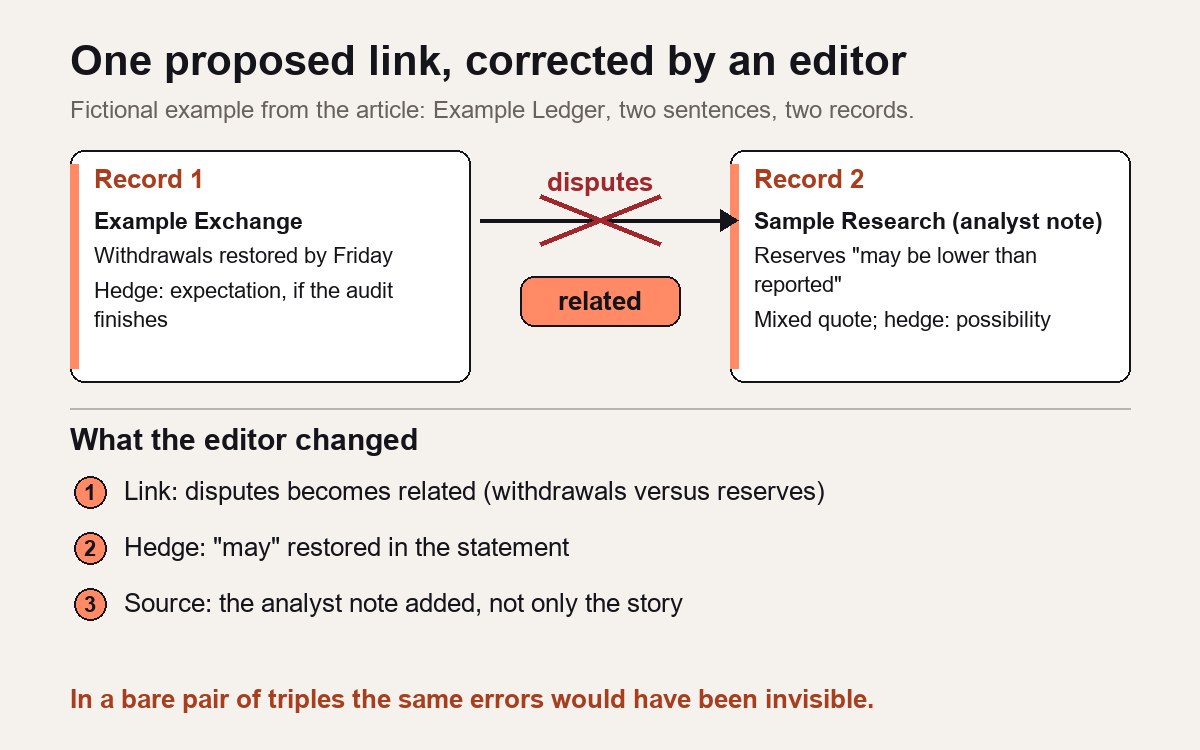
A tool proposes two records. The first is the one in the table above. The second has the analyst firm as speaker, attribution mixed, hedge "possibility, not a finding", and the exchange's reserves as the subject. It also proposes a link: record 2 disputes record 1.
The editor opens the proposal and finds three things. The link is wrong: the first claim is about withdrawals and the second is about reserves, so one does not dispute the other. The tool dropped "may" from the statement field, though the hedge field caught it. And the analyst's note is itself a document the story paraphrases, so the record should point to that note, not only to the story.
The editor changes the link to related, restores the hedge, adds the note as a source and marks both records reviewed. In a bare pair of triples the same errors would have been invisible.
Checks an editor can run
Do not trust a demo. Build a small set of stories from your own domain and label it by hand. Then check per field, not with one overall score:
- Span. Does the span contain the whole claim and nothing from another sentence?
- Speaker and attribution. Does the record name who stands behind the claim, and does it separate direct, indirect and mixed speech from the outlet's own voice?
- Hedge. Do "expects", "may", "denied" and "if" survive into the record?
- Entity. Are names resolved to the right entity? Part 02 of this series, "Resolving Ambiguous Names in News", is about that step.
- Links. Of the links the tool proposed, how many did the editor reject, and why?
Keep the labelled set and the editor's corrections. They show where the tool fails in your domain; a benchmark number from another corpus does not.
What this article cannot tell you
It does not name a tool or say which model extracts claims best on any news domain; the cited papers date from 2013 to 2025 and test other corpora. It gives no accuracy for the record design above, a proposal I have not measured. The fictional example is an illustration, not a result. It does not show how to verify a claim, how to set a check-worthiness threshold, or what legal duties apply to a published fact-check.
How this article was made
| Task | What the AI did | What a person did | How it was checked |
|---|---|---|---|
| Research | Gathered candidate sources and drafted notes | Chose the question and which papers and pages to rely on | Every quote and figure checked against the paper or page named in the sources, read on 27 November 2026 |
| Draft | Wrote the first draft from the notes | Edited the text, the record design and the fictional example | An independent review compares claims with the sources before publication |
| Images | Generated the cover illustration and diagrams | Chose and checked them | Labelled as AI-generated in the disclosure line and alt text |
| Not done by AI | — | The decision to publish and responsibility for the text | — |
Conflicts of interest: none. The author has no commercial relationship with the organisations named here.
Responsible for this article: Dmitriy Lastovka, author. Corrections: contact form.
Sources
Labels: standard (a published vocabulary), paper (a peer-reviewed paper or preprint), event page (an evaluation lab's task page). Quotes are as on the pages and papers read on 27 November 2026.
- Schema.org, types Claim and ClaimReview. https://schema.org/Claim and https://schema.org/ClaimReview Standard.
- Silvia Pareti, Tim O'Keefe, Ioannis Konstas, James R. Curran, Irena Koprinska, "Automatically Detecting and Attributing Indirect Quotations", EMNLP 2013, pages 989-999. https://aclanthology.org/D13-1101/ Paper.
- Gabor Angeli, Melvin Johnson Premkumar, Christopher D. Manning, "Leveraging Linguistic Structure For Open Domain Information Extraction", ACL 2015. https://aclanthology.org/P15-1034/ Paper.
- Pere-Lluis Huguet Cabot, Roberto Navigli, "REBEL: Relation Extraction By End-to-end Language generation", Findings of EMNLP 2021. https://aclanthology.org/2021.findings-emnlp.204/ Paper.
- Pepa Gencheva, Ivan Koychev, Lluis Marquez, Alberto Barron-Cedeno, Preslav Nakov, "A Context-Aware Approach for Detecting Check-Worthy Claims in Political Debates". https://arxiv.org/abs/1912.08084 Paper (preprint page).
- CLEF 2025 CheckThat! Lab, Task 2: Claims Extraction & Normalization. https://checkthat.gitlab.io/clef2025/task2/ Event page.
- James Thorne, Andreas Vlachos, Christos Christodoulopoulos, Arpit Mittal, "FEVER: a large-scale dataset for Fact Extraction and VERification", 2018. https://arxiv.org/abs/1803.05355 Paper (preprint page).