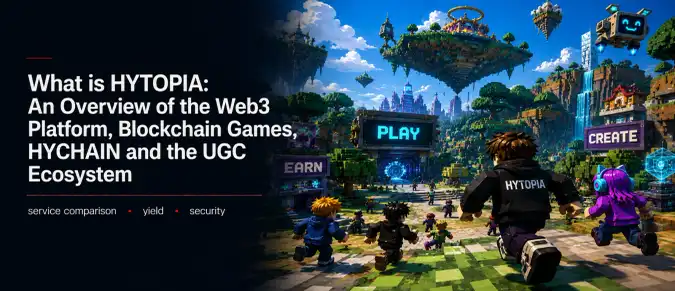

HYTOPIA is a browser-based gaming platform for creating and launching user-generated multiplayer games, combining the visual style of voxel sandboxes with a user-generated content model similar to Roblox. The project evolved from NFT Worlds, which was originally connected to Minecraft, but later abandoned its Minecraft-compatible client in favor of proprietary gaming infrastructure. Developers gained access to a TypeScript and JavaScript SDK, a world editor, and tools for building games, while the Web3 layer of the ecosystem has historically been associated with HYCHAIN, digital assets, and the TOPIA token. However, the project's current status requires particular attention: as of August 2026, the official website states that HYTOPIA services are temporarily suspended due to funding issues.
Contents
- What Is HYTOPIA and How Is the Project Connected to Minecraft and Roblox
- How Games and User-Generated Content Work on the Platform
- HYTOPIA Ecosystem: SDK, HYCHAIN, Web3 and Digital Assets
- Key Features of the Platform for Players and Developers
- HYTOPIA Development and the Project's Current Status in 2026
1. What Is HYTOPIA and How Is the Project Connected to Minecraft and Roblox
HYTOPIA's history began with NFT Worlds, a project launched in 2021. Its original concept was built around a collection of 10,000 NFT worlds generated using Minecraft-style terrain algorithms. Owners could develop their virtual territories and use them within an emerging Web3 gaming ecosystem.
The situation changed after Mojang took a position against the integration of NFTs and blockchain technologies into Minecraft in 2022. The NFT Worlds team began developing its own gaming infrastructure, and the project was later rebranded as HYTOPIA. Initially, the developers continued working on a Minecraft-compatible client, but in December 2024 they announced that this direction would be discontinued.
Following the strategy change, HYTOPIA evolved into an independent UGC platform. Visually, it retained its characteristic block-based aesthetic, but its content creation model moved closer to Roblox: developers received tools that allowed them to create standalone games across different genres and publish them within a shared ecosystem.
For this reason, the description "Roblox + blockchain" refers more to the project's concept than to any direct technical connection with Roblox. HYTOPIA is not a blockchain version of Roblox and does not use Roblox infrastructure. Instead, the project develops its own SDK, gaming runtime, and publishing system for user-generated games while maintaining ties to the Web3 direction from which the ecosystem originally emerged.
2. How Games and User-Generated Content Work on the Platform
In February 2025, HYTOPIA launched the alpha version of its new platform. The core format was based on browser-based instant-play games: users could select an available project and join it without installing a traditional game client. Developers were able to create both small mini-games and more complex multiplayer experiences.
HYTOPIA separates content creation into two main processes. The visual part of a world is built through the World Editor, which allows developers to work with maps and environments, while game logic is programmed through the HYTOPIA SDK. TypeScript and JavaScript are the primary development languages, making the platform accessible to a broad range of web developers.
The SDK provides tools for working with entities, physics, user interfaces, audio, game states, multiplayer systems, and other components. Plugins distributed as NPM packages are also supported. As a result, creators are not limited to a fixed set of mechanics within a single sandbox game but instead receive a programmable environment suitable for developing projects across different genres.
Another development direction involves AI-assisted development. HYTOPIA documentation supports the use of AI-powered editors and tools such as Cursor and Claude Code, while a dedicated MCP Server provides AI models with contextual information about the SDK. This approach is also intended for users with limited programming experience and can lower the technical barrier to building initial game prototypes.
3. HYTOPIA Ecosystem: SDK, HYCHAIN, Web3 and Digital Assets
HYTOPIA historically developed as part of a broader cryptocurrency infrastructure that originated around NFT Worlds. This ecosystem included gaming-related digital assets, HYCHAIN, and the TOPIA token. However, after the project's architecture changed, the team began drawing a clearer distinction between the HYTOPIA gaming platform itself and its associated Web3 infrastructure.
HYCHAIN was developed as blockchain infrastructure for gaming and third-party applications. One of the network's objectives was to expand the potential use cases of TOPIA beyond a single game. At the same time, the project experimented with simplified account and wallet systems designed to reduce the need for players to interact constantly with traditional cryptocurrency interfaces.
| Component | Purpose | Key Capabilities |
|---|---|---|
| HYTOPIA | UGC gaming platform | Launching and distributing user-generated browser games |
| HYTOPIA SDK | Developer toolkit | Building game logic with TypeScript and JavaScript |
| World Editor | Game world editor | Creating maps, environments, and voxel-based spaces |
| HYCHAIN | Web3 infrastructure | Supporting blockchain applications and ecosystem digital assets |
| TOPIA | Ecosystem token | Historically associated with the HYTOPIA and HYCHAIN economies |
| Creator Fund | Developer support | Attracting game studios and supporting projects built for the platform |
In 2025, the team continued developing its item infrastructure and marketplace functionality. The SDK gained capabilities for working with NFT-linked objects as well as additional methods for retrieving collection data. Blockchain could therefore function as an optional layer of digital ownership rather than a mandatory component of every in-game action.
This distinguishes the later HYTOPIA model from the original NFT Worlds concept. While the early project was closely tied to NFT land and Minecraft, the redesigned architecture focused primarily on user-generated games. Web3 functionality became one of several available platform components rather than the sole reason for the gaming product's existence.
4. Key Features of the Platform for Players and Developers
One of HYTOPIA's key features was its browser-based format. The team aimed to shorten the path between opening a game link and starting a gaming session, which is particularly important for user-generated mini-games. This distribution model brings the platform closer to modern UGC services where fast access and the ability to move easily between different experiences are important elements of user engagement.
Another major focus was reducing development complexity. Instead of introducing a proprietary programming language, HYTOPIA uses widely adopted TypeScript and JavaScript, while its SDK integrates with familiar developer tools. Additional support for AI-assisted coding makes it possible to prototype games using natural-language instructions and automatically generated code.
Key HYTOPIA features:
- browser-based platform for user-generated multiplayer games;
- voxel visual style historically connected to Minecraft;
- UGC model conceptually similar to Roblox;
- proprietary HYTOPIA SDK for game development;
- TypeScript and JavaScript support;
- World Editor for creating game maps;
- plugin support through NPM packages;
- tools for AI-assisted game development;
- support for integrating digital and NFT assets;
- historical connection to HYCHAIN and the TOPIA token.
In 2025, HYTOPIA also launched a Creator Fund designed to attract professional development teams. The first announced partner was IROC Studios, known for developing projects for Roblox. Other teams with experience in UGC gaming later joined the program, aligning with HYTOPIA's strategy of building a catalog of games across multiple genres.
However, an open development model does not eliminate infrastructure risks. Games depend on HYTOPIA's servers, runtime, account system, and other platform services. The sustainability of the ecosystem therefore depends not only on the quality of the SDK and the number of projects created but also on the operator's ability to finance and maintain the platform's centralized infrastructure.
5. HYTOPIA Development and the Project's Current Status in 2026
Following the launch of the SDK Alpha in February 2025, HYTOPIA gradually expanded its catalog of user-generated games and development tools. According to the project's own figures, by the end of September 2025 the platform had surpassed 143,000 registered users and accumulated approximately 1.93 million minutes of playtime. The team also reported an average of around 5,000 gaming sessions per day at that time.
The developers continued attracting teams with experience on Roblox and other UGC platforms. At the same time, work continued on the World Editor, physics engine, item system, AI tools, and SDK. This strategy demonstrated a gradual shift away from the idea of a single large-scale blockchain sandbox game toward a technology platform where independent creators could release their own projects.
However, HYTOPIA's current situation differs significantly from its period of active growth in 2025. As of August 2026, the official website displays a notice stating that services have been temporarily suspended due to funding issues. The team indicates an estimated downtime of one to three months, although the actual timeline for restoring operations depends on how the financing situation develops.
HYTOPIA is therefore relevant both as a Web3 project and as an experiment with an alternative UGC gaming model. The project evolved from NFT Worlds and its dependence on Minecraft into a proprietary browser engine, SDK, AI development tools, and a creator model conceptually similar to Roblox. At the same time, the current suspension highlights one of the key risks facing such platforms: even when blockchain and digital ownership are integrated, the viability of a gaming ecosystem still depends on financing, server infrastructure, developer activity, and sustainable demand from players.











