
AI tools helped gather research and write the first draft of this article. I edited it and checked every quote and figure against the source page listed at the end, read on 27 November 2026. The cover illustration is AI-generated. Details at the end.
An editor who receives a label from a language tool has one practical question: should I believe this one? A suggestion is inspectable when the editor can see what text it rests on, what the tool was built to handle, how sure it claims to be, and how to overrule it, and when overruling costs one click. A tool that only returns a topic and a score fails this test, however accurate it is on average.
This article is the last part of a series on how language tools read news. The earlier parts cover why general-purpose entity recognition misses domain meaning, resolving ambiguous names, clustering news around events, extracting claims and relationships, and why sentiment is not the same as stance. Here the question is what to build around those outputs so an editor can use them without handing over the judgement. It proposes a design and a few checks. It does not report a measured result from any newsroom.
Metadata and selection are different jobs
Two things get mixed up under "NLP assistance".
Metadata describes a story the editor already has: these companies are mentioned, this looks like a follow-up to that event, this sentence is a claim attributed to a named source. The editor can compare each item with the text in front of them.
Selection decides which stories the editor sees at all: ranking, filtering, "recommended topics", an inbox that hides what the model scored low. The editor cannot compare a hidden story with anything. A wrong label on a visible story is a small error that someone can notice. A wrong score on a story that never appears is an error that nobody sees.
The plan question for this article is how to give an editor useful metadata without opaque topic selection. The short answer is to keep the two jobs apart: let the tool annotate what the editor opens, and let any filtering be a visible, reversible setting with a count of what it hid. The rest of the article is about the first half, with a section on the second.
Why "an explanation" is not enough
The tempting fix is to attach an explanation to every output. The evidence on explanations is more careful than that.
A study by Bansal and colleagues (CHI 2021) tested people working with an AI that made recommendations. Their abstract reports that "explanations increased the chance that humans will accept the AI's recommendation, regardless of its correctness", and that the complementary gains from AI help "were not increased by explanations" [1]. The study used particular tasks and explanation types, so it does not show that every explanation misleads. What it does show is that an explanation can raise acceptance without raising accuracy. For an editor tool, that means an explanation panel is not proof of inspectability. Whether editors catch wrong suggestions better with it than without it is something to test, not assume.
The method paper behind LIME states the motivation plainly: "Understanding the reasons behind predictions is, however, quite important in assessing trust" [2]. Both statements can hold together. Reasons matter for trust, and reasons shown the wrong way can produce trust that the tool has not earned.
NIST's report on explainable AI gives a useful frame. It proposes four principles: systems deliver accompanying evidence or reasons for outcomes; the explanations are understandable to individual users; they "correctly reflect the system's process for generating the output"; and the system only operates under conditions for which it was designed and when it reaches sufficient confidence in its output. NIST names these explanation, meaningful, explanation accuracy and knowledge limits [3]. The report adds that "one-size-fits-all explanations do not exist": different users need different explanations [3]. An editor on deadline needs a different view from an engineer debugging the model.
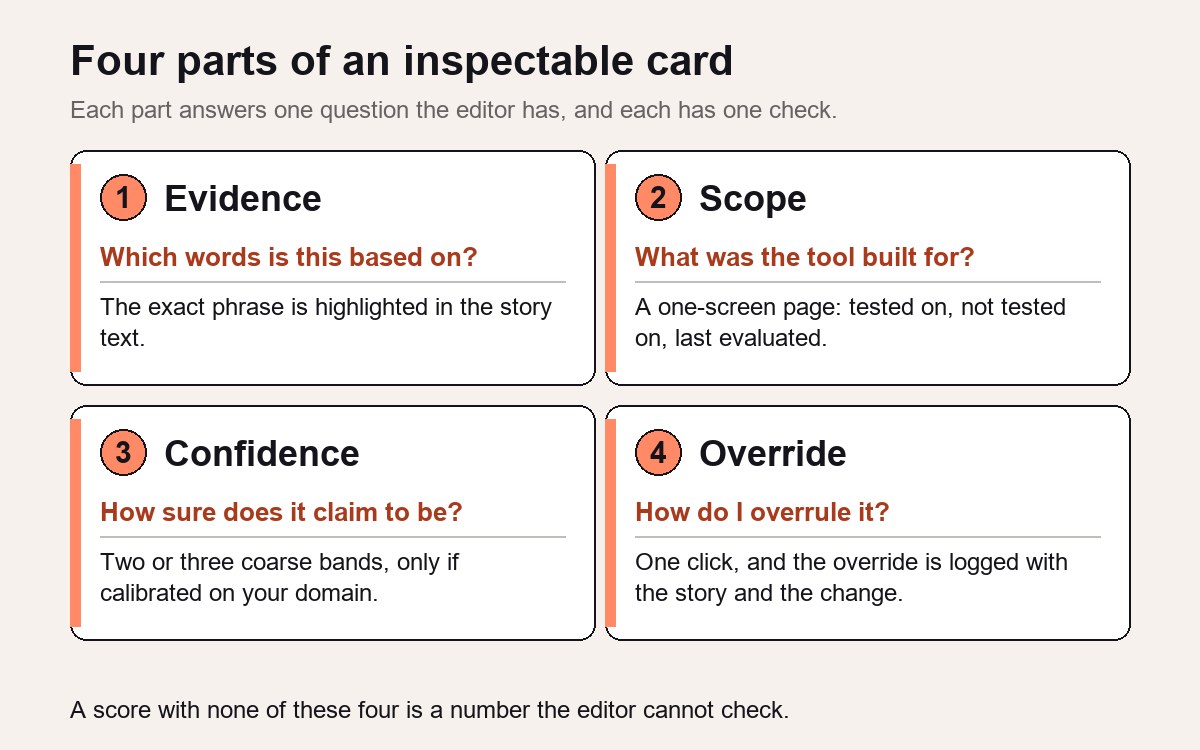
The four principles translate into four things an editor card should carry.
Four parts of an inspectable card
1. The evidence: the exact words
For each suggestion, show the passage it rests on, highlighted in the story text. "Organisation: Example Bank" should point to the characters that say so. A claim label should point to the sentence and to the attribution phrase. This is the cheapest form of the first NIST principle, and editors already read text. It also exposes a failure that scores hide: a high-confidence label attached to a sentence that does not support it.
Keep this honest. A highlighted span shows where the tool looked, not necessarily why it decided. For models whose reasons are not faithfully recoverable, say "matched this passage" and not "because of this passage". That is the "explanation accuracy" principle in plain words: do not display a reason the system did not actually use [3].
2. The scope: what the tool was built for
The Model Cards paper proposes short documents that accompany trained models, and recommends "that released models be accompanied by documentation detailing their performance characteristics" [4]. For an editorial tool, the card is not a research artefact; it is a one-screen page the editor can open from any suggestion: what text types it was tested on, what languages, what it was not tested on, and when it was last evaluated.
This matters in a domain-heavy newsroom. A tool tested on general news may say nothing reliable about token tickers, protocol names or game studios. The first part of this series makes that point for entity recognition. The scope page turns the point into a visible statement: "Not evaluated on smart-contract incident reports". A tool that cannot say what it was not tested on cannot show that it meets NIST's "knowledge limits" principle [3].
Google's People + AI Guidebook makes the same move for end users: it suggests explaining "global properties of the model", such as "its known strengths and limitations", and gives the example of a training set in which 75% of the examples show plants native to North America [5]. The editor-facing equivalent is a plain sentence about where the tool's examples came from.
3. The confidence: only if it means something
A confidence number invites an editor to treat 0.92 as a 92% chance of being right. That is only true if the model is calibrated. Guo and colleagues report that "modern neural networks, unlike those from a decade ago, are poorly calibrated", and that temperature scaling, a single-parameter post-processing method, "is surprisingly effective at calibrating predictions" on most of the image and document classification datasets they tested [6]. So raw scores from a modern neural model can be a poor basis for what you show, and calibration must be checked on your own domain data before the number is shown at all.
Even a calibrated number needs care. The Guidebook warns that "a misleadingly high confidence" may cause users to blindly accept a result, and that showing more granular confidence can be confusing when its impact on the decision is not clear [5]. A practical reading: show two or three coarse bands, such as "check this", "likely", "very likely", set from calibration measured on domain examples, and tell the editor what each band historically means (for example, "in our checks, about one in ten 'likely' labels was wrong"). If you have not measured that, show no band, and say "not yet measured". An honest blank is better than a precise-looking guess.
4. The override: one click, and it counts
Every suggestion needs a visible way to reject or correct it. The correction should cost less effort than ignoring the suggestion. Record each override with the suggestion, the story and the editor's change. The override log is the most useful data the newsroom will produce about the tool: it shows which label types fail, which story types fail, and whether the "likely" band is behaving.
A fictional example
The following example is invented. Example Ledger is a made-up publication, "Margin Notes" is a made-up assistant, and every figure is fictional. They show the format.
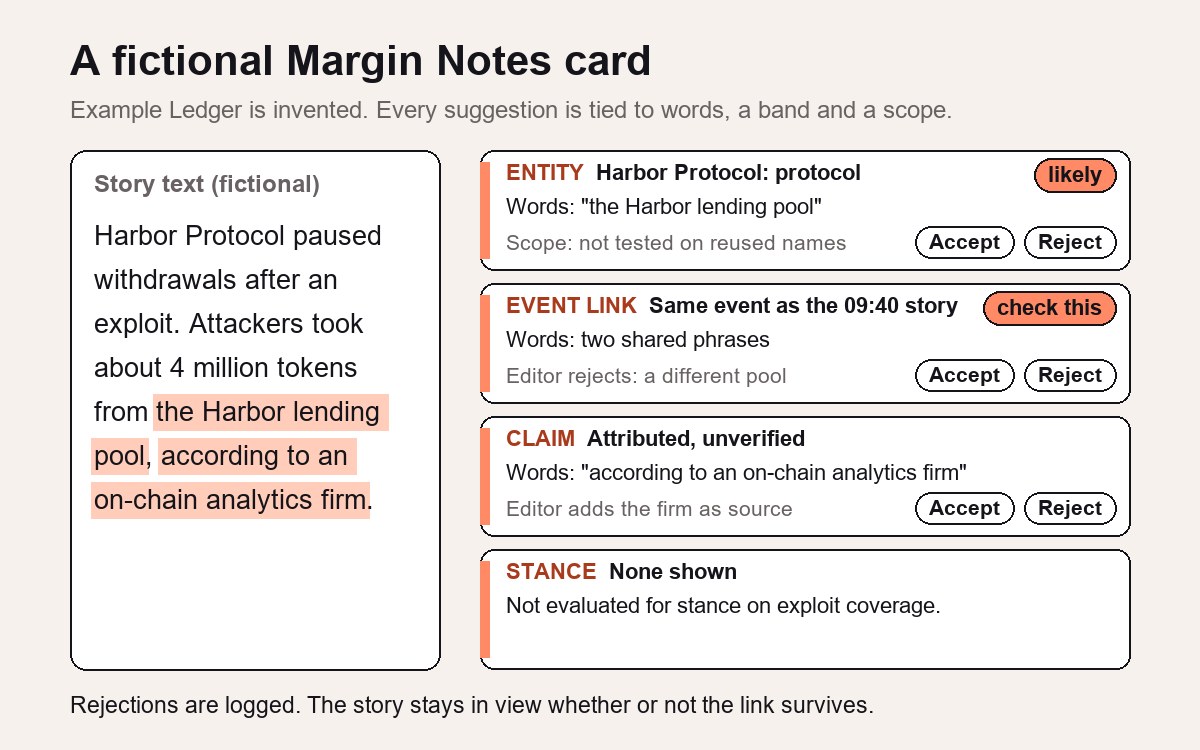
A reporter at Example Ledger covers blockchain security. A story arrives about a lending protocol that paused withdrawals after an exploit. Margin Notes proposes four things, each on a card beside the text:
- Entity: "Harbor Protocol" tagged as a protocol. Evidence: the highlighted phrase "the Harbor lending pool". Band: likely. Scope link: "Tested on protocol names from 2025 reports; not tested on forks that reuse an older name."
- Event link: "Same event as the story filed at 09:40". Evidence: two shared phrases and a matching transaction description. Band: check this.
- Claim: "Attackers took about 4 million tokens" tagged as attributed, unverified. Evidence: the sentence and the phrase "according to an on-chain analytics firm".
- Stance: none shown. Note on the card: "Not evaluated for stance on exploit coverage."
The editor opens the event link, reads the two shared phrases, sees that the earlier story is about a different pool with a similar name, and rejects the link. The rejection is logged. The claim label stays: the editor adds the analytics firm's name to the story's source field, which was the point of the label. The story is not ranked, scored or hidden by any of this; it was in the editor's inbox because a person put it there.
The design did not hide the weak link behind a score, and the story stayed in view when the link failed.
If the tool filters or ranks
Some tools must sort, because the volume of incoming material exceeds what anyone can read. Selection is then unavoidable, so make it inspectable in the same four ways.
- Show the rule. State in plain words what the ranking favours. A rule such as "stories mentioning entities from your watchlist first" is inspectable. "Relevance" is not.
- Count what is hidden. If a filter removes items, show how many and let the editor open them in one click. A filter with no visible remainder is the opaque selection the plan question warns against.
- Audit by sampling. On a schedule, draw a random sample of items the tool down-ranked and have an editor judge them. This is a way to find stories the tool is quietly losing, and it needs no insight into the model.
- Keep an unfiltered view. The raw feed stays one click away, always.
None of these four needs the model to be explainable. They need the product to be.
Testing whether it works
An inspectable design is a hypothesis about editor behaviour. Test it with the editor's actual decisions, not with the tool's accuracy alone.
- Measure acceptance against correctness. For a sample of suggestions with known right and wrong answers, record how often editors accept each. If they accept wrong suggestions as often as right ones, the card is decoration. This is the check the Bansal result points to [1].
- Compare with a plain-label version. Show some editors the same suggestions without evidence and bands, and compare the error-catching rate. If the card does not help, simplify it.
- Check calibration on your domain. Bin suggestions by band and compare each band's labelled correctness with what you tell editors it means [6].
- Read the override log monthly. Rising overrides on one label type is an early warning that the data has drifted.
- Use domain examples. Use real stories from your own beat, including difficult ones such as reused protocol names, and keep a part of them out of tuning so the result is a fair test.
Common mistakes
A score without a source. A number that cannot be traced to words in the text gives the editor nothing to check.
Showing a reason the system did not use. A neat sentence generated after the fact reads as an explanation but may not reflect the process that produced the output [3].
A precise confidence from an uncalibrated model. It looks careful and misleads [5][6].
No record of overrides. Without a log, nobody can say whether the tool is improving.
What this article cannot tell you
It cannot tell you that these cards improve editors' decisions: the sources are one study of recommendation tasks, design principles and design guidance, and none measures this design in a newsroom. The example is invented and its figures do not describe any real tool. The bands and sampling routine are untested suggestions, not standards. The article does not cover legal duties on automated systems, which differ by place.
How this article was made
| Task | What the AI did | What a person did | How it was checked |
|---|---|---|---|
| Research | Gathered candidate sources and drafted notes | Chose the question and which pages to rely on | Every quote checked against the page named in the sources, read on 27 November 2026 |
| Draft | Wrote the first draft from the notes | Edited the text, the card design and the example | An independent review compares claims with the sources before publication |
| Images | Generated the cover illustration | Chose and checked it | Labelled as AI-generated in the disclosure line and alt text |
| Not done by AI | — | The decision to publish and responsibility for the text | — |
Conflicts of interest: none. The author has no commercial relationship with the organisations named here.
Responsible for this article: Dmitriy Lastovka, author. Corrections: contact form.
Sources
Labels: paper (a research paper, preprint page), report (a government institute report), guidance (design guidance from a company's research team). Quotes are as on the pages read on 27 November 2026.
- Bansal et al., "Does the Whole Exceed its Parts? The Effect of AI Explanations on Complementary Team Performance" (arXiv 2006.14779; CHI 2021 per the arXiv page). https://arxiv.org/abs/2006.14779 Paper.
- Ribeiro, Singh, Guestrin, "Why Should I Trust You?: Explaining the Predictions of Any Classifier" (arXiv 1602.04938, 2016). https://arxiv.org/abs/1602.04938 Paper.
- Phillips et al., "Four Principles of Explainable Artificial Intelligence", NIST Interagency/Internal Report 8312, September 2021. https://doi.org/10.6028/NIST.IR.8312 Report. Principles read in the report's abstract.
- Mitchell et al., "Model Cards for Model Reporting" (arXiv 1810.03993, 2018; presented at FAT* 2019). https://arxiv.org/abs/1810.03993 Paper.
- People + AI Research, "Explainability + Trust", People + AI Guidebook (no date on the page). https://pair.withgoogle.com/chapter/explainability-trust/ Guidance.
- Guo, Pleiss, Sun, Weinberger, "On Calibration of Modern Neural Networks" (arXiv 1706.04599; ICML 2017). https://arxiv.org/abs/1706.04599 Paper.