AI tools helped gather research and write the first draft of this article. I edited it and checked every quote and figure against the source page listed at the end, read on 27 November 2026. The cover illustration is AI-generated. Details at the end.
A sentiment score tells you how a piece of text sounds. A stance label tells you where the author stands on one particular thing. The two are different questions, and a tool that answers the first cannot be trusted to answer the second. A writer can sound angry and be in favour, sound cheerful and be against, or sound neutral and still take a side.
This matters in a newsroom because the two outputs look alike on a dashboard. Both are a small label next to a story. If an editor reads "negative" as "critical of the company", the tool has quietly turned a tone into a position. This article explains the difference, shows what the benchmarks measured, walks a fictional example, and ends with a way to store the results so that nobody mistakes one for the other. It does not recommend or test any product.
What a sentiment tool actually outputs
The SemEval-2016 stance paper describes sentiment analysis as usually formulated as "determining whether a piece of text is positive, negative, or neutral", or as finding the speaker's opinion and its target [1].
A concrete example from finance: the ProsusAI FinBERT model card says the model "will give softmax outputs for three labels: positive, negative or neutral", and that it was fine-tuned on the Financial PhraseBank dataset [5]. Nothing in an output of that kind names a target. The label belongs to the sentence as a whole.
Sentiment is also not a neutral measurement; someone has to define it. The Financial PhraseBank dataset card says annotators judged sentences from an investor's point of view, asking whether the news could push a stock price up, down or not at all, and that sentences whose sentiment is "not relevant from an economic or financial perspective" count as neutral [4]. The card says 16 people labelled the sentences [4]. So "positive" in that dataset means "good for the share price, as judged by a panel of annotators", which is a narrower thing than "the writer is happy". The paper behind the data makes a related point: the overall sentiment of a sentence can differ from the polarity of its individual words, and its authors build finance-specific resources to detect sentiment in financial and economic news [6].
So a sentiment label has a perspective built into it, and no slot for "toward what".
What stance is
The SemEval-2016 Task 6 paper defines stance detection as "automatically determining from text whether the author of the text is in favor of, against, or neutral towards a proposition or target" [1]. The target is chosen in advance: a person, an organisation, a policy, a movement, a product [1]. The system is given a text and a target and must decide whether the author is in favour, against, or whether neither inference is likely [1].
The same paper spells out why this differs from sentiment. In stance detection the target of interest "may not be explicitly mentioned in the text and it may not be the target of opinion in the text" [1]. Its example uses the target Donald Trump and the tweet "Jeb Bush is the only sane candidate in this republican lineup." The opinion is about Jeb Bush, yet a reader can infer that the author is probably unfavourable toward the pre-chosen target [1]. The tone is positive, and the inferred stance toward the target is negative. A sentiment tool that looks at the sentence sees praise.
One more detail from that paper matters in a newsroom: a lack of evidence for "favor" or "against" "does not imply that the tweeter is neutral towards the target"; it may simply be that one cannot deduce stance from the text, which the authors call fairly common [1]. In other words, "no stance found" and "neutral stance" are different results.
What the benchmark numbers show
The strongest evidence that the two are distinct comes from a dataset in which both were labelled. Mohammad, Sobhani and Kiritchenko annotated the same tweets for stance and, separately, for sentiment [2]. Sentiment was annotated months later, showing annotators only the tweet and no target [2]. Their abstract says that "a person may express the same stance towards a target by using negative or positive language", and that "knowing the sentiment expressed by a tweet is beneficial for stance classification, it alone is not sufficient" [2].
The tables in the paper make this concrete. For the target "Atheism", 59.3 per cent of the training tweets were labelled "against" and 17.9 per cent "favor", while 60.43 per cent of the same training tweets carried positive sentiment and 35.09 per cent negative [2]. Most tweets in that set were against the target, and most were also positive in tone. The tables do not say why; they show only that the two label sets do not line up. For "Climate Change is a Real Concern" the training set was 53.7 per cent "favor" and 3.8 per cent "against", yet the largest sentiment group was negative, at 49.62 per cent [2]. Tone and position pointed in different directions in both sets.
The same paper measured what happens if you use sentiment as a stand-in. It built an "oracle" that, for each target, picks whichever mapping scores best in hindsight: positive means favour and negative means against, or the reverse [2]. This is an upper bound for a pure sentiment approach, because the oracle uses the human sentiment labels and a real system would not know the best mapping in advance [2]. Its F-score averaged across the five targets was 53.1, and 57.2 on the overall average, which is below the 65.2 that simply guessing each target's majority class scored on that average; a second oracle that was also told whether the tweet's opinion is about the target reached 56.1 and 59.6 [2]. For comparison, the winning shared-task system scored 56.0 and 67.8 on the same two averages [2]. The authors conclude that "even though sentiment can play a key role in detecting stance, sentiment alone is not sufficient" [2]. Sentiment is useful as a feature, and the oracle beat a majority-class guess on the first average, but an upper bound well short of 100 on a research dataset is not a promise for your archive.
One more number matters for editors. Among tweets labelled favourable, 94.23 per cent expressed opinion directly about the target. Among tweets labelled "against", only 72.75 per cent did, and 26.54 per cent expressed opinion about something or someone else [2]. The SemEval paper reports that systems found stance "markedly more difficult" to infer from tweets expressing opinion about another entity [1]. Opposition is more often expressed sideways, which is where tools do worst.
A fictional example
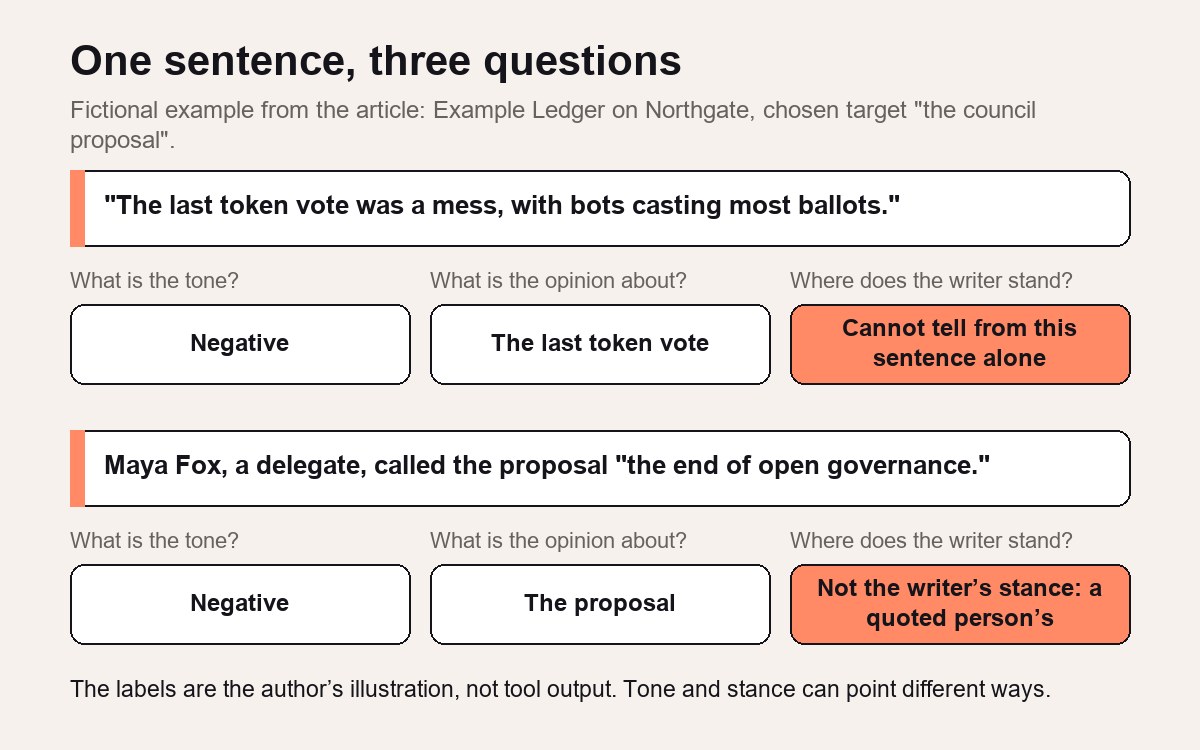
The following example is invented. Northgate is a made-up blockchain protocol, Example Ledger is a made-up publication, and the sentences are fictional. The labels in the table are my own illustration of how the two questions can come apart. They are not the output of any tool, and I did not run any tool on these sentences.
Example Ledger is writing about a proposed change to Northgate's governance: moving votes from token holders to a council. The chosen target is "the council proposal". These sentences might appear in a story:
| Sentence | Tone, as a reader might label it | Stance toward "the council proposal" |
|---|---|---|
| "The last token vote was a mess, with bots casting most ballots." | Negative | Possibly in favour, but only if the writer means the council is the fix; the sentence does not say |
| "Delegates will celebrate a faster, calmer process." | Positive | Unclear: it may describe what supporters expect, not what the writer thinks |
| "The council proposal would hand control to nine people." | Neutral | Possibly against, if "hand control" is the writer's framing, or simply a description |
| "Maya Fox, a delegate, called the proposal 'the end of open governance'." | Negative | Not the writer's stance at all: it is a quoted person's |
Row one is negative in tone, but what it implies about the proposal depends on context the sentence lacks. Row two is positive but may be reported expectation. Row four is what newsrooms see most: a quotation. The annotation instructions for the stance dataset even allowed a tweet that merely echoes somebody else's stance, such as in a quote or a retweet, to be labelled with that stance [2]. The instructions place this under cases where the poster's own stance cannot be inferred, but the tweet echoes someone else's [2]. So a benchmark label of "against" can record a stance the tweet only repeats; it does not say whose opinion it is. In a story with quotes, a tool that scores each sentence would give negative tone to a line the writer is only reporting.
Stance in news is often about documents
Stance detection for news has also been run at document level. In the Fake News Challenge (FNC-1), as Hanselowski and colleagues describe it, the goal is "to determine the perspective (or stance) of a news article relative to a given headline" [3]. Their paper lists the four labels: the document agrees with the headline, disagrees with it, discusses the same topic without taking a definite position, or is unrelated [3].
That paper is a useful warning about what shared-task scores can hide. It reports that the challenge's own metric "favors the majority class": a classifier that always predicts "discuss" for related documents would reach 0.833 on the challenge metric, higher than the top-ranked system [3]. It reports that the analysed systems mostly relied on lexical overlap, and that words such as "reports", "said" or "allegedly" pushed them to answer "discuss" [3]. Disagreement was hard to detect because it is often expressed in complex terms, with few lexical indicators such as "false", "hoax" or "fake" [3].
For a newsroom this has a practical meaning. A stance label from a headline-and-body model is a claim about the relation between two texts, not about the writer's beliefs. And a high leaderboard number may mean the system is good at the easy class.
How to keep the two apart in your own tools
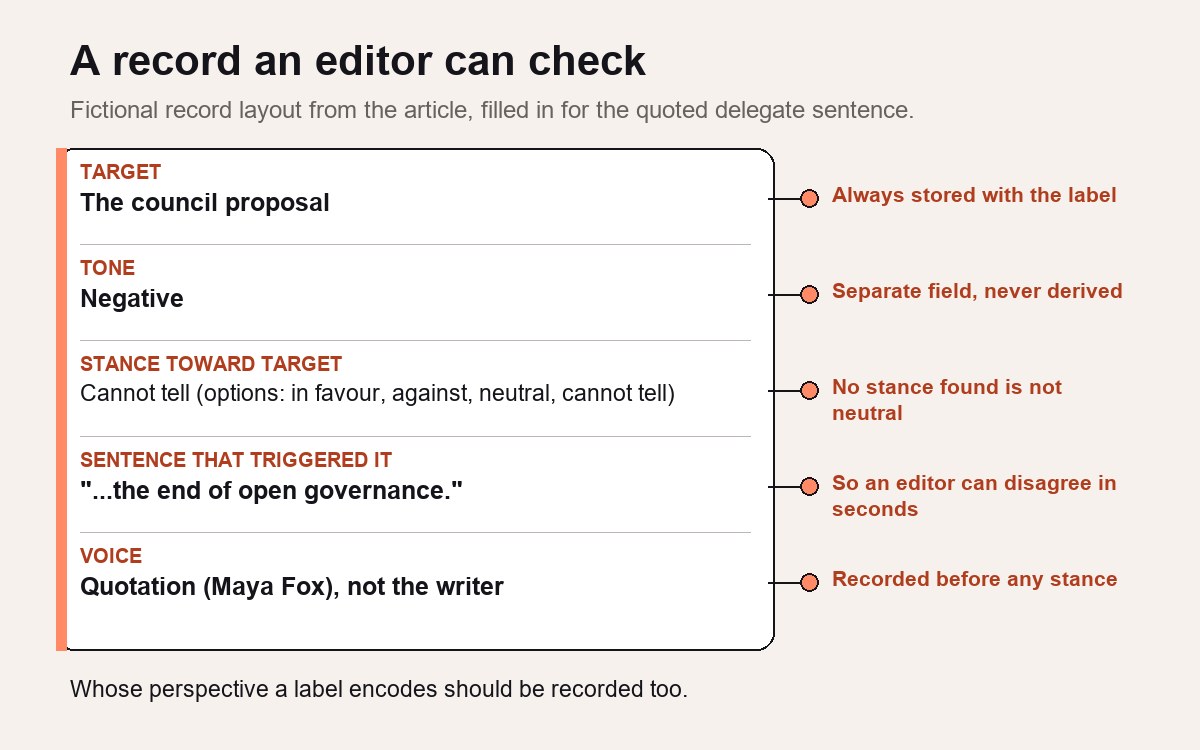
None of the sources prescribes this; it is my proposal, built on what they show. If a tool gives editors tone or stance hints, store and display them like this:
- Name the target. A stance label with no target is meaningless. Store the pre-chosen target next to the label, as the SemEval task does [1].
- Keep tone and stance in separate fields. Never derive one from the other. The oracle results above are the reason [2].
- Allow "cannot tell". The SemEval authors note that failing to find evidence is not neutrality [1]. A forced three-way answer hides that.
- Show the sentence. Attach the exact span the label came from, so an editor can disagree in seconds.
- Mark quotations. Do not attribute a quoted source's position to the writer. Whether a sentence is a quote, a paraphrase or the writer's own voice should be recorded before any stance is.
- Say whose perspective a label encodes. A tone label trained on investor-view annotations [4] answers a different question from a tone label trained on general text.
- Test on your own domain. The numbers in this article come from tweets about US public figures and issues, from annotated financial-news sentences, and from a challenge about headlines and articles [2][3][4]. None of them is crypto, AI or games coverage. Take a few dozen of your own stories, have two editors label tone and stance toward a stated target separately, and see how often they differ from each other before you compare any tool to them.
What this article cannot tell you
It does not test any sentiment or stance tool, and it does not say how accurate any current product is. The benchmark figures come from research datasets built in 2016 and 2017, with their own annotation rules; they are not estimates for modern models or for crypto, AI or games news. The tone-versus-stance table for Northgate is my illustration, not data. It does not cover sarcasm or how to extract the claims a stance attaches to; those are separate problems. The sources describe tasks and benchmark results, not newsroom outcomes: none shows that separating the two fields improves an editor's decisions. The Malo et al. paper was read as an abstract only.
How this article was made
| Task | What the AI did | What a person did | How it was checked |
|---|---|---|---|
| Research | Gathered candidate sources and drafted notes | Chose the question and which papers and pages to rely on | Quotes and numbers checked against the full text of the two stance papers and the Hanselowski paper, and against the web pages for the cards, read on 27 November 2026 |
| Draft | Wrote the first draft from the notes | Edited the text, the fictional example and the proposal | An independent review compares claims with the sources before publication |
| Images | Generated the cover illustration | Chose and checked it | Labelled as AI-generated in the disclosure line and alt text |
| Not done by AI | — | The decision to publish and responsibility for the text | — |
Conflicts of interest: none. The author has no commercial relationship with the organisations or authors named here.
Responsible for this article: Dmitriy Lastovka, author. Corrections: contact form.
Sources
Labels: paper (a peer-reviewed paper or preprint), dataset card and model card (documentation published by the data or model owner). Quotes and figures are as on the pages read on 27 November 2026.
- Mohammad, Kiritchenko, Sobhani, Zhu, Cherry, "SemEval-2016 Task 6: Detecting Stance in Tweets", SemEval-2016, pp. 31-41. https://aclanthology.org/S16-1003/ (full text: https://aclanthology.org/S16-1003.pdf) Paper.
- Mohammad, Sobhani, Kiritchenko, "Stance and Sentiment in Tweets", arXiv:1605.01655, submitted 5 May 2016 (read as the PDF of the arXiv record; Tables II, IV, V and VI). https://arxiv.org/abs/1605.01655 Paper (preprint).
- Hanselowski et al., "A Retrospective Analysis of the Fake News Challenge Stance-Detection Task", COLING 2018, pp. 1859-1874. https://aclanthology.org/C18-1158/ (full text: https://aclanthology.org/C18-1158.pdf) Paper.
- Financial PhraseBank dataset card (takala/financial_phrasebank), Hugging Face. https://huggingface.co/datasets/takala/financial_phrasebank Dataset card.
- ProsusAI/finbert, model card, Hugging Face. https://huggingface.co/ProsusAI/finbert Model card.
- Malo, Sinha, Takala, Korhonen, Wallenius, "Good Debt or Bad Debt: Detecting Semantic Orientations in Economic Texts", arXiv:1307.5336 (abstract page only). https://arxiv.org/abs/1307.5336 Paper (preprint).