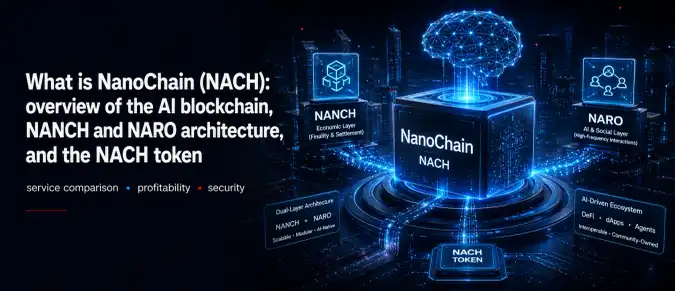

NanoChain (NACH) is an emerging blockchain project that proposes a dual-layer architecture designed to combine EVM-compatible financial operations with AI-oriented applications. The concept is built around two interconnected layers: NANCH is responsible for economic settlement and transaction finality, while NARO focuses on high-frequency social and AI interactions. The native NACH token serves as the economic asset of the ecosystem, and its ERC-20 contract has already been deployed on Ethereum. Since the project is still in its early stages of development, its proposed architecture and future functionality should be distinguished from infrastructure that is already operational.
Contents
- What Is NanoChain and How Does Its Dual-Layer Architecture Work?
- How NANCH, NARO, and NanoChain's AI Infrastructure Work
- NanoChain Compared with Other Layer 1 and AI Blockchains
- The NACH Token, Tokenomics, and Its Role in the Ecosystem
- Risks and Prospects of NanoChain as an AI Blockchain Project

1. What Is NanoChain and How Does Its Dual-Layer Architecture Work?
NanoChain is built around the idea of separating economic settlement from more frequent user or machine interactions across different layers of the system. Instead of processing every operation on a single blockchain, the project introduces two interconnected components—NANCH and NARO—each performing a distinct function within the overall architecture.
NANCH serves as the settlement layer. According to the project's documentation, it is an EVM-compatible network designed to provide transaction finality, data availability, and infrastructure for DeFi-related operations. This compatibility allows developers to leverage Ethereum's smart contract model and potentially simplifies the migration of existing Web3 applications.
NARO, in contrast, is positioned as a browser-based decentralized layer designed for high-frequency social interactions and AI-driven scenarios. The concept assumes that a significant amount of activity can occur closer to user devices, while economically meaningful results are ultimately anchored to the settlement layer.
The project refers to this architecture as a dual-core blockchain. However, it should be viewed as an evolving design: the existence of technical documentation does not necessarily mean that every proposed mechanism is already operating in a production environment with large-scale user activity. When evaluating NanoChain, it is important to distinguish between currently available infrastructure and roadmap features.
2. How NANCH, NARO, and NanoChain's AI Infrastructure Work
At the NANCH layer, the project specifies the use of Clique Proof of Authority. Under this consensus model, blocks are produced by a limited set of authorized validators, unlike open Proof-of-Stake networks where participation depends on staking and protocol rules. Proof of Authority can simplify infrastructure management during the early stages of development, although the degree of decentralization depends on validator composition and governance procedures.
NARO is designed for a different type of workload. The project associates this layer with AI agents, social interactions, and event processing that do not necessarily require immediate execution as economic transactions on the settlement network. The outcomes of these processes are intended to be connected to NANCH through intermediate state verification mechanisms.
Another concept introduced by NanoChain is Collective Memory. AI inferences and decisions generated by autonomous components are intended to create a verifiable log, with corresponding data cryptographically linked to the blockchain state. The goal is to establish an auditable history of AI activities that can be used to verify the origin and integrity of automated decisions.
The project also describes Guardian and Co-pilot as autonomous AI components designed for tasks such as bridge security monitoring and network optimization. The practical value of these AI services will depend on their permissions, verification mechanisms, and the procedures followed when incorrect decisions occur.
3. NanoChain Compared with Other Layer 1 and AI Blockchains
The AI blockchain sector includes several architectural approaches. Some networks provide general-purpose smart contract execution, allowing developers to build AI applications independently. Others focus on decentralized markets for computing resources, AI models, datasets, or machine services. NanoChain attempts to combine a settlement blockchain with a separate layer dedicated to AI and social interactions.
For this reason, comparing NanoChain solely with Ethereum or other general-purpose Layer 1 networks provides only a partial picture. Its architectural concept is based on separating different categories of workload: financial transactions receive their own settlement layer, while high-frequency interactions are handled by another component of the ecosystem.
| Model | Primary Focus | Architecture | Role of AI |
|---|---|---|---|
| NanoChain | AI and Web3 infrastructure | Two interconnected layers: NANCH and NARO | AI agents and verifiable machine processes |
| Ethereum | General-purpose dApps | Layer 1 with a Layer 2 ecosystem | AI is implemented through applications and external services |
| Solana | High-performance applications | Single Layer 1 blockchain | AI applications rely on the shared network infrastructure |
| Bittensor | Decentralized AI | Specialized subnet ecosystem | AI models and services participate directly in the network economy |
| DePIN / Compute | Distributed computing | Markets for physical and computational resources | Infrastructure for AI workloads |
A potential advantage of this specialized architecture is the ability to optimize different layers for different types of workloads. Financial transactions and local AI-agent interactions have different requirements regarding cost, speed, finality, and data storage, making workload separation theoretically beneficial for overall network efficiency.
However, introducing an additional layer also increases architectural complexity. The system must securely synchronize state, define trust boundaries, and maintain reliable communication between layers. As a result, the effectiveness of NanoChain's dual-layer design can only be evaluated after observing a functioning network, stress testing, and real application activity.

4. The NACH Token, Tokenomics, and Its Role in the Ecosystem
NACH is the primary token of the NanoChain ecosystem. Its verified ERC-20 contract is deployed on Ethereum, while Etherscan lists a maximum supply of 20 billion NACH. The contract source code has been published and verified, and the project also references a SolidProof smart contract audit.
According to the project's published token allocation, the largest category is Social Mining & Users, accounting for 40% of the total supply. Another 20% is allocated to validators and sequencers, 15% to ecosystem grants, 10% to liquidity and market making, 10% to the Foundation, and the remaining 5% to a strategic reserve.
- The maximum supply is 20 billion NACH.
- 40% is allocated to Social Mining & Users.
- 20% is reserved for validators and sequencers.
- 15% is allocated to Ecosystem Grants.
- 10% is designated for Liquidity & Market Making.
- 10% is allocated to the Foundation.
- 5% forms the Strategic Reserve.
- NACH is described as both a utility and governance token.
- The ERC-20 NACH contract is deployed and verified on Ethereum.
The ecosystem also introduces nUSD, a separate stable asset described as part of a dual-token economy. Within this model, NACH is intended to serve utility and governance functions, while nUSD is designed to provide a more stable settlement asset. The effectiveness of this structure can only be assessed after its full implementation.
When evaluating NACH, the total token supply is only one consideration. The pace at which tokens enter circulation is equally important. Allocations for users, validators, ecosystem grants, and liquidity can affect market dynamics differently, making distribution schedules, circulating supply, and application-driven demand essential factors alongside the maximum supply.
5. Risks and Prospects of NanoChain as an AI Blockchain Project
The primary technological risk for NanoChain lies in the gap between its proposed architecture and its proven real-world deployment. The dual-core model, Collective Memory, AI agents, bridge infrastructure, and future rollup mechanisms all require validation under real network conditions. Working applications, independent validators, network activity, and measurable technical performance are key indicators of ecosystem maturity.
Another important consideration is the use of Proof of Authority at the settlement layer. While this approach may simplify governance during the early stages of development, the level of decentralization ultimately depends on validator control and the process for modifying the validator set. The published roadmap suggests that the network architecture will continue to evolve over time.
The NACH token should also be evaluated independently from the broader technological concept. A verified ERC-20 contract and a smart contract audit provide confidence in the token contract itself, but they do not guarantee the security of future ecosystem components, including bridges, AI agents, additional tokens, or network protocols. Likewise, contract verification confirms the existence of the token rather than the long-term sustainability of the project.
NanoChain's future development will depend on whether its dual-layer architecture can solve practical problems more effectively than established Layer 1 and Layer 2 ecosystems. Achieving this goal will require building an active developer community, maintaining secure interaction between NANCH and NARO, and demonstrating meaningful use cases for AI agents and Web3 applications.
Overall, NanoChain represents an attempt to separate economic execution from AI-oriented processing within a unified blockchain ecosystem. When assessing the project, the most important factors remain the operational state of the network, validator decentralization, security of cross-layer mechanisms, ecosystem growth, and sustainable demand for NACH rather than the project's architectural vision alone.











